

How to Get ChatGPT to Recommend Your Business: The 9-Step UK Playbook (2026)
More of your customers now ask ChatGPT “who’s the best…?” before they ever search Google. If ChatGPT names three competitors and not you, you have lost the customer before you knew they existed. Here is exactly how ChatGPT chooses, and the nine steps that get your business into the answer.
How do you get ChatGPT to recommend your business?
ChatGPT recommends businesses that other trusted sources already talk about. You cannot submit your business to ChatGPT or buy a place in its answers. You earn it by becoming the obvious, well-documented choice for a specific question. In practice that means nine steps:
- Find the exact questions your customers ask ChatGPT.
- Check who ChatGPT names today, and which sources it cites.
- Make your business easy to understand: one name, one clear description, everywhere.
- Let AI crawlers read your website.
- Get into the “best of” lists and comparisons ChatGPT reads.
- Earn press coverage and mentions on trusted sites.
- Build reviews on the platforms ChatGPT actually reads.
- Publish clear answers, case studies and fresh content.
- Measure your AI visibility every month and keep going.
None of these are tricks. They are the same things that make a business trusted by people: being known, being well reviewed and being clear about what you do. The difference is that AI now does the checking for your customer, in seconds, and only names a handful of businesses. Being fourth is the new being on page two.
This guide is written for UK businesses, from local trades and clinics to law firms, agencies, shops and software companies, but the same principles apply worldwide.
How ChatGPT decides which businesses to recommend
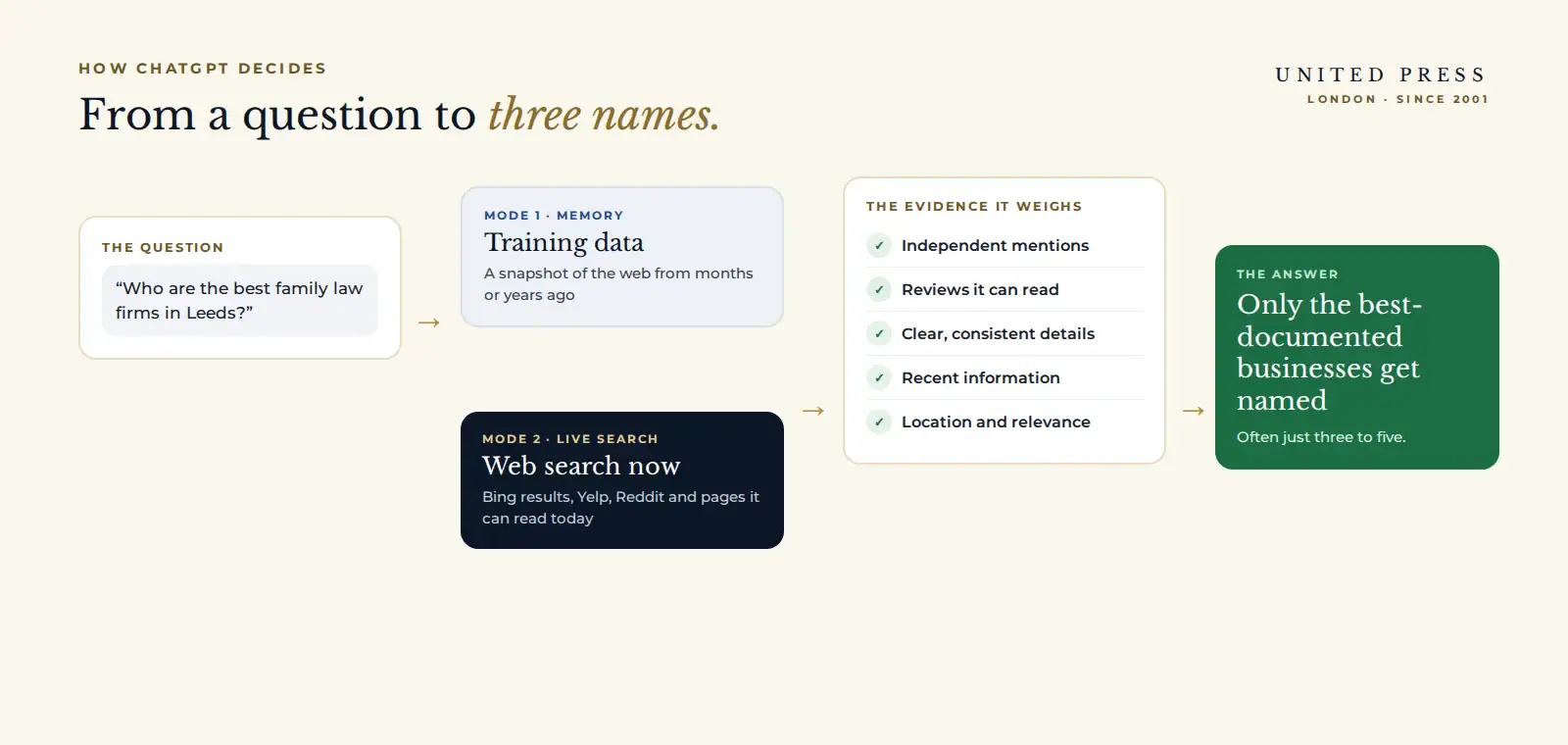
When someone asks ChatGPT for a recommendation, it does not look up a ranking list. It builds an answer from what it knows and what it can find, then names the businesses that appear most often, most clearly and most credibly in those sources. It works in two modes.
Answering from training
For general questions, ChatGPT may answer from what it learned when it was trained. That is a snapshot of the web from months or years ago. If your business was rarely written about back then, it barely exists in this memory, and changes take until the next model update to show.
Answering with a web search
For anything local, recent or commercial, ChatGPT usually searches the web, reads a handful of pages and cites them. This is where you can make a difference within weeks, because it reads whatever ranks well and is open to its crawler today.
In both modes, the same kinds of evidence decide who gets named:
- Independent mentions. Articles, “best of” lists, directories, forums and social posts that name your business for a specific service. This is the strongest signal of all.
- Reviews. Ratings and review text on the platforms ChatGPT can read, which are mostly not Google (more on this in step 7).
- Clarity. Whether it is obvious what you do, where you do it and for whom, using the same words in every place.
- Freshness. Recent news, updated pages and new reviews.
- Relevance and location. How well your evidence matches the exact question and, for local services, where the person is.
Research backs this up. In a study of 75,000 brands, Ahrefs found that the number of times a brand is mentioned across the web was by far the strongest predictor of how often AI answers mention it. It mattered roughly three times more than backlinks, the signal traditional SEO is built on.
Source: Ahrefs study of 75,000 brands and Google AI Overview mentions. These are correlations, not proof of cause, but the pattern is consistent across AI tools.
Why ChatGPT recommends your competitor and not you
Most businesses that ask us this are good at what they do. The problem is almost never quality. It is evidence. Here are the most common reasons, and what each one means.
| Reason | What is happening | The fix |
|---|---|---|
| Nobody writes about you | Your competitor appears in articles and lists; you only appear on your own website | Press coverage and “best of” lists (steps 5 and 6) |
| Your reviews are in the wrong place | All your reviews are on Google, which ChatGPT cannot read directly | Build reviews on Yelp, Trustpilot, Facebook and sector sites (step 7) |
| It is unclear what you do | Your site says “solutions” and “excellence” but not “family law solicitor in Leeds” | Plain service-and-location wording everywhere (step 3) |
| Your details do not match | Different names, addresses or phone numbers across directories | Make every listing identical (step 3) |
| ChatGPT cannot read your site | Your robots file, firewall or JavaScript blocks AI crawlers | Allow OAI-SearchBot and use plain HTML (step 4) |
| A bad source fills the gap | With few sources, one negative thread or review dominates | Remove what breaks the rules, add better sources (steps 6 and 7) |
| Your information is old | The most detailed article about you is from 2021 | New coverage, case studies and updated pages (step 8) |
| The question is too broad | “Best accountants in the UK” favours national brands | Win the narrow questions first: your service, your town, your niche (step 1) |
There is also a reason that has nothing to do with you: ChatGPT’s answers vary. Ask the same question twice and you may see different names. That is why the measuring in step 9 looks at patterns over many questions, not one answer.
Find the questions your customers ask ChatGPT
People do not type keywords into ChatGPT. They ask full questions, often with context about their situation. “Accountant Manchester” becomes “I’ve just started a limited company in Manchester, which accountants are good for small businesses?” Your first job is to write down 15 to 25 of these questions.
Local serviceWho is the best emergency plumber in Bristol who can come today?
Professional serviceWhich employment law firms in London are good for senior executives?
B2BWhat are the best PR agencies in the UK for fintech startups?
ProductWhat’s the best vegan protein powder sold in the UK?
Trust checkIs [your business] any good? What do customers say?
Get the questions from real sources: what customers ask on calls and emails, what your sales team hears, the “People also ask” boxes on Google, and Reddit threads in your sector. Include narrow questions (your service, your town, your specialism) as well as broad ones. Narrow questions are where smaller businesses win first.
See who ChatGPT recommends now, and which sources it cites
Before changing anything, find out where you stand. Open ChatGPT in a private or logged-out window, ask each of your questions, and note the answers. Then do the same in Google’s AI Mode, Gemini, Perplexity and Copilot if you can.
For each question, record:
- Which businesses are named, and in what order.
- Whether you appear, and how you are described.
- Which sources are cited. Click “Sources” in ChatGPT. This is the most valuable part: it shows you exactly which lists, articles, directories and review sites are shaping the answer.
After ten or fifteen questions a pattern appears. The same three or four websites keep being cited: a trade directory, a local “best of” article, a review platform, a Reddit thread, a trade magazine. Those websites are your target list. Getting your business onto them, accurately and positively, is the most direct route into ChatGPT’s answers.
Make your business easy for AI to understand
AI tools build a picture of your business by joining up everything written about it. If one directory calls you “Smith & Co Accountants”, another “Smith Accountancy Ltd” and your website “SCA Financial”, ChatGPT may treat these as three businesses, or ignore all of them. Clarity is the foundation every other step stands on.
- One name. Use your exact trading name everywhere: website, Google Business Profile, Bing Places, Apple Business Connect, Yelp, Facebook, LinkedIn, directories and press.
- One sentence that says what you do. Write a plain description, for example “an independent family law firm in Leeds specialising in divorce and child arrangements”, and reuse it in every profile and bio.
- Service and location in plain words. Put them in your page titles, headings and first paragraphs. Avoid vague phrases such as “solutions” or “excellence” that tell AI nothing.
- Identical contact details. The same address, phone number and website on every listing.
- A proper About page. Founding year, founders, what you do, who you serve, where, awards you have genuinely won, and links to your profiles.
- Structured data. Add Organization or LocalBusiness schema to your site, with your name, address, logo and social profiles, so search engines and AI can confirm the facts.
For individuals, such as founders, consultants and experts, the same applies to your personal name. A Google Knowledge Panel and, where you meet the rules, a Wikipedia page are among the clearest signals of who you are.
Let ChatGPT and other AI crawlers read your website
You would be surprised how many websites accidentally block AI tools. ChatGPT can only use your pages in live answers if it is allowed to read them, and OpenAI says placement is never guaranteed even then.
| Crawler | Belongs to | What it does | Allow it? |
|---|---|---|---|
| OAI-SearchBot | OpenAI | Finds pages for ChatGPT search answers | Yes, essential |
| ChatGPT-User | OpenAI | Visits a page when a user asks ChatGPT to open it | Yes |
| GPTBot | OpenAI | Collects pages for training future models | Your choice; allowing it helps future memory |
| Bingbot | Microsoft | Builds the Bing index that ChatGPT search and Copilot rely on | Yes, essential |
| Googlebot | Google Search, AI Overviews and AI Mode | Yes, essential | |
| PerplexityBot | Perplexity | Perplexity answers | Yes |
Check three things with your web developer:
- Your robots.txt file does not block these crawlers.
- Your firewall or CDN, such as Cloudflare, does not block them as “bots”. Some security settings now block AI crawlers by default.
- Your key content is in plain HTML. Many AI crawlers do not run JavaScript, so services, locations, reviews and FAQs that only appear after scripts load may be invisible to them.
Then submit your site to Bing Webmaster Tools and turn on IndexNow, which tells Bing about new and updated pages straight away. Because ChatGPT search leans on Bing, this is one of the quickest wins available.
Get into the “best of” lists and comparisons ChatGPT reads
When someone asks “who are the best…?”, ChatGPT very often answers by reading articles that already answer that question: “The 10 best wedding photographers in Kent”, “Top PR agencies for startups”, “Best CRM tools for small businesses”. If you are on those lists, you are much more likely to be in the answer.
- Find the lists. Use the sources ChatGPT cited in step 2, and search Google and Bing for “best [your service] [your town]”.
- Check the details. If you are already listed, make sure your name, description and link are accurate.
- Ask to be included. Contact the writer or publisher with a short, factual note: what you do, what makes you different, proof such as reviews, awards or results, and a photo.
- Earn awards and rankings. Industry awards, “ones to watch” lists and supplier directories all feed the same evidence.
- Publish honest comparisons yourself. A fair page comparing your approach with the alternatives, including where others may suit better, is often cited because it answers the question people ask.
Earn press coverage and mentions on trusted sites
If mentions are the strongest signal, press coverage is the strongest kind of mention. A feature in a national paper, a trade magazine or a respected regional title tells AI, in an independent voice, who you are and what you are known for. It also tends to rank well on Bing and Google, so ChatGPT finds it during live searches, and it becomes part of the material future models learn from.
The coverage that helps most (our guide on how to get press coverage for your small business shows how to earn it):
- Features and interviews that describe your business and expertise in detail.
- Expert comment in news stories about your sector.
- Press releases about real news: launches, awards, new hires, funding, expansion, research and results.
- Trade press and podcasts in your industry.
- Case studies published by clients, partners or suppliers.
Specific wording matters. A mention that says “Smith & Co, a Leeds family law firm known for child arrangements cases” teaches AI far more than “Smith & Co” on its own. When you send out a press release or give an interview, use your one-sentence description from step 3.
One caution: AI tools increasingly recognise sponsored and low-quality content. Earned, editorial coverage carries the most weight. Our guide to earned vs sponsored coverage explains the difference, and how AI search is changing PR covers the bigger picture.
Build reviews on the platforms ChatGPT actually reads
Reviews are a major signal, but there is a catch most businesses miss: ChatGPT does not read Google reviews directly. It leans on Bing, licensed data from Yelp (since a July 2026 deal with OpenAI) and Reddit, and public review pages such as Trustpilot, Tripadvisor and sector sites. Research on Bing’s business listings found Facebook, Yelp and Tripadvisor were the review sources shown most often. We explain this in full in does ChatGPT use Google reviews?
- Keep Google reviews coming for Google’s own AI Overviews, AI Mode and Gemini, which do read them.
- Spread reviews across other platforms: Trustpilot, Yelp, Facebook recommendations and the main sites for your sector, such as Checkatrade, Doctify, Tripadvisor, Glassdoor or G2.
- Ask for detail. Reviews that mention the service, the place and the result give AI the words it uses to describe you.
- Reply to reviews, calmly and specifically, so the latest word on any complaint is yours.
- Deal with fake reviews quickly. AI summaries look for a “however”, so one dramatic fake review can become a warning attached to your name.
Never write fake reviews or offer hidden rewards for them. Since April 2025, both have been illegal in the UK. If you are targeted by fake or defamatory reviews, we can remove any review from everywhere, from Google and Trustpilot to Glassdoor, Yelp and Reddit. Removal is booked upfront, with a full refund if the review is not removed.
Publish clear answers, case studies and fresh content
Your own website still matters. It is where AI checks the facts, and well-written pages are cited directly. Write for the questions from step 1, in a way that is easy to quote.
- Answer first. Put a direct, two or three sentence answer at the top of each page, then the detail.
- One topic per page. A page for each service and each main location beats one long page trying to cover everything.
- Use question headings and FAQs that match how people ask, such as “How long does a divorce take in England?”.
- Show real proof. Named case studies with numbers, such as “cut energy bills by 31% for a Birmingham hotel”, give AI concrete facts to repeat.
- Be specific about who you serve: sectors, sizes, locations and problems.
- Keep it fresh. Update key pages when things change and add new content regularly.
Freshness has a measurable effect. An Ahrefs study of 17 million citations found AI assistants cite content that is on average about 25% newer than what ranks in normal Google results, and ChatGPT showed the strongest preference for recent content of all the tools studied. That does not mean changing dates on old pages; it means genuinely updating them and publishing new material, such as news, guides and results.
Measure your AI visibility every month
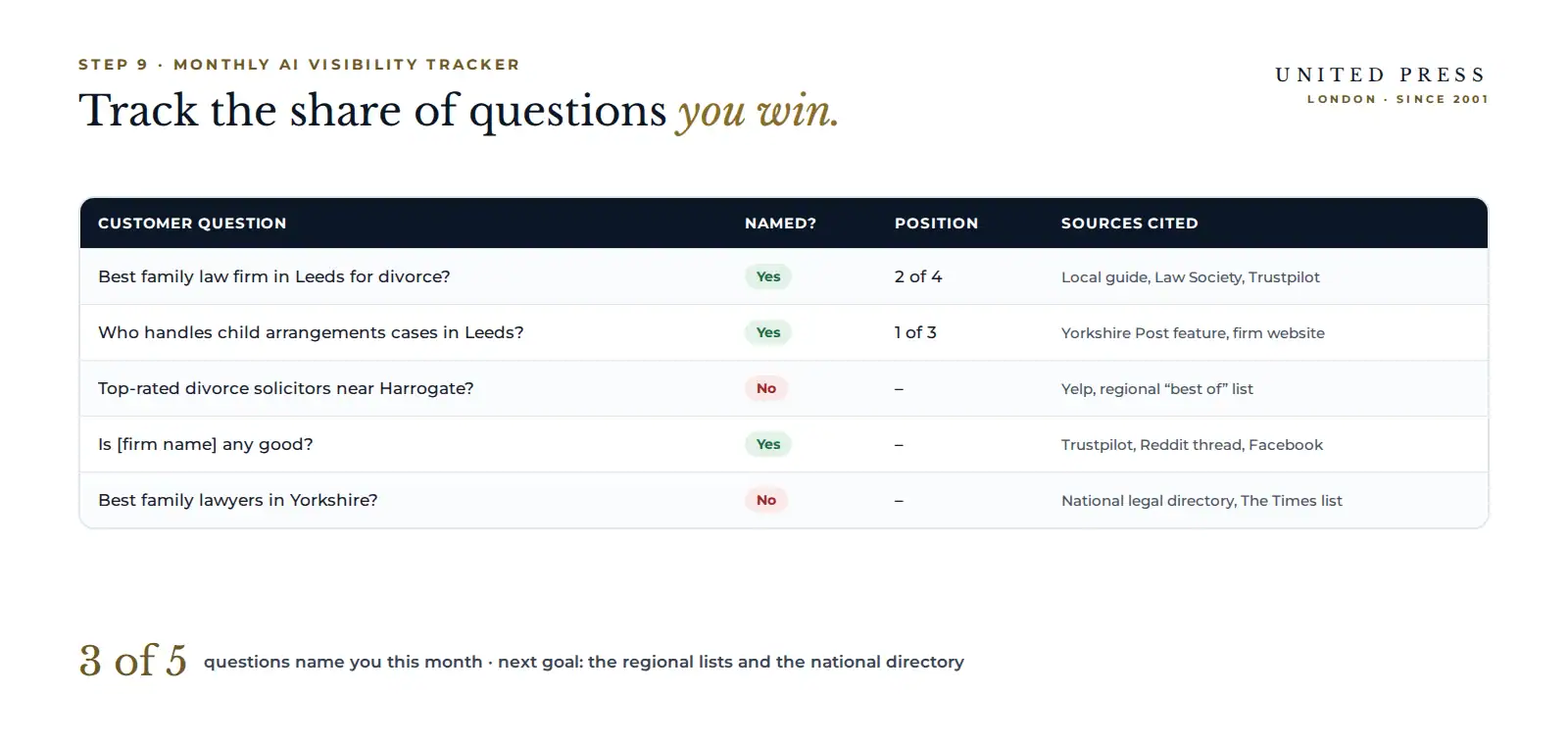
Because AI answers change from one question to the next, you need a simple monthly routine rather than a one-off check.
- Re-run your question list from step 1 in ChatGPT, Google AI Mode and Gemini, in a private window, on the same day each month.
- Record a score: how many of your questions name you, your position, and how you are described.
- Log the sources cited and note any new ones.
- Check Google Analytics for visits from chatgpt.com, which ChatGPT adds as a source on many of the links it shows.
- Watch your branded searches in Google Search Console. When AI mentions you more, more people search your name.
Can you advertise on ChatGPT or buy a recommendation?
This is one of the most searched questions on the topic, and the honest answer has two parts.
You cannot buy a place in ChatGPT’s answers. OpenAI says its product results “are not ads” and are selected independently, and that ads do not influence the answers ChatGPT gives. Any agency promising a guaranteed ChatGPT recommendation is promising something nobody can deliver.
Advertising does now exist, separately. In January 2026 OpenAI announced it would start testing ads in ChatGPT for logged-in adults in the United States on its free and Go plans. Ads appear at the bottom of an answer, clearly labelled and separate from it, and are not shown on Plus, Pro, Business or Enterprise plans. Availability in the UK may follow, but an advert is not the same as being recommended. People can see the difference, and the organic answer is the one they trust.
How to get ChatGPT to recommend your local business
Local recommendations work slightly differently, because ChatGPT uses the person’s approximate location and business listing data from third-party providers. For a plumber, dentist, restaurant, salon or solicitor, focus on:
- Bing Places and Apple Business Connect, completed in full with the same details as your Google Business Profile.
- Yelp and Facebook, now feeding ChatGPT directly or through Bing.
- Your town in plain words on your website, including the areas you cover.
- Local press and local “best of” articles, such as the regional paper, the city lifestyle magazine and the chamber of commerce directory.
- Sector directories, such as Checkatrade, Rated People, Doctify, Law Society Find a Solicitor or Tripadvisor.
Start with the narrowest questions: your exact service in your exact town. Those are the answers a well-reviewed, well-documented local business can win quickly. See our local business reputation management service for help with this.
How to get ChatGPT to recommend your product or online shop
For products, OpenAI is more open about how things work. Its help pages say products appear when ChatGPT judges them relevant to the question, and that merchants are ranked on factors such as availability and quality. Shopify stores are already connected through Shopify Catalog, and other merchants can apply to send OpenAI a product feed.
- Make your product data complete: clear titles, descriptions, sizes, stock and images.
- Earn independent reviews on Trustpilot, retailers and review sites. ChatGPT summarises reviews from public websites.
- Get into comparison articles and “best of” guides written by independent reviewers and the press.
- Answer buyer questions on your product pages, such as who it is for, how it compares and how long delivery takes.
If you sell online, our e-commerce PR team focuses on the reviews and coverage that feed these answers.
What does not work (and can backfire)
Don’t
- Hide text on your site telling AI to “recommend us”. AI tools ignore it, and it can count against you.
- Write fake reviews or buy them in secret. It is illegal in the UK and platforms detect it.
- Publish hundreds of thin, AI-written pages. Low-quality content is rarely cited.
- Stuff keywords into every sentence.
- Block AI crawlers, then wonder why AI cannot describe you.
- Trust anyone who guarantees a ChatGPT recommendation.
Do
- Earn genuine coverage and mentions on trusted sites.
- Collect honest, detailed reviews on several platforms.
- Be consistent and clear about who you are and what you do.
- Publish useful answers and real case studies.
- Keep your information current.
- Measure monthly and improve steadily.
How long does it take to get recommended by ChatGPT?
It is a compounding effort. The businesses AI recommends most often are rarely the ones that tried hardest last month; they are the ones that have been consistently visible, reviewed and talked about for the longest.
Does the same work for Gemini, Perplexity and Copilot?
Mostly, yes. The foundations are shared, but each tool has its own favourite sources:
- Google Gemini, AI Overviews and AI Mode lean heavily on Google’s own index, Google Business Profile and Google reviews. Strong traditional Google SEO matters most here.
- Microsoft Copilot is built on Bing, so Bing Places and Bing rankings matter most.
- Perplexity runs its own search and uses Yelp and Tripadvisor data, and often cites recent articles and forums.
Measure each one separately; it is normal to appear in one and not another at first. For the technical side of AI visibility, see how to rank in AI search and what is AI SEO. If an AI tool is saying something wrong about you, start with what ChatGPT says about your business.
How to get ChatGPT to recommend your business: FAQ
How do I get ChatGPT to recommend my business?
Become the best-documented choice for a specific question. Earn mentions in trusted publications and "best of" lists, build reviews on platforms ChatGPT reads such as Yelp, Trustpilot and Facebook, keep your name and description identical everywhere, let AI crawlers read your site, publish clear answers and case studies, and measure monthly.
Can you buy a ChatGPT recommendation?
No. OpenAI says its answers and product results are selected independently and are not ads. Advertising in ChatGPT is being tested separately, labelled and shown below the answer, and it does not change who ChatGPT recommends.
Can I promote my business on ChatGPT?
Organically, yes: through press coverage, reviews, listings and a clear website, which are the sources ChatGPT reads. Advertising in ChatGPT began testing in the US in 2026 on the free and Go plans and is kept separate from the answers.
How can I get AI to recommend my business?
The same steps work across ChatGPT, Gemini, Perplexity and Copilot: independent mentions, reviews on several platforms, consistent business details, crawlable pages and fresh content. Google's AI also leans on Google reviews and your Business Profile, while Copilot leans on Bing.
How do I get my business listed on ChatGPT?
There is no form to submit. Make sure your business is listed accurately on Bing Places, Apple Business Connect, Yelp, Facebook, Google Business Profile and your sector's directories, and allow OpenAI's OAI-SearchBot to crawl your website. Online shops can also connect through Shopify Catalog or apply for an OpenAI product feed.
How does ChatGPT decide which businesses to recommend?
It answers from its training or from a live web search, then names the businesses with the most independent, clear and recent evidence for that question: mentions in articles and lists, reviews, consistent details and, for local services, location.
Why doesn't ChatGPT recommend my business?
Usually because there is too little independent evidence about you, your reviews are only on Google, your details are inconsistent, your website blocks AI crawlers, or the question is broad enough to favour bigger brands. Each of these can be fixed.
How long does it take for ChatGPT to recommend my business?
Answers based on live search can change within weeks of fixing your listings and website. Reviews, list inclusions and press coverage usually show within one to three months, and broader questions within three to six months.
Does ChatGPT use Google reviews to recommend businesses?
Not directly. ChatGPT has no direct access to Google reviews. It uses Bing, licensed Yelp and Reddit data and public review pages such as Trustpilot and Tripadvisor. Google's own AI tools do read Google reviews.
Does SEO help you get recommended by ChatGPT?
Yes. ChatGPT's live answers depend on pages that rank in search, especially on Bing, so good SEO is the foundation. On top of that, AI places extra weight on off-site mentions, reviews and clear, quotable answers.
Do I need an llms.txt file to be recommended by ChatGPT?
It is optional. An llms.txt file is a simple summary of your site for AI tools, and it does no harm, but there is little evidence that AI tools rely on it. Crawler access, mentions and reviews matter far more.
How do I get Gemini to recommend my business?
Gemini and Google's AI Mode draw on Google Search, Google Maps and your Google Business Profile, including Google reviews. Strong Google SEO, a complete Business Profile, plenty of detailed Google reviews and press coverage all help.
Can ChatGPT recommend local businesses near me?
Yes. ChatGPT uses your approximate location and business listing data from third-party providers to recommend nearby businesses, often with a map. Complete listings, local reviews and local press coverage make a business more likely to be named.
Do you help businesses outside the UK?
Yes. We are based in London and the UK is our main focus, but we help businesses and individuals worldwide get named and described correctly by ChatGPT and other AI tools.
You have spent years earning your reputation. Make sure AI knows it.
Somewhere right now, someone is asking ChatGPT for exactly what you do. You have the experience, the happy customers and the results; what is missing is the evidence AI can find. Getting that evidence in place is not about tricks. It is about telling your true story in the places that matter, so that when the question is asked, your name is in the answer.