
What Does ChatGPT Say About Your Business? How to Check, Fix and Improve Your AI Reputation (UK 2026)
Customers now ask ChatGPT, Gemini and Google’s AI before they ever visit your website. Here is how to find out what those answers say about you, why they are sometimes wrong, and how to get AI to describe — and recommend — your business accurately.
Illustrative example only. Not a real AI answer about a real business.
Somewhere right now, a potential customer is typing a question about you into ChatGPT. Not into Google — into a chat box. “Is this company any good?” “Who is the best in London for this?” “Are there any problems with them?” They get one confident answer, read it in ten seconds, and make up their mind. You never see the question. You never get to reply.
For many business owners, the first time they check what ChatGPT says about their business is a shock. Sometimes it is out of date. Sometimes it confuses them with another company. Sometimes it quotes an angry forum post from years ago as if it were the whole story. And sometimes, worst of all, it simply does not mention them at all, and recommends a competitor instead.
This guide shows you how to check what ChatGPT, Gemini, Perplexity, Copilot and Google’s AI Overviews say about your business, where those answers come from, how to fix what is wrong, and how to earn the kind of reputation that makes AI assistants recommend you.
What does ChatGPT say about your business?
ChatGPT describes your business using what it learned in training and, increasingly, what it finds on the live web — your website, reviews, news coverage, Wikipedia, directories and forums such as Reddit. To see what it says, ask it directly in a fresh chat (for example “What do you know about [business name]?” and “Is [business name] trustworthy?”). If the answer is wrong or negative, you cannot edit ChatGPT itself; you fix it by correcting or removing the sources it relies on and by earning accurate, authoritative coverage that gives it a better story to tell.
- AI assistants answer questions about your business every day, whether or not you have ever checked what they say.
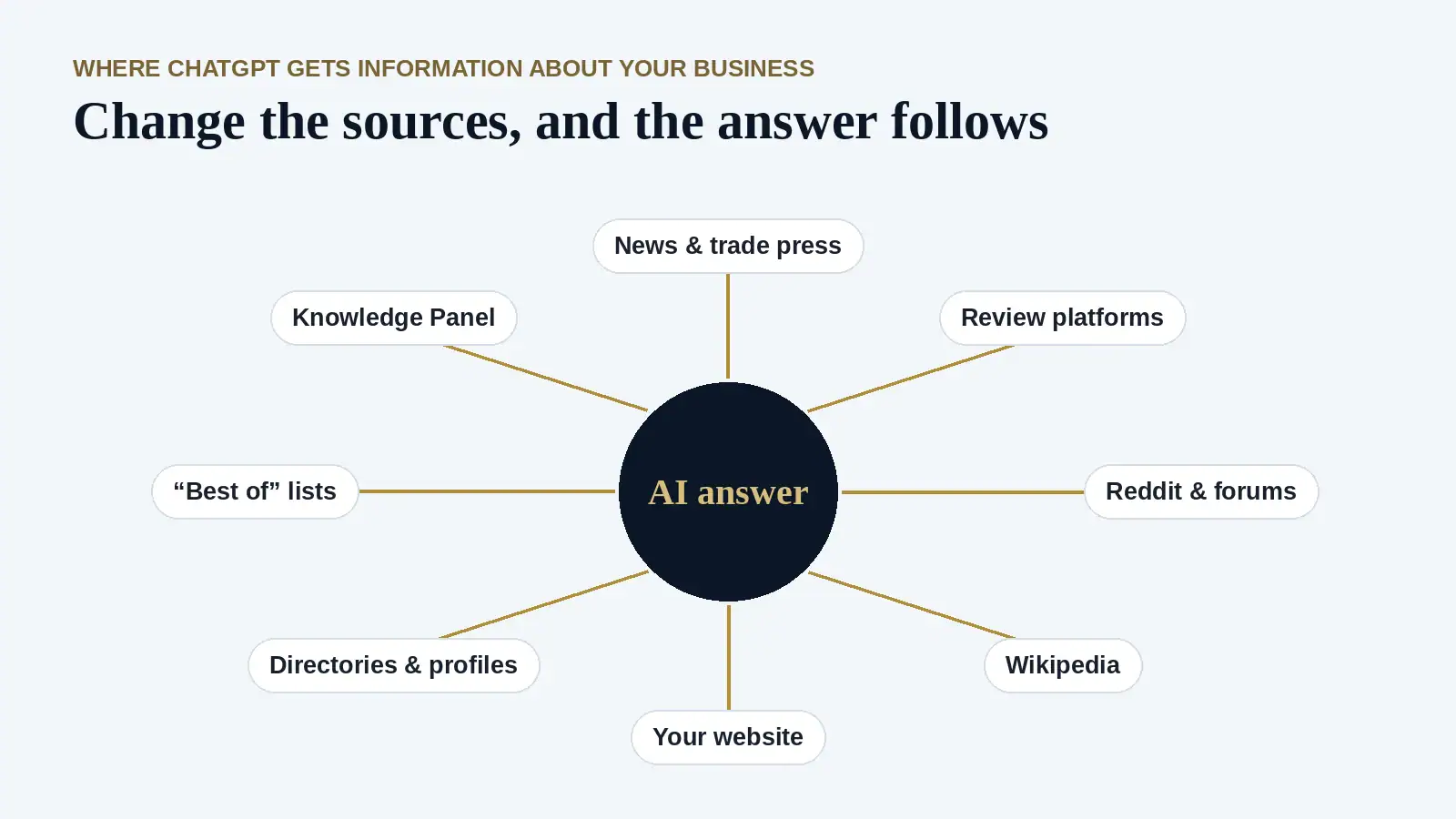
- Answers are built from sources: reviews, news, Reddit, Wikipedia, directories and your own website. Change the sources and the answers follow.
- Wrong details usually come from outdated or inconsistent information online; negative answers usually trace back to a handful of specific pages.
- Getting recommended depends on being mentioned by trusted, independent sources — especially respected publications and genuine reviews.
- You cannot buy a better organic answer from OpenAI or Google. The reliable route is earned reputation.
- Check monthly. Answers change as models update and the web changes.
Why what AI says about your business matters in 2026
A few years ago, “online reputation” meant the first page of Google and your star rating. Those still matter. But a growing share of people now skip the list of links entirely and ask an AI to summarise it for them.
In the UK, Google’s AI Mode and AI Overviews now sit at the top of many searches, and assistants such as ChatGPT, Gemini, Copilot and Perplexity are built into phones, browsers and workplace tools. That changes three things for every business:
- The summary is the first impression. People read the AI’s paragraph about you before — and often instead of — your website or reviews.
- One answer, not ten options. When someone asks “Who is the best accountant in Leeds?”, the AI names a few firms. If you are not one of them, you are invisible for that question.
- Old problems get new life. An AI can repeat a story from years ago as though it happened last week, because it is still on the web and nothing newer outweighs it.
That is why AI visibility is now part of reputation management, not a separate marketing project. Our guide to what online reputation management is explains how it all fits together.
How to check what ChatGPT says about your business: a 15-minute audit
You do not need special software to start. Open a fresh chat (or a private window, logged out where possible, so your own history does not shape the answer) and ask the questions your customers ask. Save every answer with the date.
| What you are testing | Prompt to try | What to look for |
|---|---|---|
| Basic facts | What do you know about [business name] in [town]? | Correct services, location, founding date, owner, contact details |
| Trust | Is [business name] trustworthy? Any complaints? | Which complaints it mentions, and which sources it cites |
| Reviews | What do customers say about [business name]? | Whether it reflects your recent rating or old reviews |
| Recommendations | Who are the best [service] providers in [city]? | Whether you are named at all, and who is named instead |
| Comparisons | [Your business] vs [competitor] — which is better? | How it positions you and why |
| People | Who is [founder or director name]? | Accuracy, old roles, confusion with someone else of the same name |
| Problems | What problems have people had with [business name]? | Specific negative stories and where they come from |
Then repeat the same questions in Gemini, Microsoft Copilot, Perplexity and Google (look for the AI Overview or AI Mode answer). The tools draw on different sources, so they often disagree. When an assistant shows its sources, click every one — that is your fix list.
Where does ChatGPT get its information about your business?
AI assistants do not have a private file on your company. They build answers from what is publicly available, in two main ways:
- Training data — a huge snapshot of the public web, books and other text, captured up to a cut-off date. This is why answers can be out of date.
- Live web search — ChatGPT, Gemini, Copilot, Perplexity and Google’s AI features can search the web in real time and summarise what they find, often with links. This is where today’s reviews, articles and posts come in.
Across both, the same types of source come up again and again:
| Source | Why AI trusts it | What you can do |
|---|---|---|
| News and trade publications | Independent, edited and widely cited | Earn accurate coverage; correct errors in old articles |
| Review platforms | Large volumes of first-hand experiences | Invite genuine reviews; challenge fake ones; reply well |
| Reddit, Quora and forums | Seen as candid, real-world opinion | Address genuine issues; report rule-breaking threads |
| Wikipedia and Wikidata | Structured, referenced summaries | Correct errors through proper channels; build a notable, cited presence |
| Your own website | The primary source for facts about you | Clear About page, services, locations, people and schema markup |
| Business directories and profiles | Confirm names, addresses and categories | Keep Google Business Profile, Bing Places, LinkedIn and Companies House details consistent |
| “Best of” lists and comparisons | Directly answer “who is the best…?” | Earn a place on credible, independent lists in your sector |
The pattern is simple: AI repeats what trusted, independent sources say about you. That is why press coverage matters so much — our analysis of how AI assistants decide which brands to mention goes deeper, and our list of the best publications for AI visibility shows where coverage counts most.
Why ChatGPT gets your business wrong: 7 common reasons
Your details are inconsistent
Different addresses, old phone numbers, or a past trading name across directories confuse the AI about which facts are current.
Old content outranks new
A detailed article from years ago carries more weight than nothing at all. If there is little recent coverage, the old story wins.
A forum thread is filling the gap
Where there are few independent sources, one Reddit or Quora thread can shape the whole answer.
Name confusion
Another business or person with a similar name gets blended into your answer — common for founders and family firms.
Training cut-offs
Without a live search, the model only knows what it learned up to a certain date, so recent changes are missing.
Your website is unclear
If your site does not say plainly what you do, where and for whom, the AI fills the gaps from elsewhere.
Plain mistakes
AI tools can still produce confident errors, known as hallucinations. These are less common with live search, but they happen — usually where good sources are thin.
The common thread
Almost every wrong answer traces back to weak, missing or outdated sources. That is good news: sources can be fixed.
How to fix wrong information about your business in ChatGPT
There is no form that lets you rewrite an AI answer. But there is a clear process that works, because it changes what the AI reads. Follow these steps in order.
Make your website the clearest source of truth
Update your About page with your full business name, what you do, where you operate, when you were founded and who runs the business. Add Organization and LocalBusiness schema markup, a consistent contact block and up-to-date service pages. Make sure AI crawlers are not blocked in your robots.txt if you want to be described accurately.
Fix your listings everywhere
Correct your name, address, phone, website and category on Google Business Profile, Bing Places, Apple Business Connect, LinkedIn, Companies House and major directories. Consistency is how AI works out which version of you is current. Bing matters more than many people realise, because several assistants draw on Bing’s index; Bing Webmaster Tools lets you check how it sees your site.
Correct the sources the AI cites
Ask publishers to correct factual errors or add outcomes to old stories. Update or remove outdated profiles you control. Where a Wikipedia article about you is wrong, raise it on the article’s talk page with reliable sources rather than editing it yourself.
Deal with harmful content at the source
Fake reviews, defamatory posts and threads that break platform rules can often be removed. Once the source disappears, AI answers stop repeating it after the next refresh. See our Reddit post removal, Google review removal and Trustpilot review removal services.
Report the answer inside the AI tool
Use the thumbs-down or report option on the inaccurate answer and explain what is wrong. On Google, use the menu on the AI Overview to report an issue. This does not guarantee a change, but it flags the problem.
Use your data rights for personal information
If an assistant shares inaccurate or private information about you as an individual, UK GDPR gives you rights to rectification and erasure. OpenAI offers a privacy request route for personal data in ChatGPT outputs, and the ICO explains your right to erasure.
Publish newer, better, independent information
This is the step that makes the fix last. Earn coverage in respected publications, collect fresh genuine reviews and publish useful expert content, so the AI has a recent, authoritative story to tell instead of an old one.
Re-check monthly
Run the same audit prompts every month and note what has changed. Live-search answers can update within days of a source changing; answers based on training data take longer.
How to remove negative information from AI answers
When ChatGPT or Google’s AI repeats something negative about your business, the question to ask is: where is it getting that from? Click the sources, or ask the assistant directly, “What sources is that based on?” Then deal with each source on its merits:
| The AI is repeating… | Best route | Related service |
|---|---|---|
| Fake or rule-breaking reviews | Report to the platform with evidence; fake reviews are banned under UK law since April 2025 | Google review removal |
| An old or inaccurate news story | Publisher correction or update; de-listing for outdated personal data | News article reputation management |
| A Reddit or Quora thread | Report rule breaches; respond to genuine issues; build stronger sources | Reddit reputation management · Quora reputation management |
| Outdated personal information | UK GDPR erasure requests to Google and the site; privacy request to the AI provider | Right to be forgotten UK |
| A genuine past problem | Show what has changed: new coverage, recent reviews, a clear public explanation | Online reputation management UK |
Our step-by-step guide on how to remove a negative article from Google is a useful companion, because AI answers and Google results usually share the same problem sources.
How to fix a wrong Google AI Overview about your business
Google’s AI Overviews and AI Mode work slightly differently from ChatGPT. They lean heavily on pages that already rank in Google, and on your Google Business Profile. So when an AI Overview gets your business wrong, the fix usually lives in Google itself:
- Check which pages it links to. AI Overviews show their sources. Those pages are almost always the cause.
- Update your Google Business Profile. Opening hours, services, categories, photos and your business description all feed Google’s understanding of you.
- Strengthen the pages that should be cited. A clear, up-to-date page on your own site that answers the exact question — “Is [business] open on Sundays?”, “Does [business] cover Kent?” — gives Google a better source.
- Report the AI Overview. Use the menu on the AI Overview to report an inaccurate answer, describing what is wrong.
- Tackle the negative pages behind it. If the AI Overview summarises a negative article or review thread, our Google reputation management team works on the pages themselves.
How to get ChatGPT to recommend your business
This is the question most business owners really want answered: how do I get ChatGPT to suggest my business when someone asks for the best in my field? There is no shortcut, but there is a clear pattern among businesses that AI recommends.
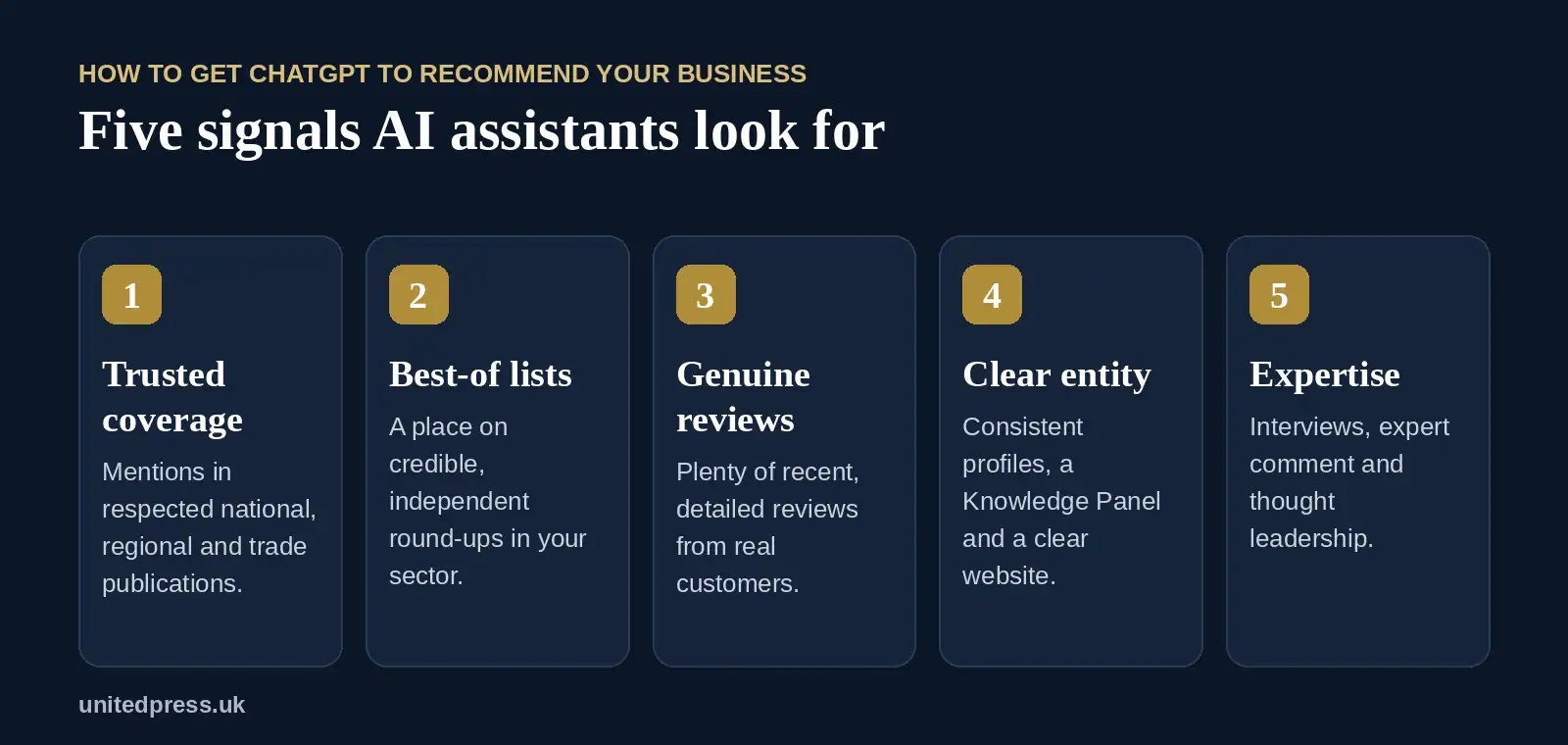
- Be mentioned by trusted, independent sources. Coverage in national, regional and trade publications is one of the strongest signals. Our PR for media coverage and guaranteed press release publication services are built for this — placements go live within 14 days of your approval, or you receive a 100% refund.
- Appear on credible “best of” lists. When someone asks “Who is the best…?”, AI often draws on independent round-ups and comparisons.
- Have plenty of recent, genuine reviews. Volume, freshness and detail all help, across Google and the review sites your customers use.
- Be clear about what you do and where. Specific service pages and location information help AI match you to specific questions.
- Be a recognised entity. A Google Knowledge Panel, consistent profiles and, where you genuinely qualify, a Wikipedia article help AI understand exactly who you are. See our Knowledge Panel service and Wikipedia page creation.
- Show expertise. Interviews, expert comment and thought leadership give AI reasons to describe you as a leader, not just a provider.
- Take part in real conversations. Helpful, honest participation in relevant communities (never fake accounts) builds the kind of discussion AI notices.
For a full playbook, read our guides on getting mentioned by ChatGPT and how to rank in AI search, or see what AI SEO involves. If you want it done for you, our AI PR agency UK team specialises in exactly this.
Can you promote your business on ChatGPT?
People often ask whether they can simply buy a better answer. The short answer: you cannot buy your way into ChatGPT’s or Google’s organic recommendations. Where AI platforms offer advertising, it is shown and labelled separately from the answer itself. The organic answer — the one people trust — comes from the sources the AI considers reliable.
That is good news for honest businesses. It means the same things that build a strong reputation with people — trusted coverage, happy customers, clear information — are exactly what build a strong reputation with AI. Our article on earned vs sponsored coverage explains why earned media carries more weight.
What does ChatGPT say about you personally?
Founders, directors, doctors, solicitors, consultants and creators are increasingly searched by name in AI tools — by investors, journalists, employers, clients and dates. The questions are personal: “Who is she?”, “Is he legit?”, “What happened with…?”
Personal AI answers go wrong in particular ways: blending you with someone of the same name, repeating an old role, or surfacing a single negative story without context. The fixes are similar to those for a business, with two additions:
- Your data rights are stronger. As a private individual, UK GDPR gives you rights over personal data, including inaccurate information. That applies to search engines and, increasingly, to AI providers. Our right to be forgotten UK service handles requests to Google and other platforms.
- A clear personal profile helps AI tell you apart. An up-to-date LinkedIn profile, a professional bio on your company site, interviews and, for leaders, a Knowledge Panel all help assistants identify the right person.
See our personal reputation management UK and executive PR services for confidential support.
AI search and reputation: 6 myths to ignore
Your monthly AI reputation checklist
- Run your audit prompts in ChatGPT, Gemini, Copilot, Perplexity and Google, and save the answers with the date.
- Click every source the assistants cite and note anything new, wrong or negative.
- Check your Google Business Profile, Bing Places and key directories are still accurate.
- Reply to new reviews, and report any that break platform rules.
- Search Reddit and relevant forums for your business name.
- Add at least one new piece of genuine, independent coverage or expert comment each quarter.
- Update your website’s About and service pages whenever something changes.
- Note whether you appear for “best [service] in [place]” prompts, and who appears instead.
How United Press improves what AI says about you
Since 2001, United Press has helped individuals and businesses shape what people find about them. Today that includes what AI assistants say. From our office on Brook’s Mews, off Bond Street in London, we work with clients across the UK and worldwide.
- AI reputation audit across ChatGPT, Gemini, Copilot, Perplexity and Google, with every source mapped.
- Removal of harmful sources that break platform rules or UK law — booked upfront, with a full refund for any item in your plan that is not removed.
- Coverage in trusted publications that AI tools cite, with placements live within 14 days of your approval or a 100% refund.
- Entity building: Knowledge Panels, consistent profiles and, where eligible, Wikipedia.
- Bespoke plans, never fixed packages, recognised by awards including PRWeek, CIPR Excellence, the UK Agency Awards, PRCA DARE, The Drum Awards and the UK Social Media Communications Awards.
Explore our AI SEO agency, digital PR and SME reputation management services, see everything we do, or email our team in confidence.
ChatGPT and AI reputation FAQ
How do I find out what ChatGPT says about my business?
Open a fresh chat and ask directly, for example “What do you know about [business name] in [town]?”, “Is [business name] trustworthy?” and “Who are the best [service] providers in [city]?”. Repeat in Gemini, Copilot, Perplexity and Google’s AI Overviews, and save the answers and their sources.
Where does ChatGPT get information about my business?
From its training data and, when it searches the web, from live sources such as your website, review platforms, news and trade publications, Wikipedia, business directories, and forums such as Reddit and Quora.
Why is ChatGPT giving wrong information about my company?
Usually because the information online is outdated, inconsistent or thin. Old articles, mismatched directory details, forum threads and name confusion with similar businesses are the most common causes. Occasionally the AI simply makes a mistake.
How do I correct wrong information in ChatGPT?
Fix the sources: update your website and schema, correct your listings, ask publishers to correct errors, remove rule-breaking content, and publish newer authoritative information. Also report the inaccurate answer inside the tool. For personal data, use your UK GDPR rights.
Can I remove negative information about my business from ChatGPT?
Not directly from the answer, but you can remove or correct the sources it relies on — fake reviews, defamatory posts, inaccurate articles and outdated personal data — and balance genuine past issues with newer, positive coverage. When the sources change, answers follow.
How do I get ChatGPT to recommend my business?
Earn mentions in trusted, independent publications and credible “best of” lists, build plenty of recent genuine reviews, make your website clear about what you do and where, keep profiles consistent, and become a recognised entity with a Knowledge Panel.
Can I promote my business on ChatGPT?
You cannot buy a place in ChatGPT’s organic answers. Any advertising that AI platforms offer is shown separately from the answer. Organic recommendations are earned through reputation, coverage and reviews.
How long does it take to change what ChatGPT says?
Answers based on live web search can change within days or weeks of the sources changing. Answers based on training data take longer, often until the next model update. Most businesses see meaningful improvement within one to six months.
Does Google’s AI Overview use the same sources as ChatGPT?
Not exactly. Google’s AI features draw heavily on Google’s own search index and Business Profiles, while ChatGPT and Copilot also rely on other indexes and partners. The most trusted sources — major publications, reviews and Wikipedia — tend to influence all of them.
Can I stop ChatGPT using my website?
You can block AI crawlers in your robots.txt file, but that usually makes things worse for reputation: the AI then relies entirely on what others say about you. For most businesses, allowing access and making your site clear is the better choice.
Can ChatGPT damage my reputation?
It can, if it repeats inaccurate or one-sided information to people deciding whether to trust you. That is why checking and managing your AI reputation is now part of protecting your business.
Do you help businesses outside the UK?
Yes. We are based in London and the UK is our main focus, but we help businesses and individuals worldwide improve how AI assistants describe them.
Let AI tell the story you have earned
You have spent years building your business — the late nights, the customers who came back, the reputation you earned one job at a time. It is not fair that a single paragraph from a machine can undo that in ten seconds. But it does not have to stay that way.
The answers come from somewhere. When the sources are accurate, recent and trusted, the answer becomes accurate, recent and trusted too. Tell us what ChatGPT says about you, and a specialist will show you, honestly, what can be changed.
Your reputation was built by people. Make sure the machines are listening to them.
Written by United Press media, reputation and AI search specialists in London. This guide is general information, not legal advice. Last reviewed 9 October 2026.