Reputation Management
Visa & Immigration PR
Award-Winning PR Agency·Best PR Agency UK 2027·Est. 2001
We can remove any review from everywhere — whenever it breaks the platform’s rules or the law.
One fake one-star review can undo years of honest work overnight. United Press builds the evidence, files it the way Trustpilot’s Content Integrity Team needs to see it, and follows it through to a decision — while rebuilding the trust that one post tried to take from you.

Trustpilot and the Trustpilot logo are trademarks of Trustpilot A/S. United Press is an independent agency and is not affiliated with, or endorsed by, Trustpilot.
Yes, Trustpilot reviews can be removed. United Press removes Trustpilot reviews within 96 hours, or 100% refund, building the evidence Trustpilot's Content Integrity Team needs under its own guidelines and UK law and following each review through to a decision. Free review check within 24 hours.
You did not sleep well. Somewhere between checking the alert on your phone and reading it for the fifth time, the stomach-drop turned into anger. The review names your business, gives you one star, describes an experience that never happened — or one that happened very differently — and it is now the first thing a new customer sees when they search your name.
You know your team. You know how hard you have worked for every honest five-star rating. And you know that people who were about to buy from you this morning are reading that review right now and quietly closing the tab. Nobody emails to tell you they changed their mind. They simply go elsewhere.
That feeling — that something unfair is happening in public and you cannot stop it — is exactly why United Press exists. Since 2001 our London team has helped founders, directors and brand owners take back control of what the internet says about them. Our job on this page is simple: to remove Trustpilot reviews that break Trustpilot’s own rules or UK law, to answer the fair ones in a way that wins customers back, and to make sure one post never defines years of work.
We will be honest with you from the first conversation. Trustpilot does not delete reviews because a business dislikes them, and nobody — including us — should promise that it will. What Trustpilot does remove, every single day, are reviews that are fake, written by competitors or people with a hidden connection, posted in exchange for incentives, that expose personal information, that advertise something, that are about a different company, or that are harmful or unlawful. In 2024 alone it took down 4.5 million fake reviews. Our specialists know precisely what its Content Integrity Team needs to see before a review joins that number — and that is why businesses across the UK call us the best Trustpilot review removal service UK 2027 has to offer.
If your review is one of those, we build the case, file it, and follow it through. If it is not, we will tell you — and show you the faster, safer way to make it matter less. Either way, by the end of this page you will know exactly where you stand.
It is not in your head. UK shoppers lean on Trustpilot more than almost any other source before they buy from a business they do not know — and Trustpilot itself confirms how much of what gets posted is not genuine.
Trustpilot says around 90% of the fake reviews it removed in 2024 were caught automatically. The rest — the clever ones, the competitor posts written to look like real customers, the ex-employee “reviews” of a service they never received — are the ones that slip through and land on your profile. Those are exactly the reviews that need a person to build the case. That is what we do. If a fake review is part of a wider attack on your name, our crisis PR agency UK team can move alongside the removal work the same day.
Every successful removal starts with the right label. Flag a review under the wrong reason and it can be rejected — and repeated weak flags can count against your account. Find your situation below; our specialists confirm it for you in the free assessment.
| What you are seeing | Can it come down? | Trustpilot route | Evidence that wins |
|---|---|---|---|
| A “customer” you have no record of | Strong case | Not based on a genuine experience | Order, booking and CRM searches across every name, email and date; a request for proof of experience through Trustpilot, which gives the reviewer a short window to respond. |
| A competitor posting as a customer | Strong case | Not based on a genuine experience / conflict of interest | Timing patterns, wording matched to competitor marketing, public links between the profile and a rival business, clusters of similar reviews. |
| A former employee, partner or relative | Strong case | Special relationship not disclosed | Employment or contract records, timeline of the dispute, public profiles that connect the reviewer to your business. |
| A review that names your staff, address or phone number | Strong case | Contains personal information | The exact text identifying a private individual; we also assess a UK GDPR route where an individual is identifiable. |
| Threats, hate, or a false accusation of a crime | Strong case | Harmful or illegal | Precise wording, why it is untrue, and the harm it causes. These flags are hidden from view while Trustpilot investigates. |
| A review clearly about another company | Strong case | About a different business | Proof the product, branch, order number or person named belongs to someone else. |
| A post selling something or pushing a link | Strong case | Advertising or promotional content | The promotional element and who benefits from it. |
| A burst of one-star reviews in a day or two | Often removable | Not genuine / report suspicious activity | Timestamps, account ages, shared phrasing, traffic spikes — submitted as one pattern rather than many separate flags. |
| A real customer who exaggerates or gets facts wrong | Case by case | Harmful or illegal (only if seriously false) | Documents that disprove specific factual claims; where the gap is opinion, we switch to a public reply and resolution strategy. |
| A real customer who is unhappy and fair | Not removable | No valid reason — do not flag | None needed. We help you reply, resolve, invite the reviewer to update it, and outweigh it with genuine reviews and press coverage. |
Not sure which row is yours? That is normal — most of the businesses that contact us have two or three types of review mixed together. Send us the link through the form and we will map every review on your profile for free. The same diagnosis works on other platforms too, which is why many clients ask us to remove Google reviews in the same project.
The decisions you make in the first three days shape whether a damaging review comes down quickly or sticks for good. Here is the checklist our specialists give every new client.
Trustpilot’s Content Integrity Team reviews huge volumes of flags. The ones that succeed are clear, specific and matched to the right guideline. Our process is built around giving them exactly that — nothing vague, nothing emotional, nothing that breaks the rules.
You send us the profile link and the reviews worrying you. A specialist reads every one, maps it to the triage table above, and tells you honestly which reviews have a removal case and which need a different approach. No obligation, no pressure, completely confidential.
You receive a short plan naming each review we will act on, the Trustpilot guideline it breaches and the evidence we need from you. Removal work is booked upfront, and if a review in the plan is not removed you receive a full refund for that review. Nothing is submitted until you approve it.
We gather and organise the proof: record searches, timeline analysis, profile and pattern checks, comparisons with other reviews, and any documents that disprove false statements of fact. Every point is tied to a specific line in Trustpilot’s Guidelines.
Flags are submitted through your Trustpilot Business account with the right reason selected. Where it helps, we request proof of experience from the reviewer through Trustpilot’s own process. Patterns of suspicious activity are reported together so the team sees the full picture.
Trustpilot decides. Many flags are reviewed within days; complex cases take longer. If a decision goes against a strong case, we use the appeal link in the decision email with any additional evidence. You get a plain-English update at every stage.
Once the rule-breaking reviews are gone, we help you invite every genuine customer to review, write replies for the fair critics, and secure editorial coverage so Google and AI search see the real story first. You also get a monitoring routine so the next fake review is caught on day one.
Most business owners who reach us have already tried. They flagged, waited, and received a polite email saying the review meets the Guidelines. It is not because the review was fair — it is usually one of these.
A review flagged as “harmful” when the real problem is that the reviewer was never a customer will often be judged on the wrong test. Matching the flag reason to the breach is the single biggest factor in a removal.
“This is clearly fake” is an opinion. “No order, booking or contact exists under this name, email or date range, and this profile posted identical one-star reviews of three competitors in the same week” is evidence.
“Slow and rude” is a view a customer is entitled to share. Flags that attack opinions get rejected — and weaken your next flag. Facts are what can be disproved.
Ten separate flags look like a business that dislikes criticism. One organised report of a coordinated pattern looks like what it is: an attack.
Pressure, threats or offers to the reviewer can turn a winnable case into a breach by your own business — and invite a Consumer Warning.
A rejected flag is not always the end. Trustpilot decisions can be appealed with new evidence. Most owners never use the appeal — we treat it as a standard part of the process.
The same discipline applies on employer review sites, where we regularly help companies tackle fake Glassdoor reviews and remove Indeed reviews that break those platforms’ rules.
If you want to try before calling in specialists, follow these steps exactly. Done properly, they give a genuine rule-breaking review its best chance — and keep your account safe.
If your flag has already been rejected, do not panic and do not re-flag the same review with the same words. Send it to us and we will tell you whether an appeal with a stronger Evidence File is worth making. Businesses dealing with complaint and directory sites at the same time can also read about our directory and complaint site reputation work.
For years, fake reviews sat in a grey area. Not any more. If your business is being targeted, the law in England, Wales, Scotland and Northern Ireland is more on your side than it has ever been.
Since 6 April 2025, the Digital Markets, Competition and Consumers Act 2024 treats fake consumer reviews as an automatically unfair commercial practice. Writing them, commissioning them, and publishing them in a misleading way are all banned — and that includes concealed incentivised reviews.
The Competition and Markets Authority can now enforce consumer law directly, with penalties of up to 10% of global turnover.
The CMA’s fake reviews guidance, published in April 2025, expects review platforms to take reasonable and proportionate steps to prevent and remove fake reviews. A clear, evidenced report from a business supports exactly that obligation — which is why well-built flags matter more than ever.
The same rules also ban businesses from suppressing genuine negative reviews, so the honest route is the only route.
A business must show a statement has caused, or is likely to cause, serious financial loss. That is why we use the Trustpilot route first — it is faster, private and does not require a court to agree on harm.
Where a review accuses you of fraud, a crime or something seriously untrue, the “harmful or illegal” route is often the strongest place to start.
In 2024 the High Court gave summary judgment in Trustpilot’s favour against a firm that sued over around 20 reviews, finding no realistic prospect of proving serious financial loss. The case drew far more attention to the reviews than they ever had.
The lesson: evidence and the platform’s own process usually achieve more, faster, and more quietly.
We would rather tell you the truth on day one than take on a case we cannot win. So every review in your plan is one we believe breaks Trustpilot’s Guidelines or the law, and every one carries the same promise.
Read our refund policy and editorial policy — both are public, because confidence should be checkable.
Claim My Free AssessmentSome reviews should stay up — and that is not a defeat. Shoppers distrust a perfect 5.0. What wins them over is seeing how a business behaves when something goes wrong. Here is how we help you turn a genuine complaint into proof that you care.
A short, warm, factual reply within 24–48 hours. Thank them, own what went wrong, explain what you have changed, and offer a direct contact. Never argue in public; never share private details.
Repeat themes in your reviews are free consultancy. We help you spot them — delivery delays, unclear terms, one branch, one product — so the next review is better than the last.
When an issue is properly resolved, you may ask the reviewer if they would like to update their review. You must not offer anything in return or pressure them — the choice is theirs.
Trustpilot’s rules say invitations should go to all customers, not just happy ones. Done consistently, the volume of genuine reviews puts one bad day in context.
Independent coverage in trusted business titles gives Google and AI assistants a stronger, more balanced story to tell about you than a single review ever can.
A simple alert routine means fake reviews are flagged in hours, not months — before they shape what new customers, investors or journalists believe.
“This is completely false. We have no record of you and frankly this review is a disgrace. Remove it or we will take legal action.”
“Thank you for taking the time to write this — we are sorry your order arrived late. We have since changed couriers for your area. We would really like to put this right; please contact our customer team directly so we can help.”
Rebuilding trust after a damaging review is part of wider online reputation management services. For UK founders and owner-managed firms, our SME reputation management programme combines review clean-up, replies and press coverage in one plan.
When someone searches your brand, a feature in a respected business title sits alongside your Trustpilot profile and changes the first impression. Domain Authority (DA, Moz) and Domain Rating (DR, Ahrefs) show how much weight Google gives each site. These are examples of titles we secure editorial placements in for review-hit businesses. Placements go live by the date agreed in writing, or a 100% refund.
| Publication | Audience | Typical turnaround | Why it helps after a bad review |
|---|---|---|---|
| Reuters | Global / US | 1–3 days | One of the most trusted news names in the world; carries real weight with investors and partners. |
| Business Insider | Global / US | 3–5 days | Business-first readership that checks credibility before it buys or invests. |
| USA Today | Global | About 1 week | Mass consumer reach — ideal for e-commerce and consumer brands with an international audience. |
| MSN | Global / US | 3–5 days | Syndication across a huge network; often appears in branded search results. |
| Yahoo Finance | Global | 3–5 days | Strong for finance, fintech and growth companies where trust is everything. |
| The Independent | UK | About 2 weeks | A national UK title that reassures British customers searching your name. |
| Evening Standard | UK / London | About 1 week | London’s paper — powerful for London businesses, hospitality and professional services. |
| Entrepreneur (UK) | UK | About 1 week | Founder stories that put your journey, values and track record front and centre. |
| Fortune | Global / US | On request | Leadership credibility for scale-ups and established brands. |
| Benzinga | Global / US | About 1 week | Market and business news, widely indexed and cited. |
| The European Business Review | Europe | 1–3 days | Fast, thoughtful thought-leadership for B2B and professional firms. |
| London Loves Business | UK / London | 1–2 weeks | Respected London business news — great local trust signal. |
| TechRound | UK | 1–2 weeks | UK start-up and tech coverage for SaaS, apps and digital brands. |
DA and DR are third-party metrics and change over time; figures shown are a snapshot from October 2026. Some publications label partner or sponsored content — where that applies we tell you before you approve, so everything you publish is transparent and compliant. Browse the full UK and international media list, or see how our guaranteed press release publication service works.
Why does this matter for a Trustpilot problem? Because when a potential customer, lender or recruit searches your name, they see a page of results — not a single review. Coverage in titles like Forbes, The Guardian and The Wall Street Journal sits on that page as independent proof of who you are. It does not hide a fair review; it gives it the context it deserves.
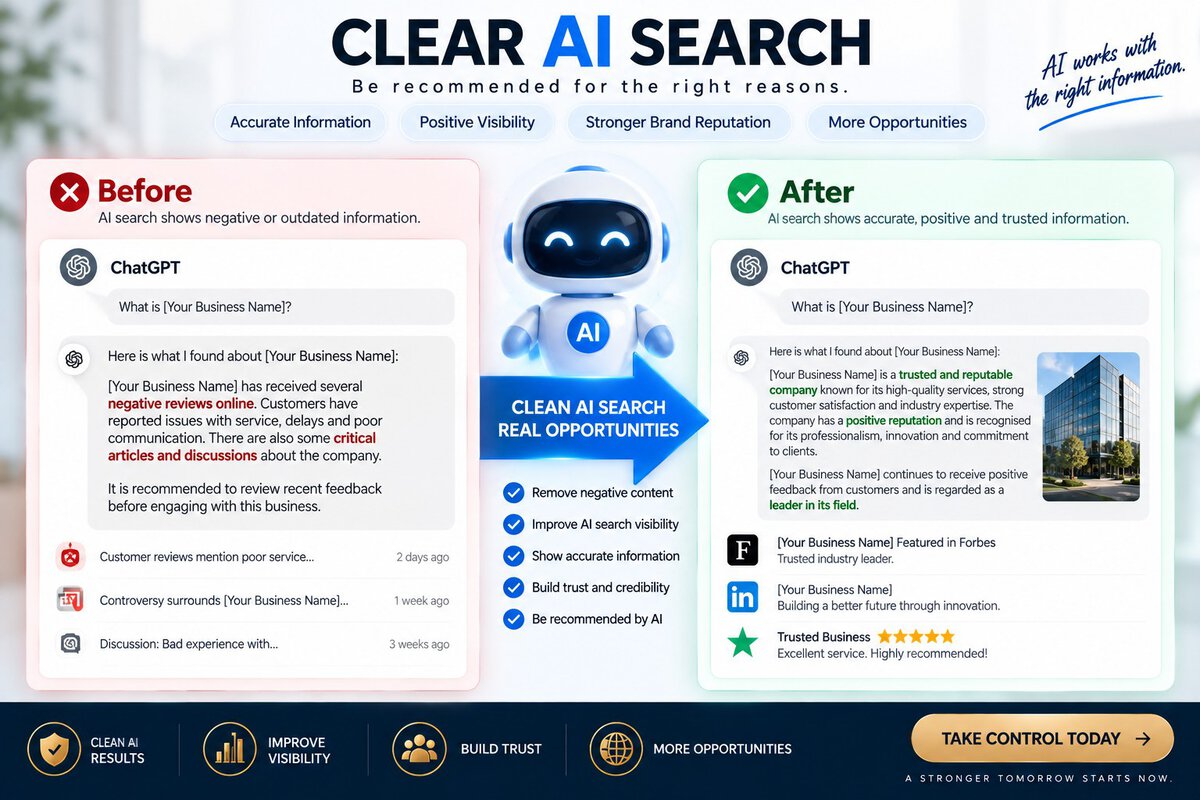
More people now ask an AI assistant about a business before they visit its website. Questions like “is [your brand] trustworthy?”, “[your brand] reviews UK” or “is [your brand] a scam?” are answered by pulling together review platforms, news coverage and forum posts. Trustpilot is one of the sources these tools read most often — so a fake one-star review does not just sit on Trustpilot. It can be summarised, repeated and presented as fact.
That is why our Trustpilot work does not stop at removal. We make sure the sources AI search relies on tell an accurate story:
Learn more about how we help brands get mentioned by ChatGPT and which titles carry the most weight in our guide to the best publications for AI visibility.
Fake and unfair reviews hit hardest where trust decides the sale. These are the sectors where we see the most Trustpilot attacks — and where we have built dedicated teams.
Delivery disputes, chargeback revenge and competitor attacks during peak season. See our retail reputation management and e-commerce PR agency work.
Where a single “scam” review can stall onboarding and investor conversations. Our fintech PR agency team pairs removal with credibility coverage. When the “scam” claim follows your name across Google, see scam allegation removal.
Hotels, restaurants and travel brands where reviews drive bookings. Explore hospitality reputation management.
Ex-employees posing as customers, and review bombing after a product change or outage. Our SaaS PR agency knows the pattern.
Law firms, accountants, agencies and consultants where one review can lose a client relationship. See professional services reputation management.
Owner-run firms where every review feels personal. Our small business PR agency keeps it simple and fast.
From Mayfair to Shoreditch, our London team meets clients in person. Read about reputation management in London.
When a review names you personally, it follows you everywhere. Our personal reputation management service protects you, not just the brand.
Someone who targets your Trustpilot profile often targets other sites too. We handle the whole picture in one plan: Google reviews, Glassdoor reviews, Indeed reviews, directory and complaint sites, negative news articles, TikTok posts and Facebook group posts. That is what we mean when we say we can remove any review from everywhere — wherever it breaks the platform’s rules or the law. Prefer to see every service in one place? Visit all services.
| What matters | Doing it yourself | With United Press |
|---|---|---|
| Choosing the right flag reason | Best guess from a drop-down menu | Each review mapped to the exact Trustpilot guideline it breaches |
| Evidence | A short explanation of why it feels unfair | A structured Evidence File: records, timelines, patterns and profile analysis |
| Risk to your account | Repeated weak flags can restrict flagging or trigger a Consumer Warning | Only rule-breaking reviews are flagged, so your account stays in good standing |
| Coordinated attacks | Flagged one by one, easy to dismiss | Reported as a single, documented pattern |
| Rejected decisions | Usually the end of the road | Appealed with new evidence where the case is strong |
| Genuine reviews | Left unanswered, or answered in frustration | Calm, professional replies and a plan to resolve the cause |
| Google and AI search | The review keeps shaping what people see | Editorial coverage and entity clean-up give a balanced story |
| Your time and stress | Evenings lost to screenshots and appeals | One specialist handles it; you approve and get on with your business |
| Guarantee | None | Booked upfront, full refund if a review in your plan is not removed |
Trustpilot has its own language. Knowing what these terms mean helps you understand every email you receive — and every decision that gets made about your profile.
Your overall score out of five, calculated from your reviews with more weight given to recent ones. Removing rule-breaking reviews and inviting every customer to review both help it reflect reality.
The Trustpilot team that investigates flagged reviews and suspicious activity, supported by automated detection software. They are the people your evidence needs to convince.
A report from a business or consumer that a review may break the Guidelines. A flag starts an investigation — it does not remove anything on its own.
A request, made through Trustpilot, for the reviewer to show they had a real experience with your business. If they cannot or do not respond, the review may be removed.
Any undisclosed connection that makes a review unreliable: owners, staff, former staff, relatives, friends, competitors or business partners writing about a company.
A public notice Trustpilot can place on a profile when it finds misuse, such as fake reviews or repeated invalid flagging. It can hide your TrustScore for months.
An invitation for a customer to leave a review. Trustpilot’s rules say invitations must not be selective — you invite happy and unhappy customers alike.
A second look at a flag decision, requested through the link in the decision email. It works best when you bring new evidence, not the same argument twice.
Trustpilot also places a “Verified” label on some reviews where it can confirm the reviewer had a real interaction with the business, for example through an invitation. A verified review can still be removed if it breaks another rule — such as revealing personal information or being about a different business — but it is much harder to argue that it is fake. That is one reason our specialists check every review’s label before choosing the route.
For a quick sense check of where your wider online presence stands — beyond Trustpilot — speak to our team about a full reputation audit as part of our online reputation management service.
A business cannot delete a review itself, but it can flag a review that breaks Trustpilot’s Guidelines. Trustpilot’s Content Integrity Team then decides whether to remove it. Reviews are removed when they are not based on a genuine experience, contain personal information, are harmful or illegal, are advertising, or are about a different business. United Press builds the evidence and files the flag for you.
No. Trustpilot is clear that not liking a star rating or disagreeing with a negative review is not a valid reason for removal. Unfair reviews come down when they also break a rule — for example, a factual claim that is provably false and damaging, or a reviewer who was never a customer. For genuine criticism, the best route is a professional reply and a plan to outweigh it.
Our assessment is usually returned within 24 hours and the Evidence File is typically filed within a few working days. Trustpilot then reviews the flag; many decisions arrive within days, while complex or pattern-based cases can take a few weeks, especially if an appeal is needed. We keep you updated at every stage.
Yes — when the service only targets reviews that break the platform’s rules or the law, and uses the platform’s own reporting process. What is illegal under the DMCC Act 2024 is writing fake reviews, concealing incentivised reviews, or suppressing genuine negative reviews. We do none of those things.
Removal work is booked upfront, and if a review included in your plan is not removed, you receive a full refund for that review. We also help you reply to it and reduce its impact through genuine reviews and editorial coverage.
Show that no customer record exists for the reviewer, highlight inconsistencies between the review and your products, dates or locations, and point out patterns across reviews or profiles. Trustpilot can also ask the reviewer for proof of their experience. The stronger and more specific the evidence, the more likely the review is to be removed.
Usually, yes. Trustpilot does not allow reviews from people with an undisclosed special relationship with a business — owners, employees, relatives or competitors. Evidence linking the reviewer to that relationship is often enough for removal.
A Consumer Warning is a public notice Trustpilot may place on a business profile when it finds misuse, such as fake reviews, pressuring reviewers or repeatedly flagging reviews without a valid reason. It can stay in place for months and can hide the TrustScore. You avoid it by only flagging genuine breaches and never offering incentives to reviewers — exactly how we work.
Possibly, but in England and Wales a company must show the review caused or is likely to cause serious financial loss under the Defamation Act 2013. The High Court’s 2024 decision in BW Legal v Trustpilot shows how hard that can be. The Trustpilot route is usually faster and more discreet; we will tell you if your case needs a solicitor.
You can respond and, once a problem is genuinely resolved, ask whether they would like to update their review. You must not pressure them or offer anything in return — that breaks Trustpilot’s rules and can breach UK consumer law.
Yes. Our team works with businesses across the UK, Europe, the US, the Middle East and beyond. Trustpilot’s Guidelines apply worldwide, and we handle reviews in any market where your brand trades.
Flags are submitted through your own Trustpilot Business account, in your business’s name. We never post on your behalf without approval and we never publicise our clients. Everything you share with us stays confidential.
It can. Trustpilot profiles often rank for branded searches, and AI assistants such as ChatGPT, Gemini, Perplexity and Google AI Overviews draw on review platforms when describing businesses. Removing rule-breaking reviews and adding trusted editorial coverage gives search engines and AI tools a more accurate story to tell.
Just your Trustpilot profile link and the reviews worrying you. Our specialist will tell you which ones have a removal case, which need a reply, and what evidence would help — all in a free, confidential assessment with no obligation.
Think about the people who searched your name today. The ones who almost booked, almost ordered, almost signed. They did not see your years of early starts, your loyal team or the hundreds of customers you have looked after properly. They saw one review that should never have been there.
You can keep refreshing that page and hoping it goes away. Or you can let a team that has protected reputations since 2001 take it from here — with the evidence, the process and a promise in writing.
One message tonight. A clear answer tomorrow.
United Press · Brook’s Mews, Bond Street, London W1K 4HA · ceo@unitedpress.uk · Free assessment · No obligation · 100% confidential
Read about United Press and our complaints procedure.
Good question. A real person on our team will answer it - where should we reply?
Free · No obligation · We reply within 24 hours