


TikTok Post Removal Stop One Video Defining Who You Are
A single TikTok video can reach hundreds of thousands of people before you have even seen it. United Press assesses every harmful video, comment and account, pursues every legitimate route to have it taken down, and protects your name while we do it.
🛡️ GuaranteedEvery harmful TikTok video dealt with — removed wherever TikTok’s rules or UK law allow, and pushed down by genuine positive coverage where they don’t. Never ignored.
- Videos, comments & accounts
- Stitches, duets & re-uploads
- In-app, legal, privacy & IP routes
- UK specialists since 2001
- Posted
A 40-second video goes up with your name, face or shop sign in it.
- 50,000 views
The algorithm pushes it to For You pages across the country.
- Stitched
Other creators react, duet and add their own “takes”.
- Your inbox
Customers, staff and family start sending you links.
- On Google
The video appears when people search your name.
An illustration of how quickly a harmful video can spread.
Nobody warns you how fast it happens. One evening, someone posts a video about you or your business. Maybe it is a furious “storytime” about a bad experience that never happened the way they say. Maybe it is a clip filmed without your permission, cut to make you look like the villain. Maybe it is a stranger who decided you were an easy target.
By the time you wake up, it is everywhere. The comments are cruel. Your phone will not stop buzzing. You want to reply, but you know it could make things worse. You try reporting it, and a few hours later you get a message saying it does not break the rules.
Maybe your staff are being recognised in the street. Maybe your children have seen it at school. Maybe a customer you have served for years has quietly stopped coming in. The worst part is often not the video itself, but the feeling that everyone has made up their mind about you, and you never got the chance to speak.
If you are reading this in the middle of that feeling, take a breath. You are not powerless, and you do not have to deal with it alone.
A video can go viral in a night. Your reputation took years to build, and it deserves a proper defence.
Many harmful TikTok videos can be removed when the right report, with the right evidence, goes to the right team. Others need persistence, a legal route or a different approach. And even when a video stays up, its power over your name can be taken away. That is what we do, calmly and confidentially, for people and businesses across the UK.
Can a TikTok video about me be removed?
Yes, many harmful TikTok videos can be removed, but only when they are reported through the right route with the right evidence. TikTok removes content that breaks its Community Guidelines, such as harassment, bullying, hateful behaviour, threats, impersonation and sharing private information, and it can remove or restrict content that is illegal, such as defamation or copyright infringement. The person who posted it can also delete it, and in serious cases a UK court can order removal.
United Press chooses the right route, prepares the evidence, follows it through and tracks down copies. If a video cannot be removed, we take away its power with a considered response, genuine positive voices and trusted published coverage.
Written for UK businesses, creators, professionals and individuals. Updated September 2026. General information, not legal advice.
The main ways to get a TikTok video taken down
- An in-app report under TikTok’s Community Guidelines, choosing the most accurate category
- A “report illegal content” request for defamation or privacy, naming the country, the law and the reasons
- An intellectual property report when your video, photos, music or logo have been used without permission
- An impersonation report when an account is pretending to be you or your business
- Where justified, a solicitor’s letter or court order for serious defamation or harassment
What is the video doing to you? Pick it and see your removal route
Every case is different, but these are the TikTok posts we are asked about most. Choose the one closest to yours to see the usual route, the evidence that matters and how realistic removal usually is.
Threats, harassment or targeted bullying
Community Guidelines report for harassment and bullying or violent behaviour, backed by UK harassment law where serious.
Every video, comment and message from the account, with dates, so a single post becomes a clear pattern.
Report the worst content first, document the pattern and, where you are at risk, bring in specialist solicitors.
Your address, phone number or private details
Privacy report and UK data protection rights. Sharing personal information is taken seriously by TikTok.
The exact moment or caption where your details appear, with a timestamp, and proof that the details are yours.
Move quickly, file the privacy report and check comments and copies where your details may have been repeated.
Your own videos or photos re-uploaded
Copyright report through TikTok’s intellectual property process, as the rights holder.
Your original files, the date you first posted them and links to every copy.
Prepare the rights-holder report, find every re-upload by sound, caption and username, and deal with each one.
Fake accounts pretending to be you
Impersonation report with proof of identity or business ownership.
ID or business registration, your real account and screenshots of the fake one messaging your followers.
File the impersonation report, warn your audience calmly where it helps and look for linked fake accounts.
Hateful content about you or your staff
Community Guidelines report for hateful behaviour.
The exact words, images or moments that target someone, with timestamps and links.
Report under the right category, support the staff involved and deal with pile-on comments and copies.
False accusations of crime, fraud or danger
“Report illegal content” for defamation with evidence, plus a solicitor’s letter where serious harm is shown.
The specific false claim, proof of the truth and records of the real harm the video has caused.
Build a clear, evidence-backed report, escalate through reviews and work with solicitors where the harm is serious.
Filming you or your staff without consent
Privacy and harassment routes, depending on where it was filmed and how it is used.
Where and when it was filmed, who is identifiable and how the footage is being used against you.
Assess the privacy and harassment angles, report the strongest one and track reposts of the footage.
Fake “storytime” reviews of your business
Evidence that the events did not happen, via defamation or harassment routes, plus reports on coordinated accounts.
Booking records, orders, receipts or CCTV that show what really happened, or that nothing happened at all.
Match the claims against your records, report with that proof and deal with the fake reviews that often follow.
Misleading edits of a real moment
Context, original footage and evidence of the misleading edit, via defamation or harassment routes.
The full, unedited footage or other recordings that show what the cut leaves out.
Show reviewers what was cut, report the misleading version and help you share the full context where wise.
A real customer’s honest bad review
Rarely removable, as honest opinion is protected. Best handled with a calm response and by taking away its power.
What went wrong, what you have done to put it right and any parts of the video that go beyond honest opinion.
Help you respond well, gather genuine positive voices and publish trusted coverage so one video is not the whole story.
Outlooks are general guidance based on how TikTok’s rules and UK law usually apply. Your free assessment gives you an honest view of your specific case.
The For You effect: why TikTok harm travels faster than anywhere else
TikTok is not like a review site or a Facebook group. Understanding how it spreads is the key to stopping it.
The For You page
TikTok shows videos to people who do not follow the creator. A video can reach a huge audience within hours, even from a brand-new account.
Stitches and duets
Other creators can react to a video, reuse part of it and add their own commentary, creating new videos you also have to deal with.
Downloads and re-uploads
Videos can be saved and posted again by other accounts, or shared to Instagram, YouTube Shorts, X and WhatsApp.
The comment pile-on
Comments often do as much harm as the video itself, with strangers repeating claims, naming your staff or tagging your business.
TikTok is a search engine
Many younger customers search TikTok for recommendations before Google. A harmful video can sit at the top of results for your business name.
It shows up on Google too
Public TikTok videos can appear in Google results and be picked up by AI tools, so the damage can follow you well beyond the app.
Five routes to a TikTok takedown, and the UK law behind each one
The most common reason a harmful TikTok stays up is the wrong report. Each route below is reviewed differently, against different rules, by different teams. A TikTok video is not above the law, and this is how the rules line up.
Community Guidelines report
Made from the share arrow or the three dots on the video, then “Report”. Best for harassment, bullying, hateful behaviour, threats and dangerous content. Choosing the most accurate category matters more than reporting many times.
Report illegal content
For content you believe breaks the law, such as defamation or privacy violations. TikTok asks you to name the country, the relevant law and a clear explanation, supported by evidence, so vague reports rarely succeed.
Privacy and personal data
Videos that expose your home address, phone number, workplace details, health information or identifiable images can be challenged through TikTok’s privacy reporting and your own data rights.
Intellectual property and impersonation
For your own videos, photos, music, artwork or logo used without permission, reports are made by the rights holder or someone authorised to act for them. For accounts pretending to be you, your business or your brand, TikTok may ask for identification or proof that you own the business name.
Legal pressure, reviews and appeals
If a report is rejected, you can often ask for a review and add more evidence. A well-prepared appeal is frequently where cases are won. Harmful comments, LIVE streams and whole accounts can be reported too, and where one account repeatedly targets you, reporting the pattern can be more effective than reporting single videos.
We decide which route to use, in which order and with what evidence. One well-prepared report to the right team usually achieves far more than dozens of rushed ones.
This is general information, not legal advice. Where a case needs legal action, we work alongside specialist UK solicitors so you get the right advice for your situation.
How to remove a TikTok video: our takedown reel, in seven moves
A calm, structured approach beats panic reporting every time. This is how we handle every TikTok case, from the first screen recording to the day your name is linked with the truth again.
Capture the evidence
We record the video, username, link, view count, comments and date before anything is edited or deleted.
Assess the content
We check it against TikTok’s Community Guidelines and UK law and give you an honest verdict.
Choose the route
We decide between guideline, illegal content, privacy, impersonation or intellectual property reports.
File the report
We submit a precise, evidence-backed report through the right channel, with the right category.
Review and escalate
If it is rejected, we request a review with new evidence and, in serious cases, work with solicitors.
Hunt down copies
We search for stitches, duets, re-uploads and shares on TikTok and other platforms, and deal with each one.
Rebuild your name
We help you respond, gather genuine positive voices and publish trusted coverage about the real you.
Swipe to see every step →
One video, ten copies: chasing down stitches, duets and re-uploads
Removing the original is often only half the job. On TikTok, one harmful video can quickly become ten, and every copy is a new door back to the same story.
Stitches
Creators use a clip of the original and add their own reaction. If the original is removed, the stitched section may remain in their video, so each stitch needs its own assessment.
Duets
Side-by-side reactions that repeat the harmful content to a new audience. They are often reportable on the same grounds as the original.
Re-uploads
Downloaded copies posted by other accounts, sometimes with new captions. Where the original was your own content, copyright reports can be effective.
Cross-posting
Copies on Instagram Reels, YouTube Shorts, X, Facebook groups and forums. Each platform has its own rules, which we also know how to use.
Sounds and hashtags
A trending sound or hashtag can keep a story alive. We search by sound, caption, hashtag and username to find every version.
Comments elsewhere
Harmful claims repeated in the comments of unrelated videos. We track and report these too, so the story stops spreading quietly.
Screenshots and write-ups
Stills from the video shared in forums, group chats or articles. We check where they have landed and use the right route for each site.
For ongoing protection of your brand on the platform, see our TikTok reputation management service. If a harmful video has reached other platforms, see our Facebook group post removal service and our wider online reputation management work.
Just seen a TikTok about you? Your calm checklist for the next 24 hours
The first day matters. What you do now can make removal easier, or much harder. Tick through the left-hand list, and hold back on everything on the right.
Do these now
- Screen-record the video, including the username, caption, date and view count
- Copy the link using “Share” then “Copy link”
- Screenshot the worst comments and the accounts behind them
- Note any real impact: cancellations, calls, messages or lost customers
- Check your own settings: you can limit comments, duets and stitches on your account
- Search TikTok for your name and business to see if copies exist
- Get an assessment before you report
Hold back on these
- Stitching or duetting the video to argue back, which pushes it to more people
- Going LIVE while you are angry or upset
- Asking friends to mass-report it, which can look coordinated and backfire
- Commenting on the video, which boosts its engagement
- Threatening the creator publicly, which can become a new video
- Hiring anyone who offers to hack or “ban” the account
- Assuming nothing can be done, because often it can
The evidence locker: nine things that get TikTok videos taken down
TikTok’s reviewers see a huge number of reports. The ones that succeed are specific, clear and backed by proof. These are the pieces of evidence that make the biggest difference.
The exact link
The direct link to the video, comment or account, not just a username. Each copy needs its own link.
A screen recording
A recording showing the video playing, the username, caption, date and view count, in case it is edited or deleted.
The specific false claim
The exact words or moments that are untrue, with a timestamp, rather than a general complaint about the video.
Proof of the truth
Booking records, receipts, delivery confirmations, CCTV or messages that show what really happened.
Proof of identity or ownership
For impersonation and intellectual property reports: ID, business registration, trade marks or original files.
Evidence of harm
Cancelled orders, lost bookings, abusive messages or calls that followed the video, with dates.
A pattern of behaviour
Other videos, comments or accounts from the same person, which can turn single incidents into a harassment case.
The right category
A report filed under the rule the video actually breaks. The wrong category is the most common reason for rejection.
The applicable law
For illegal content reports, the country and the law involved, such as UK defamation or data protection law.

TikTok videos about farms, farm shops and rural businesses
Farming has found a huge audience on TikTok. Farmers share lambing season, harvest and everyday life with millions of viewers. But the same reach cuts both ways. A clip filmed on your land without permission, a misleading edit about animal welfare, or a viral claim about your produce can put a family farm in front of an angry audience that has never set foot on it.
For farming families, the harm is personal. Many videos include the farm’s name, location and even the faces of children or staff. Some are filmed on private property. Others make serious allegations that are simply untrue. Each of these can give grounds for removal.
- Filming on private land, of your family, staff or animals
- False or misleading animal welfare and food safety claims
- Planning and diversification disputes that turn into call-out videos
- Fake reviews of farm shops, cafés and farm stays
Once a harmful video is dealt with, we help rural businesses put their real story in front of people through agriculture and regional publications, such as:
- Farm Weekly
- Farm Online
- Queensland Country Life
- Country World
- County Times
- Western Telegraph
- Hereford Times
- Eastern Daily Press
- East Anglian Daily Times
- Cotswold Journal
- Craven Herald
- The Westmorland Gazette
Read more on our agriculture PR agency page.
The people and businesses a single TikTok can hurt most
TikTok can make or break a reputation overnight. These are the people and businesses who come to us most often, and the kind of video that usually brings them to us.
Restaurants, cafés and takeaways
Viral “worst meal ever” videos and hygiene accusations can empty tables within days. See our restaurant PR page.
A food video filmed from a different restaurant, tagged with yours.
Salons, clinics and aesthetics
Before-and-after complaints and “botched” allegations spread fast in beauty communities. See our healthcare PR page.
A treatment complaint that names the practitioner and their home town.
Online shops and TikTok Shop sellers
Unboxing complaints and scam accusations can hit sales immediately.
A “never received my order” video about an order that was delivered.
Creators and influencers
Call-out videos, fake screenshots and impersonation accounts can damage brand deals and wellbeing alike. See our PR for content creators page.
A fake account copying your content and messaging your followers.
Schools, teachers and clubs
Pupils or parents filming staff and posting clips can create a crisis in hours. See education reputation.
A teacher filmed in class and ridiculed.
Professionals and individuals
Directors, doctors, landlords and private individuals targeted by ex-partners, ex-staff or strangers.
A revenge video that now appears whenever someone searches your name.
Local business owners can also read our guide to reputation management for local businesses, and start-ups can see our technology start-up reputation page.
If a TikTok stays up, we take away its power
Some videos are honest opinions, and some creators and platforms will not move. That does not mean the video gets the last word. We deal with every harmful video, and where removal is not possible, we build four layers around your name so it stops shaping how people see you.
A calm, considered response
When it helps, a short, factual reply or pinned comment, written with you, that shows viewers the other side.
Your own side of the story
Where appropriate, a well-judged video from your own account that answers the claim without fuelling it.
Genuine positive voices
Real customers, staff and partners sharing their honest experience, so one video is not the only voice.
Trusted published coverage
Positive, accurate stories in respected publications, so Google, TikTok search and AI tools find the truth first.
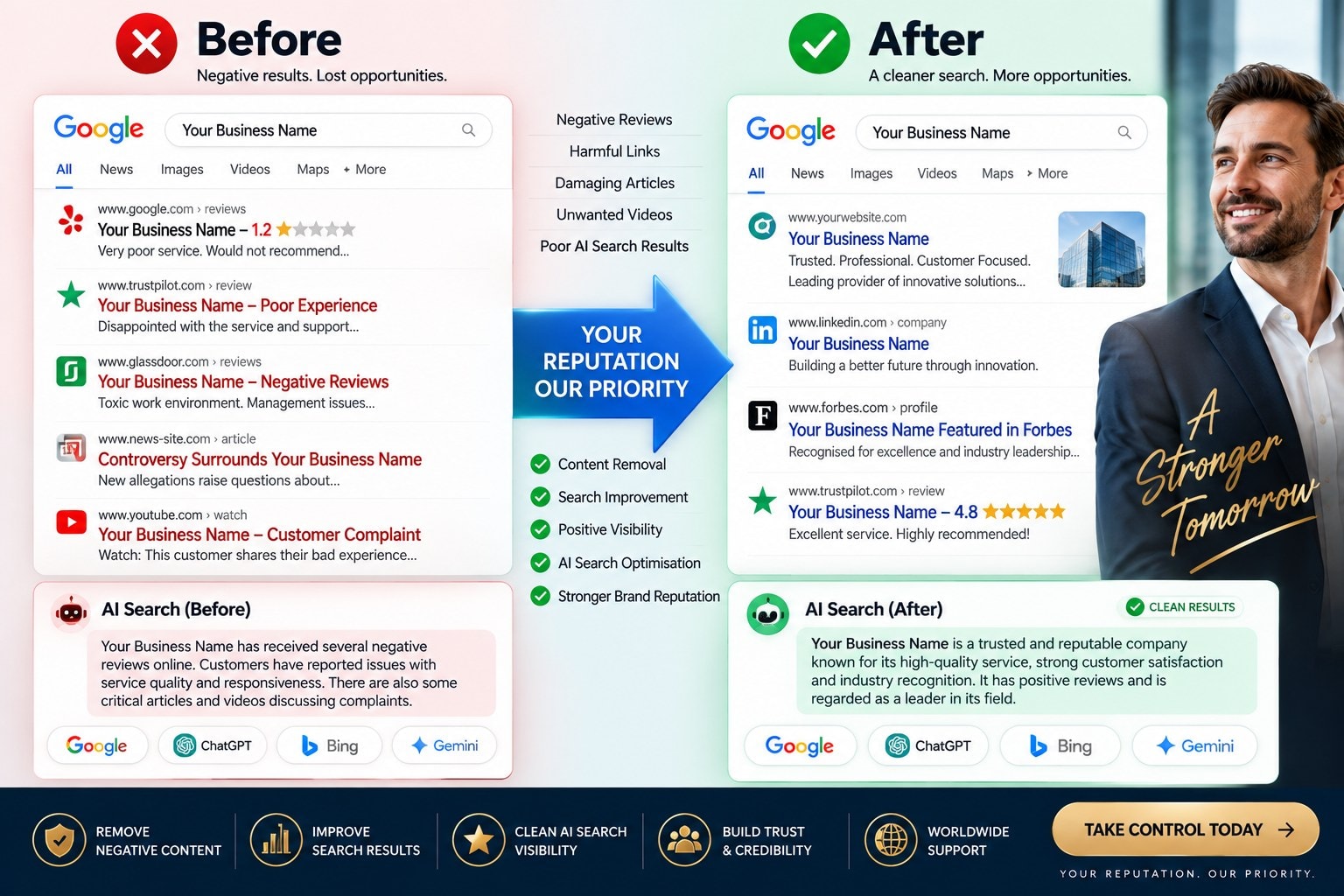
Taking away a video’s power means changing what people find and feel when they look you up, not hiding the truth.
Why a TikTok video can follow you into Google, TikTok search and ChatGPT
For a growing number of people, TikTok is where they go to find out whether a business is any good. That makes a harmful video far more dangerous than it looks.
Younger customers often type a business name straight into TikTok search before they ever open Google. Public TikTok videos can also appear in Google results, and AI assistants such as ChatGPT, Gemini, Perplexity and Google’s AI Overviews learn from what is publicly available. If the loudest thing about you is one angry video, that is the story they may repeat.
What people can find while the video leads
- The harmful video near the top of TikTok search for your name
- Copies and stitches repeating the same claim
- Screenshots of it on other sites
- AI answers that echo the loudest source
What we work towards
- The video removed, or no longer the first thing people see
- Genuine customer voices around your name
- Trusted, published coverage that tells the real story
- Consistent facts that AI tools can rely on
That is why every TikTok case we take on is also a search and AI case. We check TikTok search, Google and AI answers for your name after removal; we look for copies, screenshots and discussions on other platforms; we publish accurate, positive coverage in publications that search engines and AI tools trust; and we help keep your business facts consistent everywhere, which strengthens how you are described.
When it is time to rebuild, we can place your story in national and business titles such as The Times, Evening Standard, Business Insider, London Loves Business and New Statesman, and in lifestyle and regional titles across the UK. Read how we help brands get mentioned by ChatGPT, earn a Google Knowledge Panel, and choose the best publications for AI visibility.
The United Press TikTok guarantee: every harmful video dealt with
When you are desperate for a video to disappear, it is easy to believe anyone who promises it will. Here is exactly what we promise you, and the things nobody can honestly promise.
We guarantee
- Every harmful video, comment and account is assessed against TikTok’s rules and UK law
- An honest verdict on your chances before any work begins
- Every legitimate removal route is pursued, not just one report
- Stitches, duets and re-uploads are tracked and dealt with too
- Complete confidentiality: nobody is told you contacted us
- A plan for every case: removal where possible, damage control where not
Nobody can honestly promise
- That TikTok will remove a video that breaks no rule and no law
- That a real customer’s honest opinion can be deleted
- That nobody has already downloaded or screen-recorded the video
- Instant results in every case, as some routes take weeks
- Anything achieved through hacking, fake reports or bribery, which we never use
United Press · Brook’s Mews, London · since 2001
DIY reports, a solicitor, “ban” sellers or United Press: a scorecard
Each option has its place. Here is how they compare for a typical harmful TikTok video.
Reporting it yourself
- Choosing the route
- Trial and error
- Evidence
- Usually limited
- Stitches and copies
- Hard to track
- Honest assessment
- —
- If removal fails
- Video stays
- Google, TikTok search and AI
- Not covered
Solicitor only
- Choosing the route
- Legal routes only
- Evidence
- Thorough
- Stitches and copies
- Not usually covered
- Honest assessment
- Yes
- If removal fails
- Litigation may be next
- Google, TikTok search and AI
- Not usually covered
Online “ban” sellers
- Choosing the route
- Usually mass reporting
- Evidence
- Rarely
- Stitches and copies
- Rarely covered
- Honest assessment
- Often “100% guaranteed”
- If removal fails
- Often nothing more
- Google, TikTok search and AI
- Not covered
United Press
- Choosing the route
- Every route assessed for your case
- Evidence
- Prepared the way TikTok needs it
- Stitches and copies
- Tracked and dealt with
- Honest assessment
- Honest verdict before work begins
- If removal fails
- Response, reviews and trusted coverage
- Google, TikTok search and AI
- Included in every plan
From 300,000 views to back on track: how a salon owner might recover
This is an illustration of how a case can work, not a real client story.
Imagine an independent hair salon. A customer who was refused an appointment posts a tearful “storytime” video claiming the owner insulted her and damaged her hair. The video names the salon, shows the shopfront and reaches 300,000 views in two days. Other creators stitch it. One-star reviews start appearing on Google.
Evidence
The video, comments, stitches and the salon’s booking records are captured. The owner is advised not to respond on TikTok yet.
Reports
The video is reported through the right route, with records showing no appointment took place and the staff member’s private details removed.
Copies and reviews
Stitches and re-uploads are assessed and reported, and fake one-star reviews that break Google’s rules are challenged.
Recovery
Loyal clients share genuine experiences and a positive local story is published, so the salon’s name is linked with the truth again.
Dealing with reviews as well? See how we help remove Google reviews and remove Trustpilot reviews that break the rules, or read about news article reputation management.
Six reasons people hand a harmful TikTok to United Press
When your name, your business or your family is involved, you need people who are calm, careful and completely on your side.
UK specialists
More than two decades of UK PR and reputation work, from local businesses to national brands.
Complete confidentiality
Nobody is told you contacted us, and we never post or reply on your behalf without your agreement.
A straight answer first
You get an honest view of what can be removed, and why, before any work begins.
No shortcuts that backfire
Only official TikTok routes, data protection and intellectual property rights, and solicitors where justified.
The video and its copies
We deal with the original, the stitches, duets and re-uploads, the search results and what AI tools say.
Publications
When it is time to rebuild, we can place your real story in named national, regional and sector titles.
Before you hire anyone: six red flags of a TikTok removal scam
People in distress are exactly who scammers target. Be careful of anyone offering these.
“Ban any account in 24 hours”
No one controls TikTok’s moderation. Promises like this usually mean fake mass reports, or nothing at all.
Hacking offers
Accessing someone else’s account is illegal in the UK and can turn you from the victim into the wrongdoer.
Report bots
Automated mass reporting breaks TikTok’s rules, rarely works and can put your own account at risk.
“Inside contacts” at TikTok
Claims of a friend at TikTok who can delete videos are a classic scam line. Legitimate removals go through official routes.
No questions asked
A real specialist wants to see the video and understand the harm before promising anything.
Anonymous sellers
Forum and messaging-app sellers with no company, address or history cannot be held to account.
United Press is a UK agency established in 2001, based in Brook’s Mews, London. Read more about us.
Switch these on now: six ways to protect your business on TikTok
You cannot stop every unfair video, but you can make your brand much harder to attack, and much quicker to defend.
Claim your name
Set up an official TikTok account for your business, even if you rarely post, so impersonators cannot take your name and customers know which account is really you.
Tighten your settings
Use comment filters, keyword filters and controls on who can duet, stitch or download your videos, so your own content cannot easily be turned against you.
Register your trade mark
A registered trade mark makes impersonation and brand-misuse reports far stronger and faster to resolve.
Keep good records
Bookings, orders, delivery confirmations and customer messages are your best defence when someone claims something that never happened.
Monitor your name
Search TikTok regularly for your business name, products and key staff, so you catch a problem in hours, not weeks.
Build trusted coverage now
Positive, published coverage in respected titles means that if a harmful video appears, it lands on top of a strong, credible reputation rather than an empty one.
Building that reputation in advance is exactly what our guaranteed press release publication and social media placement services are for.
Real clients on working with United Press
“United Press built our brand from launch to nationwide recognition. Real media coverage gave new customers the trust they needed — our ROI has been over 100:1, which blows my mind.”
“The team understood our industry and, more importantly, understood the story we needed to tell. Seeing our company featured across relevant publications gave us a much stronger presence when potential customers researched us.”
“United Press helped us turn our company story into something journalists could genuinely engage with. The coverage gave our brand a level of credibility that was difficult to achieve through our own marketing channels.”
A quick TikTok removal glossary
- Community Guidelines
- TikTok’s rules on what is and is not allowed, covering areas such as harassment, hateful behaviour, violence, privacy and impersonation.
- Stitch
- A TikTok feature that lets a creator use a short clip from another video at the start of their own, usually to react to it.
- Duet
- A TikTok feature that places a new video side by side with an existing one, so viewers see both at once.
- For You page
- TikTok’s personalised feed, which shows videos to people who do not follow the creator. It is the main reason videos go viral so quickly.
- Defamation
- A false statement of fact, shared with others, that causes or is likely to cause serious harm to someone’s reputation. In a video or written post, this is libel.
- Norwich Pharmacal order
- A UK court order requiring a platform or other third party to disclose information that helps identify someone behind an anonymous account.
Removing a video
How do I get a TikTok video about me removed?
Report it through the route that matches what the video does wrong: a Community Guidelines report for harassment or hate, “report illegal content” for defamation or privacy, an intellectual property report for your own content, or an impersonation report for fake accounts. We assess your video and choose the right route for you.
Can I get a TikTok video removed if it does not show my face?
Often, yes. If the video names you or your business, shows your premises or shares your personal details, it can still be reportable, depending on what it says and how it identifies you.
How long does it take to remove a TikTok video?
Clear breaches such as threats, personal information or copyright can sometimes be removed within days. Rejected reports that need a review, or defamation cases, can take several weeks. We give you a realistic timeline in your assessment.
Can you guarantee a TikTok video will be removed?
No one can honestly guarantee removal, because the decision rests with TikTok, the creator or a court. What we guarantee is that every harmful video is dealt with: an honest assessment, every legitimate route pursued, full confidentiality and a plan to push it down if it stays up.
Will the creator know I reported their video?
TikTok does not normally reveal who made a Community Guidelines report. Some legal reports, such as intellectual property claims, may share details with the creator. We explain this before anything is filed.
Can you remove comments and stitches too?
Yes. Harmful comments, stitches, duets and re-uploads can be reported on their own merits, and we deal with them alongside the original video.
What if the video has been re-uploaded to other platforms?
We track copies on Instagram, YouTube Shorts, X, Facebook and elsewhere, and use each platform’s own rules to deal with them.
Can a whole TikTok account be removed?
TikTok can ban accounts that repeatedly or seriously break its Community Guidelines, including accounts that exist mainly to harass or impersonate. We document patterns and report them where the evidence supports it.
What if my report was rejected?
A rejection is not always the end. A review with better evidence, a different category or a different route, such as a legal or privacy report, often succeeds where a first quick report did not.
Can you remove a TikTok LIVE recording or clip?
Clips from LIVE streams that are re-posted as videos can be reported like any other video. Harmful LIVE streams themselves can be reported while they are happening, and recordings of them can be challenged afterwards.
Can you help with TikTok Shop reviews?
We can assess TikTok Shop reviews and videos about your products, and report those that break TikTok’s rules, such as fake or abusive reviews, while helping you build genuine positive feedback.
What if a video about my child or a young person is posted?
Content involving young people is treated very seriously. Tell us immediately; privacy and safety routes are often the strongest, and we will explain your options straight away.
Law and rules
Is a TikTok video defamation?
It can be. Under the Defamation Act 2013, a false statement of fact that causes or is likely to cause serious harm to reputation may be defamatory. For a business, that means serious financial loss. True statements and honest opinion are generally protected.
How long do I have to act on a defamatory TikTok?
In England and Wales, defamation claims generally need to be brought within one year of publication, so it is important to act quickly. Platform reports can be made at any time.
Can someone film me and post it on TikTok without permission?
It depends on where it was filmed and how it is used. Filming in some places, sharing personal information or using footage to harass someone can give grounds for removal under TikTok’s rules or UK law.
Can I find out who is behind an anonymous TikTok account?
In serious cases, a UK court can order a platform to disclose information about an account, known as a Norwich Pharmacal order. This needs a solicitor, and we can connect you with specialists.
Does the Online Safety Act help?
The Online Safety Act 2023 gives large platforms legal duties to act on illegal content, such as threats and harassment, once they are aware of it. It strengthens the case for removal when content crosses that line.
Businesses and reputation
Someone posted a fake review of my business on TikTok. What can I do?
Gather records showing the events did not happen, such as bookings, orders or CCTV, then report the video through the right route with that evidence. If it comes from a fake or coordinated account, that can be reported too.
Can a TikTok video affect my Google results?
Yes. Public TikTok videos can appear in Google results, and screenshots can spread to other sites. We check Google, TikTok search and AI answers as part of every case.
Will a TikTok video change what ChatGPT says about my business?
It can, if it is one of the few public sources about you. Accurate, positive coverage in trusted publications gives AI tools better sources to learn from.
Do you help farms and rural businesses?
Yes. We help farms, farm shops and rural businesses targeted by misleading or unauthorised videos, then rebuild their reputation through agriculture and regional titles such as Farm Weekly, Farm Online and the Eastern Daily Press.
Can you help creators and influencers?
Yes. We help creators deal with impersonation accounts, stolen content, fake call-out videos and harassment, and rebuild their credibility with brands.
Should I reply to the video?
Not straight away. Stitching, duetting or commenting boosts the video. A calm, well-judged response can help later, and we can plan it with you.
Can you help if the video is about me personally, not my business?
Yes. We help individuals and professionals targeted by ex-partners, former staff, pupils or strangers, with the same care and confidentiality.
Can you remove a TikTok video that uses my business name in the caption or hashtags?
If the video uses your brand to mislead people, impersonate you or make false claims, it may be reportable on those grounds. Using a trade mark in a misleading way can also support an intellectual property report.
What if the harmful video is in another language or posted from abroad?
TikTok’s Community Guidelines apply globally, and illegal content reports ask which country’s law applies. We assess where the harm is happening and choose the route most likely to work.
Working with us
Is the assessment free and confidential?
Yes. Your assessment is free, with no obligation, and everything you share is kept confidential.
What do you need from me?
The link to the video, a screen recording if you have one, the creator’s username and a short explanation of what is untrue or harmful. Anything showing the real impact on you is also useful.
Do you use fake reports, bots or hacking?
Never. We only use legitimate routes: TikTok’s official reporting and appeals, data protection and intellectual property rights, and legal action through solicitors where justified.
Do you work with solicitors?
Yes. Where a case needs legal action, we work alongside specialist UK solicitors, and we handle the reputation side while they handle the legal side.
Do you work across the UK?
Yes. We help businesses and individuals everywhere, from Swansea and Milton Keynes to York and Northampton.
What happens after the video is removed?
We confirm it has gone, check for copies, and help you rebuild with genuine reviews and positive coverage, including guaranteed press release publication in named titles if you want it.
It took one video to hurt you. It won’t take one video to define you.
Think about everything that really says who you are. The customers who keep coming back. The team who trust you. The years of work behind your name. The family who know exactly who you are. None of that was captured in 40 seconds on someone else’s phone.
Right now, that video may be the first thing people see. It does not have to stay that way.
Picture searching your name next month and finding the truth: the video gone or buried, real customers speaking up, and published coverage that shows who you really are.
It starts with a free, confidential assessment. Send us the link and a few lines about what happened. We will tell you honestly what can be removed, how, and exactly what we will do if it cannot.
Tonight, put the phone down. Let us deal with it.