Does ChatGPT Use Google Reviews? What Every AI Tool Reads About Your Business (UK 2026)
Short answer: not directly. ChatGPT leans on Bing, Yelp, Reddit and the wider web, while Google’s own AI reads your Google reviews word for word. Here is which reviews each AI tool really uses, how one bad review can end up in the answer, and what to do about it.
Does ChatGPT use Google reviews?
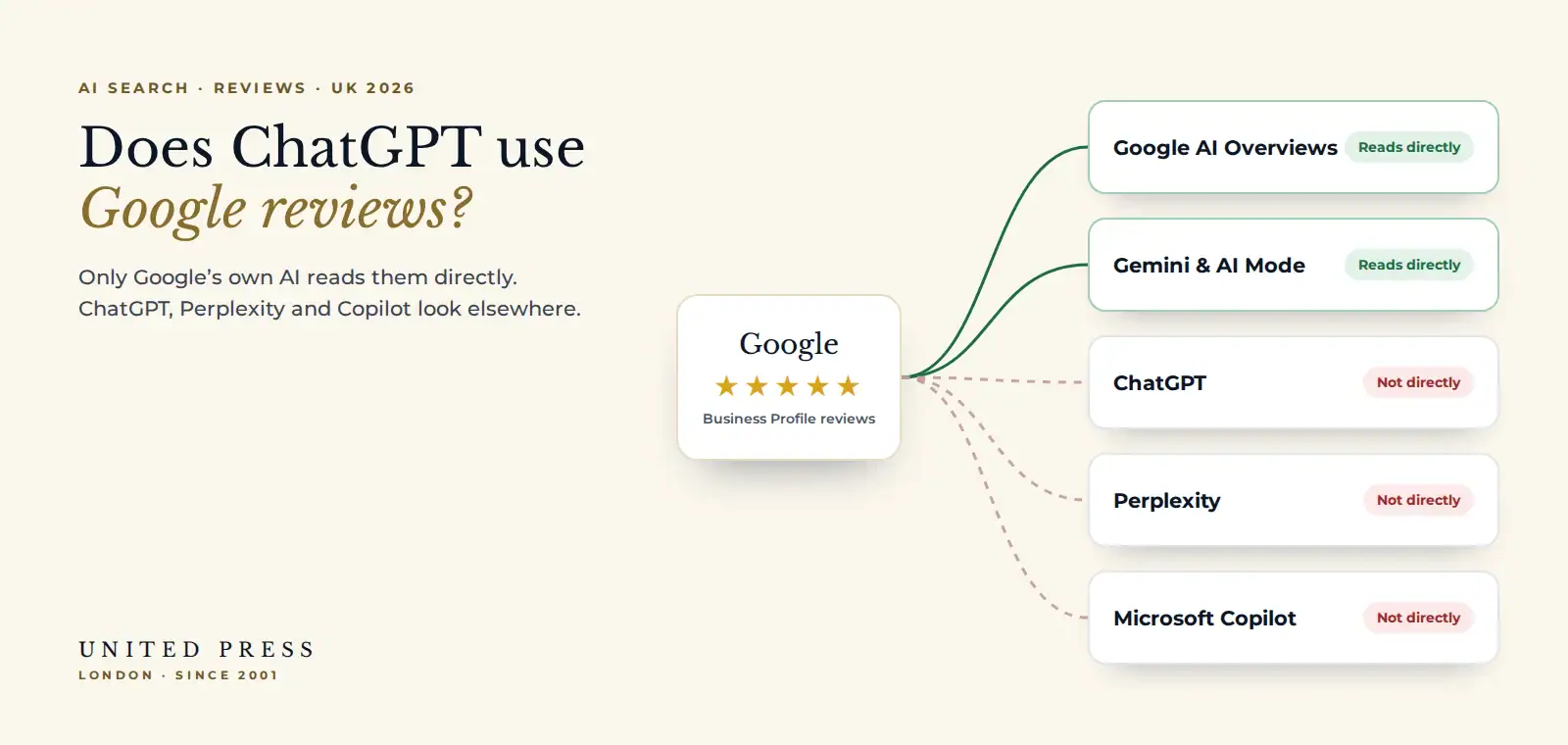
No, not directly. ChatGPT has no public agreement with Google to read Google Business Profile reviews. When it searches the web, it works with search partners (OpenAI’s own help page points to Microsoft, which runs Bing), licensed data from partners such as Yelp and Reddit, and any public web page its crawler is allowed to read.
So your Google star rating can still reach ChatGPT, but only second-hand: when it is repeated on your website, in a directory, in a news story or in a forum thread. Google’s own AI tools are different. AI Overviews, AI Mode and Gemini in Maps read your Google reviews directly and summarise them.
That difference matters more than most business owners realise. You could have 400 glowing Google reviews and still be described badly by ChatGPT, because the sources it actually reads tell a different story. And a single fake one-star review on Google can turn up in Google’s AI summary of your business within weeks.
This guide is for UK businesses, but it applies wherever you trade. It covers which reviews each AI tool reads, why reviews now shape AI answers, how to check what AI is using about you, and how to fix it, from earning better reviews to removing fake ones and earning press coverage that AI trusts.
Which reviews does each AI tool read?
Every AI assistant answers questions about businesses in a slightly different way. Some search the web live, some use licensed data from review platforms, and Google’s tools sit on top of the largest review database in the world. Here is the picture as of October 2026.
| AI tool | Reads Google reviews? | Main review and business sources | What this means for you |
|---|---|---|---|
| ChatGPT (OpenAI) | Not directly | Search partners (OpenAI points to Microsoft, which runs Bing), licensed Yelp data since July 2026, Reddit through a data deal since 2024, and public pages its crawler can read | Your Yelp, Facebook, Trustpilot and sector-site reviews, Reddit threads and press coverage carry the most weight |
| Google AI Overviews & AI Mode | Yes | Google’s search index, Google Business Profile and Google reviews | Your Google reviews and their wording feed straight into the summary |
| Gemini (app and in Google Maps) | Yes | Google Maps places data and reviews, plus Google Search | Gemini writes review summaries for places, so recurring words in reviews become your description |
| Perplexity | Not directly | Its own web index, Yelp data (since 2024) and Tripadvisor data for hotels (since 2025) | Yelp and Tripadvisor ratings can appear word for word, with quotes |
| Microsoft Copilot | Not directly | Bing search and Bing’s business listings | A complete, accurate Bing Places listing matters |
| Apple Maps & Siri | No | Apple’s own ratings and Yelp data | Apple’s own ratings and Yelp shape what iPhone users hear |
Two things stand out. First, Google reviews only reach Google’s own AI directly. Second, Yelp is now everywhere: it supplies ChatGPT, Perplexity and Apple Maps. If your business has never looked at its Yelp page because “nobody in the UK uses Yelp”, AI has changed that.
Where does ChatGPT get its reviews and business information?
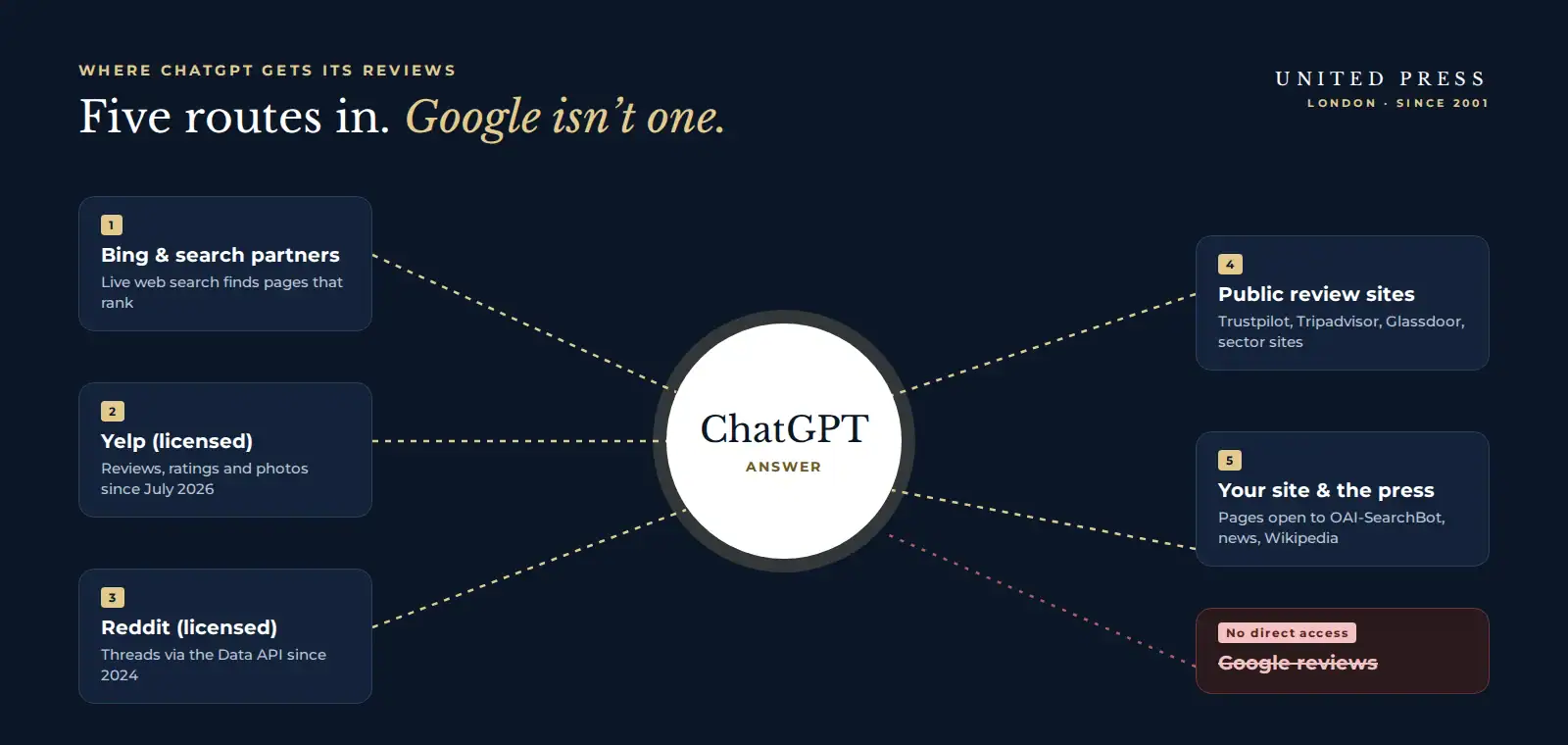
ChatGPT answers questions about a business in two ways. Sometimes it answers from what it learned in training, which can be months or years old. More often, for anything local or recent, it runs a live web search and cites its sources. Those sources fall into five groups, roughly in order of how often they shape a business answer.
Bing and other search partners
When ChatGPT searches, it rewrites your question into short search queries and sends them to its search partners. OpenAI’s help page on ChatGPT search names Microsoft’s privacy policy for how those partners handle queries, and Microsoft runs Bing. In practice, if a page about you ranks well on Bing, ChatGPT is far more likely to find it. Many UK businesses have never checked their Bing Webmaster Tools account or Bing Places listing.
Licensed review data: Yelp
In July 2026 Yelp announced a licensing agreement with OpenAI, reported first by Axios. ChatGPT can now show Yelp reviews, ratings, photos and business details in answers to local questions, with Yelp branding and links. Yelp also said a “Request a Quote” feature would come to ChatGPT, so people may contact service businesses straight from the chat.
Licensed discussion data: Reddit
In May 2024 OpenAI and Reddit announced a partnership giving OpenAI access to Reddit’s Data API, described as real-time, structured content. That is why Reddit threads appear so often in ChatGPT answers about companies, and why one angry post can colour an answer.
Public review and directory pages
Trustpilot, Tripadvisor, Checkatrade, Glassdoor, Indeed, Feefo, sector directories and comparison sites are public web pages. If ChatGPT’s search finds them and they are open to crawlers, their ratings and review text can be quoted. These are not special data deals; they are simply pages that rank and can be read.
Your own website, the press and Wikipedia
ChatGPT can only read your website if you allow OpenAI’s search crawler, called OAI-SearchBot. OpenAI says placement is not guaranteed even then. News articles, interviews, trade press and Wikipedia are among the strongest signals of all, because they are independent of you. We cover this in depth in what ChatGPT says about your business.
Notice what is missing: Google Business Profile. ChatGPT has no direct line into Google’s reviews, and Google has every reason to keep it that way. Google reviews are one of the most valuable assets Google owns.
How your Google rating can still reach ChatGPT
“ChatGPT doesn’t read Google reviews” is true, but it is not the whole story. Your Google rating escapes Google in several ordinary ways, and ChatGPT can pick it up from any of them:
- Your website. A review widget or a line such as “rated 4.9 on Google from 380 reviews” is plain text ChatGPT can read and repeat.
- Directories and listing sites that copy or display Google ratings alongside their own.
- “Best of” lists and local guides. Articles such as “the 10 best dentists in Leeds” often quote Google ratings, and AI tools love these lists.
- News stories and forum posts that mention your reviews, good or bad: “the firm has dozens of one-star Google reviews complaining about…”.
- Training data. Older snapshots of the web that the model learned from may include copies of reviews or ratings.
This second-hand route is weaker and slower than a direct feed, and it can be out of date. A rating quoted in a 2023 article stays frozen at its 2023 value. That is one reason ChatGPT sometimes describes a business by its old reputation rather than its current one.
Can ChatGPT see Google Maps and your Business Profile?
Partly, and less than you might think. Your Google Business Profile is built with JavaScript, the code that loads reviews, photos and the map after the page opens. Many AI crawlers do not run JavaScript, so when they visit a Google Maps listing they see little more than an empty shell, with no reviews tab at all. SEO testers in 2025 showed exactly this: a business with a 4.9-star Google rating looked blank to a crawler.
Since late 2025, local SEO specialists have reported ChatGPT showing maps and basic business details, such as name, address and opening hours, for local searches. OpenAI says this comes from “trusted third-party providers” for business listings. What still has not appeared is the text of your Google reviews being read and quoted the way Google’s own AI does.
Does ChatGPT use Reddit as a source?
Yes, heavily. It is one of the most common questions people type into Google about ChatGPT, and the answer has real consequences for reputation. Thanks to the 2024 Data API partnership, ChatGPT can surface recent Reddit threads quickly, and Reddit pages also rank well on Bing and Google, so they are found through ordinary search too.
For a business this cuts both ways. A thread where real customers recommend you is excellent evidence. A thread titled “Avoid [your company], worst service ever” can become the main “independent” source in an answer, especially if few other independent sources exist. Reddit posts that break the platform’s rules, such as harassment, personal information or false claims presented as fact, can be reported and removed. Our Reddit post removal and Reddit reputation management teams handle exactly this.
Does Gemini have access to Google reviews?
Yes. Gemini and Google’s other AI features are built on Google’s own data, and reviews are a central part of it. In October 2024 Google announced Gemini-powered features for Google Maps, including review summaries under a place’s rating and an “Ask Maps about this place” box that answers questions with snippets from reviews. Google said these would come to Search as well. In 2026 marketers have also reported Gemini-written summaries in local panels with headings such as “People talk most about”, built from review text.
That means the exact words in your Google reviews matter. If twenty reviews mention “friendly staff” and three mention “hidden charges”, both phrases may appear in the AI summary. For Google’s AI, a review is no longer just a star rating; it is raw material for a paragraph about you that thousands of people will read first.
Which review sites matter most for ChatGPT? What the research shows
Because ChatGPT leans on Bing, one useful clue is which review sites Bing attaches to business listings. In 2025, local SEO firm Whitespark studied 153 searches across 17 types of local business in 9 US cities and recorded every review source shown on the first page of Bing Places results. The findings surprised many business owners:
- Facebook was the most common review source overall, appearing on roughly one and a half times as many businesses as the next platform, and it ranked first in 10 business categories.
- Yelp came second, with more than twice as many appearances as third place, and ranked first in 5 categories.
- Tripadvisor came third, and mattered most for food businesses such as bakeries and restaurants.
- Sector sites such as Porch, Angi and Yellow Pages mattered in their own niches, which in the UK means sites like Checkatrade, Rated People, Trustpilot or Doctify.
Google reviews were not part of the picture at all, because Bing does not show them. The research is from the US and looks at Bing rather than ChatGPT directly, but the lesson travels well: your Facebook recommendations, Yelp page and sector review sites may count for more in ChatGPT than your Google reviews. Since the Yelp deal in July 2026, Yelp’s weight in ChatGPT answers is likely to have grown further.
The practical step is simple. Search Bing for your service and town, open the top listings, and note which review sites appear beside your competitors. Those are the platforms worth building for your business and sector.
Why reviews now shape AI answers about your business
A few years ago, reviews mattered when someone was already looking at your listing. Now they matter before anyone sees your name at all, because AI tools read them, weigh them and decide whether to mention you. The numbers from BrightLocal’s 2026 survey of US consumers show how fast this has moved:
Source: BrightLocal Local Consumer Review Survey 2026 (1,002 US adults). UK habits tend to follow the same direction.
Put simply, nearly a quarter of people would now make a decision about you from an AI paragraph without ever opening a single review. And the review sites they use are spreading out: Google’s share fell from 83% to 71% in one year, while Apple Maps almost doubled. The AI tools sit on top of all of this.
When an AI assistant decides whether to recommend a business, reviews help it answer three questions:
- Is this business real and active? A steady flow of recent reviews across several platforms says yes.
- Is it any good? Ratings and the balance of positive and negative comments give a quick verdict.
- What is it known for? The words people use, “fast”, “honest”, “expensive”, “rude”, become the description.
The third question is the one most businesses miss. AI does not just count stars. It reads the text and repeats the themes, which is why the content of reviews matters as much as the score.
What one bad or fake review can do to an AI answer
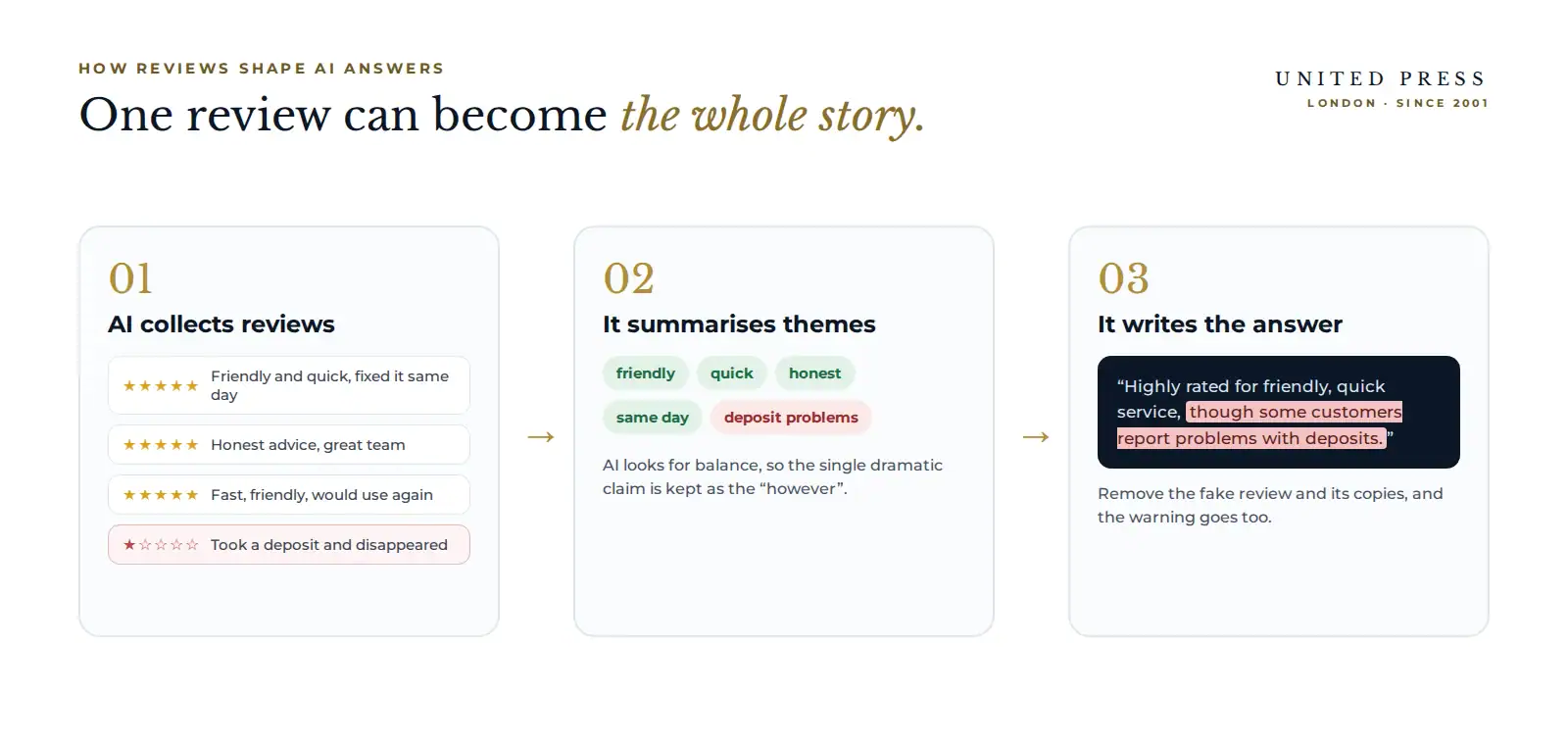
On a review page, one one-star review among two hundred five-star reviews barely registers. In an AI answer, it can be the line people remember. AI tools are built to give balanced summaries, so they often look for a “however” to include. If the only criticism they can find is a single dramatic review, that review gets an outsized role.
What the AI finds
212 five-star reviews about friendly, quick service. One detailed one-star review, posted by a competitor, claiming the firm “took a deposit and disappeared”. One Reddit thread that links to it.
What the AI may say
“Highly rated for friendly, quick service, though some customers report problems with deposits.” One fake review has now become a warning attached to the business name, repeated to every person who asks.
This is not a rare edge case. It is how summary-style answers work. The fake review also has a habit of spreading: once it is quoted in a Reddit thread or a complaints site, it exists in several places, and each one strengthens the others in the AI’s eyes.
Three kinds of reviews cause the most damage in AI answers:
- Fake reviews from competitors, former staff or people who were never customers.
- Specific, alarming claims such as fraud, theft, safety failures or data breaches, true or not. These are exactly the details an AI picks out as worth mentioning.
- Old reviews about problems you have fixed. The AI may not know the problem is history unless newer sources say so.
Top of Google but missing from ChatGPT? Why the two disagree
Many businesses discover the same thing: they sit at the top of Google’s map results with hundreds of five-star reviews, yet ChatGPT recommends someone else. That is not a glitch. The two systems choose in different ways.
Google’s map results reward
- Number of Google reviews and star rating
- How close you are to the searcher
- A complete, active Business Profile
- Relevance to the exact search
ChatGPT’s answers reward
- Brand authority and how often you are mentioned
- Links and coverage from trusted websites and the press
- Reviews on Yelp, Facebook, Trustpilot and sector sites
- Clear, consistent information it can read and repeat
An experiment by a UK SEO agency shows the gap clearly. Searching for the best estate agents in one Kent town, Google’s local results showed seven agents with ratings between 4.6 and 5.0 from dozens or hundreds of reviews. ChatGPT named eight agents, and only two of them were on Google’s list. The others were mostly well-known national brands with strong websites, press coverage and links, even though some had weaker technical performance.
Results also change with the wording of the question. A narrow question, such as a specific service in a specific town, can name a small specialist first, while a broad question, such as “best agencies in the UK”, may name only famous brands. ChatGPT also uses your approximate location, so two people in different cities can get different answers to the same question.
Neither Google nor OpenAI offers a way to buy a place in these answers, and Google says there is no special trick for its AI Overviews beyond being indexed and eligible to show a snippet. What closes the gap is the same mix that builds a reputation offline: genuine reviews in several places, independent coverage, and clear facts about who you are and where you work.
How to check which reviews AI is using about your business
You can see what AI tools rely on in about fifteen minutes. Use a private or logged-out browser window so your own history does not shape the answers, and repeat the same questions in ChatGPT, Google (AI Overviews or AI Mode), Gemini, Perplexity and Copilot.
1 · The reputation questionWhat do customers say about [business name] in [town]?
2 · The source questionWhich review sites did you use for that answer? List them with links.
3 · The recommendation questionWho are the best [your service] providers in [town]? Why?
4 · The worry questionAre there any complaints or problems with [business name]?
As you go, note four things in a simple spreadsheet:
- Which sources are cited. In ChatGPT, open the Sources panel. In Google, look at the links beside the AI Overview. You will quickly see whether Yelp, Trustpilot, Reddit or a directory is doing the talking.
- Which ratings are quoted and whether they are current.
- Which words describe you. Do they match what your best customers say?
- Any negative claims, and where each one comes from.
Repeat the check every month. Answers that use live search can change within days of a source changing, so this is also how you measure whether your fixes are working. If you find a claim that is simply wrong, our guide to fixing what ChatGPT says about your business explains how to correct it at the source.
How to get better reviews into AI answers
The goal is not simply more Google reviews. It is a strong, genuine and recent review picture on every platform the AI tools actually read. Work through these steps in order.
1. Know which platforms matter for your sector
Run the source check above and list every review site the AI tools cite for you and your competitors. For a restaurant that may be Google, Tripadvisor and Yelp. For a tradesperson, Google, Checkatrade and Trustpilot. For an employer, Glassdoor and Indeed. For a software firm, G2 and Trustpilot. Focus on those, not every site that exists.
2. Claim and complete every listing
Claim your Google Business Profile, your Facebook page (with recommendations switched on), Bing Places (which feeds Copilot and Bing-based search), Yelp, Apple Business Connect and the main sites for your sector. Use exactly the same business name, address, phone number and website everywhere. Inconsistent details are one of the most common reasons AI tools confuse or ignore a business. Add services, opening hours, photos and a clear description in plain words: what you do, where, and for whom.
3. Ask for detailed reviews, the honest way
Ask every happy customer, at the moment they are happiest, and make it one click. Encourage people to mention what you did, “fixed our boiler the same day”, rather than just “great”. Detail gives AI the words it uses to describe you. Under UK law, you must not fake reviews, write them yourself or offer hidden rewards for them, so keep your requests open and honest (more on the law below).
4. Spread your reviews across platforms
If every review you have is on Google, ChatGPT and Perplexity have very little to go on. Point some customers to Trustpilot, Yelp or your sector site instead. A steady trickle on three platforms beats a flood on one.
5. Reply to reviews, especially the negative ones
A calm, specific public reply shows readers and AI that the issue was handled. “Thanks for raising this. We refunded the order and changed our delivery partner in March” gives an AI a newer, more balanced fact to use. Never argue, and never reveal customer details.
6. Put your best reviews on your own website
Quote real reviews with the reviewer’s first name and the platform, and keep them up to date. Make sure your site allows OAI-SearchBot, Googlebot, Bingbot and PerplexityBot to crawl it, so the AI tools can read them. If AI cannot read your site, it relies entirely on what others say about you.
7. Check monthly and fix fast
Review platforms and AI answers move quickly. A monthly check lets you catch a fake review, an outdated rating or a confused answer before it settles into the AI’s picture of you. For the wider strategy, see how to rank in AI search and our get mentioned by ChatGPT service.
How to use ChatGPT to reply to Google reviews, safely
Replying to every review helps both customers and AI tools, and many businesses now use ChatGPT to draft replies. It can save time, but only if you stay in charge. A good reply is specific, calm and short, and it never invents facts.
A simple prompt you can adaptYou reply to customer reviews for [business name] in [town]. Write one public reply to the review below in 2 to 4 sentences. Thank the customer, mention one specific detail from their review, and if there is a problem, say what we have done or how to contact us. Do not invent facts, discounts or promises. Do not include any personal details. Use plain British English and no emojis.
Then pasteStar rating: [x] · Review: “[review text]” · Facts I can share: [e.g. we changed our delivery partner in March]
- Check every draft before posting. ChatGPT can mix up details, use the wrong location or sound like a template.
- Give it the facts. It only knows what you tell it, so add the real outcome or fix you want to mention.
- Never paste customer data such as phone numbers, order details or addresses into the chat.
- Do not use AI for the serious ones. Reviews involving threats, safety, discrimination, legal disputes or allegations of fraud need a person, and sometimes a lawyer. If the review is fake or defamatory, replying is not enough: it should be reported and removed.
- Vary your replies. Dozens of identical replies look automated to customers and add nothing new for AI to read.
To check whether AI tools are now sending you visitors, look in Google Analytics for traffic from chatgpt.com. ChatGPT adds this source to many of the links it shows, so it is a simple way to see your AI visibility growing month by month.
Removing fake and unfair reviews before AI repeats them
Because AI tools pick out dramatic claims, a fake review is now more dangerous than it has ever been. The good news is that the law and the platforms are both firmly against fake reviews, and the right approach gets results.
What UK law says about fake reviews
Since 6 April 2025, fake reviews and reviews that hide the fact they were incentivised have been banned outright under the Digital Markets, Competition and Consumers Act 2024. Businesses that publish reviews must take reasonable steps to stop fake ones appearing. The Competition and Markets Authority can fine businesses up to 10% of global turnover, and in March 2026 it opened its first investigations into fake and misleading reviews. The CMA’s short guide for businesses sets out the rules.
For you, this means two things. Never be tempted to fight bad reviews with fake good ones. And when a competitor or troll posts a fake review about you, the platform has a clear legal and policy reason to take it down.
Which reviews can be removed?
- Reviews from people who were never customers, including competitors and former staff posing as customers.
- Defamatory claims: false statements of fact that damage your reputation.
- Reviews with hate speech, harassment, threats or personal information.
- Conflicts of interest, spam and duplicate reviews from the same person.
- Reviews about a different business with a similar name.
Flagging a review yourself works sometimes, but platforms receive millions of reports, and a single flag is often ignored. A properly evidenced case, built around each platform’s own rules, is far more effective.
Removing the review is the first step. The second is making sure it does not live on elsewhere. If it has been quoted on Reddit, a complaints site or a forum, those copies need dealing with too, or the AI will keep finding it. Our complaint site reputation and negative article removal guides explain how.
Press coverage: the other source AI trusts as much as reviews
Reviews tell AI what customers think. Press coverage tells it what independent journalists think, and AI tools give that a great deal of weight. When ChatGPT or Google’s AI Mode answers “who are the best” questions, it leans on articles, interviews and respected lists far more than on a company’s own website.
Coverage helps your AI reputation in three ways:
- It adds authority. A feature in a national title, a trade magazine or a respected regional paper is the kind of source AI tools cite with confidence.
- It adds new facts. An article about your award, your growth or your new service gives the AI something recent and positive to say, which pushes old complaints out of the summary.
- It balances reviews. If a few bad reviews are all the AI can find, it will use them. If it finds a profile in a newspaper and an expert quote in a trade title, the picture changes.
Not every business has something to remove. Many simply want to be found, trusted and recommended. For them, a steady flow of genuine news, sent out as a press release or placed as a feature, is the fastest way to give AI tools good material. Our guaranteed press release publication service puts your news on named titles, and our media coverage team can get you featured in publications such as Forbes. Placements go live within 14 days of approval or you receive a 100% refund. To understand which kinds of coverage AI trusts most, read earned vs sponsored coverage and how AI search is changing PR.
Reviews and AI search: myths to ignore
Does ChatGPT use Google reviews? Frequently asked questions
Does ChatGPT use Google reviews?
Not directly. ChatGPT has no public agreement to read Google Business Profile reviews. It uses search partners (OpenAI points to Microsoft, which runs Bing), licensed data from Yelp and Reddit, and public web pages. Your Google rating can reach ChatGPT second-hand when it is repeated on other websites, in articles or in forum posts.
Does ChatGPT read Trustpilot reviews?
It can. Trustpilot review pages are public and rank well in search, so when ChatGPT runs a web search about a business it can find and quote them. There is no special data deal; Trustpilot pages are read like any other public page.
Does ChatGPT use Yelp reviews in the UK?
Yelp announced a licensing agreement with OpenAI in July 2026, so ChatGPT can show Yelp reviews, ratings and photos in local answers. The announcement did not limit this to one country, so it is worth making sure your UK Yelp listing is accurate and active.
Does Gemini have access to Google reviews?
Yes. Gemini and Google's other AI features, including AI Overviews and AI Mode, are built on Google's own data. In Google Maps, Gemini writes review summaries for places and answers questions using snippets from reviews.
Does ChatGPT use Reddit as a source?
Yes. OpenAI and Reddit announced a partnership in May 2024 that gives OpenAI access to Reddit's Data API. Reddit threads also rank well in search, so they appear often in ChatGPT answers about companies.
Can a fake review end up in an AI answer?
Yes. AI summaries look for balance, so a single dramatic negative review, real or fake, can be repeated as a warning. Removing fake reviews quickly, along with any copies on other sites, stops the AI from finding them.
How quickly do AI answers change after a review is removed?
Answers based on live web search can change within days or weeks once the source changes. Answers based on training data can take longer, often until the next model update. Checking monthly shows you when the change has come through.
Are fake reviews illegal in the UK?
Yes. Since 6 April 2025, fake reviews and reviews that hide an incentive have been banned under the Digital Markets, Competition and Consumers Act 2024. The CMA can fine businesses up to 10% of global turnover.
Can you buy a place in ChatGPT's recommendations?
No. Organic AI answers are earned through genuine reviews, independent press coverage and a clear, consistent online presence. Any advertising on AI platforms is shown separately from the answer.
Which review sites matter most for AI search?
Google reviews matter most for Google's AI. For ChatGPT, Perplexity and Copilot, Yelp, Trustpilot, Tripadvisor, Reddit and your sector's main review sites carry more weight. Run a source check to see which sites the AI tools cite for your business.
Do you help businesses outside the UK?
Yes. We are based in London and the UK is our main focus, but we remove reviews and improve AI reputation for businesses and individuals worldwide.
Should you trust Google or ChatGPT?
Use both, for different jobs. Google shows you a list of sources you can open and judge yourself, which is better for checking facts, local businesses and anything recent. ChatGPT is better for explaining, summarising and comparing, but it can sound confident even when it is wrong. For important decisions, ask ChatGPT for its sources and check them.
Can you really trust Google reviews?
Mostly, but not blindly. Most Google reviews are genuine, and Google removes many fake ones, but fake and unfair reviews still get through. Look at the overall pattern rather than one review, read the most recent ones, and be wary of very short reviews posted in bursts. Since April 2025, fake reviews have been illegal in the UK.
Can I trust ChatGPT with my Google account?
Signing in to ChatGPT with Google only shares basic profile details, such as your name and email address. Connecting Gmail, Google Drive or Calendar to ChatGPT gives it access to that content, so only connect what you need. You can see and remove access at any time in your Google Account under third-party connections.
Is ChatGPT or Google more accurate for information?
It depends on the question. Google is usually more reliable for current facts, news, opening hours and local information, because you see the original sources. ChatGPT is strong at explaining and summarising, but it can make mistakes, known as hallucinations, especially on niche or recent topics. When ChatGPT searches the web and cites sources, check the sources it links to.
Why are people not using Google anymore?
Most people still use Google every day, but more of them now ask AI assistants first, especially for recommendations and explanations. A 2026 BrightLocal survey found 45% of US consumers use AI tools like ChatGPT for local business recommendations, up from 6% a year earlier. Google has responded with AI Overviews and AI Mode, so many searches now get an AI answer either way.
Is ChatGPT Plus worth it in the UK?
For occasional questions, the free version of ChatGPT is enough for most people. A subscription such as ChatGPT Plus is worth it if you use ChatGPT every day for work, because it gives higher usage limits and access to newer models and features. Try the free version first and upgrade only if you keep hitting its limits.
What is the most trusted site for reviews?
No single site wins for everything. Google is the most used review platform, Trustpilot is widely used for UK online businesses, Tripadvisor leads for travel and restaurants, and sites such as Checkatrade or Glassdoor lead in their sectors. Reviews are most trustworthy when the same picture appears across several independent sites.
Can I be traced from a Google review?
Google reviews are public and show your Google profile name and photo, so they are not anonymous. The business cannot see your email address, but it can often work out who you are from your name and what you wrote. In serious cases, such as defamation, a UK court can order Google to reveal who posted a review.
Can businesses remove bad Google reviews?
A business cannot delete a Google review itself. It can report a review that breaks Google's policies, for example fake reviews, conflicts of interest, harassment or off-topic content, and Google may remove it. Genuine negative reviews usually stay, so the best response is a calm public reply. For fake or defamatory reviews, a properly evidenced removal request works far better than a single flag.
What should you not share with ChatGPT?
Do not share passwords, bank or card details, passport or National Insurance numbers, full medical records, confidential work or client information, or other people's personal details without their permission. Treat anything you type into an AI chatbot as something that could be stored and read later.
How confidential is ChatGPT?
ChatGPT is private but not confidential in the way a doctor or lawyer is. Your chats are stored on your account and, unless you turn it off in Data Controls, may be used to improve OpenAI's models. Temporary Chats are not saved to your history or used for training. Business plans such as ChatGPT Business and Enterprise do not use your data for training by default.
Is it safe to talk to ChatGPT about personal issues?
It can help you put your thoughts in order, but it is not a replacement for a doctor, therapist or someone you trust, and it can get things wrong. Avoid sharing details that identify you or others. If you are struggling or feel unsafe, talk to a professional; in the UK you can call Samaritans free on 116 123, any time.
Can ChatGPT see Google Maps?
Only partly. Google Maps listings are built with JavaScript, which many AI crawlers do not run, so they cannot read the reviews on them. ChatGPT can show maps and basic business details from third-party listing providers, but it does not read and quote your Google review text the way Google's own AI does.
Do Facebook reviews matter for ChatGPT?
They can matter a lot. Research on Bing business listings, which ChatGPT relies on, found Facebook was the most common review source shown, ahead of Yelp and Tripadvisor. Keeping Facebook recommendations switched on and active is worth doing.
Why does my business rank on Google but not in ChatGPT?
Google's map results reward Google reviews, distance and a complete Business Profile. ChatGPT rewards brand authority, press coverage, links and reviews on other platforms such as Yelp, Facebook and Trustpilot. Building those wider signals closes the gap.
Can I use ChatGPT to reply to Google reviews?
Yes, as a drafting tool. Give it the review and the real facts, ask for a short, specific reply, and check every draft before posting. Never paste customer data, and handle serious, legal or fake reviews yourself.
How do I know if ChatGPT is sending customers to my website?
Look in Google Analytics for visits from chatgpt.com. ChatGPT adds this source to many of the links it shows, so you can track AI referrals over time.
Your reviews are now the first thing AI says about you.
Every review you earned came from a customer you looked after. It deserves to be the story AI tells, not one fake post from someone who never walked through your door. Whether you need a review taken down, your best reviews seen, or your name in the press AI trusts, we will look at your situation in confidence and tell you plainly what we can do.