
Google Reputation Management UK
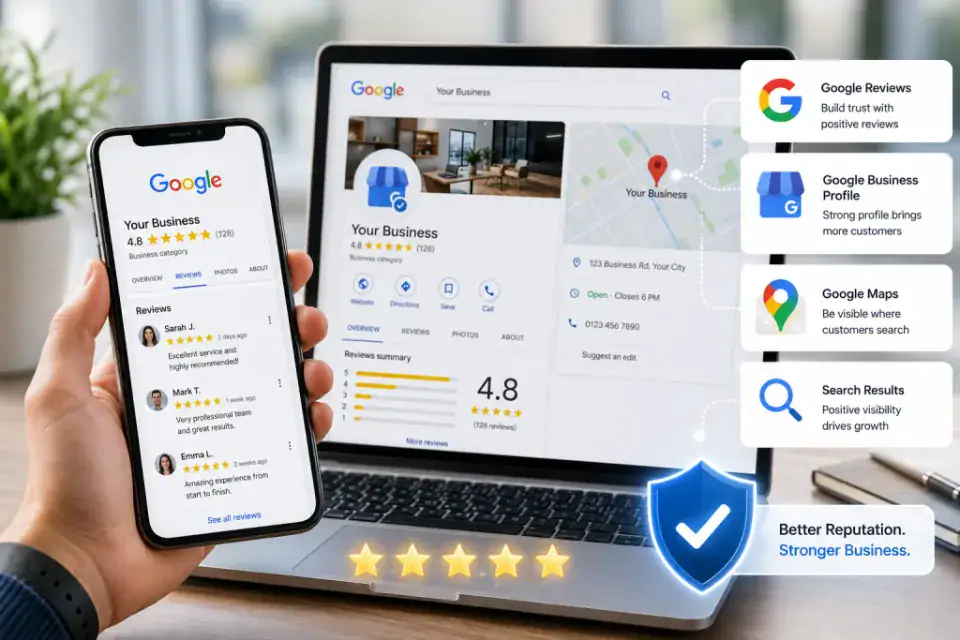
From negative reviews and damaging search results to your Google Business Profile and Maps listing — we help UK businesses and individuals protect, repair and rebuild how they appear on Google, ethically and always within Google’s own policies.
Google Reputation Management matters more than any other platform because Google is where the judgement happens. Whatever someone hears about you elsewhere, they verify it with a search, and the star rating beside your business profile plus the first page of results is what they act on. Our approach is evidence-led: we report reviews that genuinely breach Google’s policies, correct or claim inaccurate business profiles, and build authoritative coverage that displaces damaging results. Google publishes its prohibited and restricted content policy openly, and every report we file cites the specific clause it breaches. See how this fits alongside our wider work on our full list of services.
Trusted by SMEs, professional practices, corporate brands, and individual professionals across the UK since 2001.
How We Help With Google Reputation Management
01Negative Google Reviews
We identify reviews that may breach Google’s review policies — fake, spam, competitor-driven or off-topic — and pursue eligible removals, while helping you earn genuine positive reviews. We never promise every review can be removed.
02Google Business Profile
We protect and optimise your Google Business Profile against fake listings, unauthorised edits and damaging Q&A or photos, keeping your most important local listing accurate.
03Google Search Results
Where harmful pages can’t be removed, we suppress them with authoritative, positive content and digital PR so they rank lower and are seen by fewer people.
04Google Maps
We manage map-based reviews and location reputation, and challenge fake, duplicate or misplaced listings that mislead customers.
05Google Images & Knowledge Panel
We address damaging images and inaccurate Knowledge Panel information through the correct Google channels, protecting the first impression people get of your brand.
06Ongoing Google Monitoring
We continuously monitor your Google presence so new reviews, results and listing changes are caught and handled early, before they cause damage.
From First Contact To Reputation Recovery
A structured, four-step process built to move from initial consultation to a clear, ethical reputation strategy.
Free Consultation & Audit
We review your current search results, reviews and online mentions to understand the full picture and identify what’s driving the issue.
Strategy & Eligibility Assessment
We assess which content may qualify for removal under platform policies or UK law, and design a tailored strategy combining removal, suppression and content development.
Action: Removal, Suppression & Monitoring
We submit the appropriate reports, begin suppression and digital PR work where needed, and set up ongoing monitoring.
Reputation Recovery & Ongoing Protection
We track results, adjust strategy as needed, and keep monitoring your online reputation so new issues are caught early.
Google Reputation — Frequently Asked Questions
Can you remove a negative Google review?
Not every review can be removed. Google only removes reviews that breach its policies — such as fake, spam, off-topic, conflict-of-interest or offensive content. We assess each review and, where it qualifies, report it through the correct channels. We never guarantee removal, as the final decision always rests with Google.
How long does Google review removal take?
It varies. Some clearly policy-breaching reviews are actioned within a few days; others take weeks or need escalation. We keep you updated throughout and never promise a fixed timeframe.
Can you remove a result from Google search?
In some cases yes — for example under the UK ‘right to be forgotten’, or where content is unlawful. Where removal isn’t possible, we suppress harmful results by promoting positive, authoritative content so they appear lower. We don’t guarantee removal of any specific result.
Can you delete fake reviews left by competitors?
If a review breaches Google’s policies — including fake or competitor-driven reviews — we can report it for removal. Google reviews the evidence and makes the final decision, so we assess eligibility honestly before acting.
Can you help improve my Google star rating?
Yes. Alongside challenging policy-breaching reviews, we help you ethically generate genuine positive reviews from real customers, which is the most sustainable way to improve your rating.
What is Google reputation management?
It’s the practice of monitoring, protecting and improving how your business or name appears across Google — including reviews, your Business Profile, Maps, search results and images — using ethical, policy-compliant methods.
Is Google reputation management legal and safe?
Yes. We work strictly within Google’s policies and UK law. We never use fake reviews, false legal claims or manipulative tactics that could put your account or reputation at risk.
How much does Google reputation management cost?
It depends on the scale and complexity of your situation. We start with a free consultation and audit, then provide a tailored, no-obligation proposal.
How long does a Google review removal take?
Most reports receive a decision within three to fourteen days. Where the first report is declined but the breach is clear, we escalate, and escalations typically add a further two to three weeks. We tell you at the outset which category each review falls into so the timeline is realistic.
Can you remove a negative result from Google Search itself?
Only where there is a lawful basis, such as content that breaches Google’s removal policies or personal data covered by your right to erasure. Journalism and fair comment stay. Where removal is not available, we suppress the result by building stronger, more relevant coverage that ranks above it.

Take Control of Your Google Reputation
Whether you’re dealing with a damaging review, a harmful search result or a compromised Business Profile, we’ll assess your situation honestly and show you what’s realistically achievable. Book your free Google reputation review today.
Request a Free Google Reputation ReviewGoogle Reputation Management · United Press
What does Google reputation management actually cover across search, reviews and Maps?
Google is rarely a single surface. When someone types your name or brand, they encounter a blend of Google Search results, Google Business Profile reviews, Google Maps listings, autocomplete predictions and, for established names, a Knowledge Panel. Effective Google reputation management in the UK treats all of these as one connected ecosystem rather than a list of unrelated problems, because a single damaging article or a cluster of unfair reviews tends to ripple across every surface at once.
Our approach at United Press is to map the full footprint first, establish what Google's own policies and UK law will and will not support, and then combine legitimate removal, ethical suppression and proactive content so that the first page people actually see reflects a fair and accurate picture. Nothing we do relies on manipulation, fake engagement or back-channel tricks; everything is grounded in published policy and demonstrable fact.
Google Business Profile reviews: what Google removes and what it protects
Your Google Business Profile is often the most visible and volatile part of your reputation, and a run of 1-star reviews can distort the star rating that customers judge you by in seconds. Google does not remove reviews simply because they are negative or commercially inconvenient, and it is important to be honest about that. What Google will act on are reviews that breach its content policies: fake reviews from people who were never customers, reviews containing profanity, hate speech, personal attacks or off-topic rants, spam, conflict-of-interest posts from competitors or former staff, and content that reveals private information. A genuine, policy-compliant complaint about a real experience is protected, and rightly so.
We assess each contested review against the specific policy it appears to breach, assemble the supporting evidence, and submit a structured, well-argued flag through the correct channels rather than mass-reporting in the hope something sticks. Where a review is defamatory in the legal sense rather than merely critical, a different, evidence-led escalation route applies. Alongside contested-review work, we help you build a steady, authentic flow of legitimate feedback so that the profile recovers durably instead of relying on any single takedown.
Negative pages ranking in Google Search results
Some of the most damaging reputation problems are not reviews at all but web pages ranking in Google Search — an old news story, a hostile forum thread, a scraped data-broker profile or a complaints-site entry. Two routes exist, and they are very different. The first is removal, which is only realistic on narrow grounds: content that breaches the host site's own rules, material that is genuinely unlawful or defamatory, or pages that qualify under Google's removal policies (for example doxxing, non-consensual intimate imagery, or certain sensitive personal and financial data). Google will not de-index lawful, accurate journalism simply because it is unflattering.
The second route — and the one that resolves the majority of cases — is ethical suppression through digital PR. Because most people never look beyond the first page, we build and earn genuinely authoritative, accurate content that Google ranks above the problem page: owned profiles, credible editorial coverage, expert commentary and structured assets that legitimately outperform the negative result over time. This is not about hiding the truth; it is about ensuring an outdated or one-sided item no longer defines a fair search result.
Suppression works because Google rewards relevance, authority and freshness. A ten-year-old article with few inbound links is far easier to displace than a recent, widely cited story, and the honest answer for any given case depends on how entrenched the negative page is and how much accurate material already exists about you. We prioritise the search terms that matter most — usually your exact name or brand — and concentrate durable, well-sourced content around them, so improvements hold rather than fading the moment activity slows. Where a page qualifies for genuine removal on legal or policy grounds, we pursue that in parallel; the two routes are complementary rather than mutually exclusive.
Google Maps listings and location-based reputation
For any business with a physical or service-area presence, Google Maps is where reputation meets footfall. Problems here include duplicate or hijacked listings, incorrect categories or opening hours, spam pins created by bad actors, and review clusters that behave differently on Maps than they do in the main Business Profile view. We audit your Maps presence for accuracy and policy compliance, resolve duplicate and unauthorised listings through Google's verification process, and correct the structured data that feeds both Maps and local search. A clean, verified, accurate listing is itself a reputation asset, and it strengthens the credibility signals Google uses when deciding what to show. Because Maps reviews and photos are contributed by the public, we also monitor for policy-breaching content — spam pins, fake check-ins and off-topic or malicious posts — and handle each through the same evidence-led process we apply to Business Profile reviews, so your local presence stays both accurate and fairly represented.
Google autocomplete, related searches and the Knowledge Panel
Google autocomplete is algorithmic, not editorial. Those predictions are generated from real search volume, freshness and web content, filtered by Google's policies — which means a damaging suggestion usually reflects a pattern of searches rather than an opinion Google holds. Google will remove predictions that breach its policies, such as those that are defamatory in context, sexually explicit, hateful or that expose sensitive personal information, and these can be reported through the correct channels with proper justification. For predictions that do not breach policy, the only legitimate path is to change the underlying search behaviour over time by building positive visibility and fresh, genuine activity around your name. We are candid that no one can pay Google to delete a suggestion, and any service claiming a secret shortcut should be treated with suspicion.
The Knowledge Panel — the profile box that can appear beside search results for notable people, organisations and brands — is a separate discipline. Inaccuracies there often stem from the data sources Google draws on, so correction means fixing the underlying signals and, where you are eligible, claiming and verifying the entity so suggested edits carry weight. Done properly, an accurate Knowledge Panel becomes one of the strongest first-impression assets you can hold on Google.
How AI answer engines change Google reputation management
People increasingly ask questions of AI systems rather than scrolling a results page, and those systems summarise the web in their own words. ChatGPT, Google Gemini, Perplexity, Microsoft Copilot, Claude and Grok all draw on public sources — including the Google surfaces above — to generate answers about you, and they can repeat outdated or one-sided material as though it were settled fact. Because these engines favour authoritative, consistent, well-structured information, the same disciplined work that improves your Google footprint also improves how AI describes you. We help ensure the accurate, credible sources these models rely on are the ones most likely to be cited, so an old story or a distorted claim is far less likely to become the summary a prospect reads first.
Who this helps across the UK
We work with UK businesses, professionals, executives and public figures who need their Google presence to reflect reality rather than a single bad moment — from local firms defending a Business Profile against unfair reviews, to directors facing a legacy news article, to organisations correcting an inaccurate Knowledge Panel. As UK-based reputation specialists, United Press applies only ethical, policy-based methods, is honest about what Google will and will not remove, and focuses on outcomes that hold up over the long term rather than quick fixes that unravel.
Google reputation management: frequently asked questions
Can Google reviews be removed?
Google removes reviews that breach its content policies — fake reviews from non-customers, spam, hate speech, personal attacks, off-topic content, conflict-of-interest posts and private information — but it will not remove a genuine, policy-compliant review simply for being negative. We assess each contested review against the specific policy it breaches, gather evidence and submit a structured flag through the correct channel.
Can you remove negative pages from Google Search results?
Sometimes. Removal is realistic where content is unlawful, genuinely defamatory, breaches the host site's rules, or qualifies under Google's removal policies. Where removal is not available, we use ethical suppression through digital PR to rank accurate, authoritative content above the problem page, since most people never look beyond the first page.
Will Google remove a negative autocomplete suggestion?
Google removes autocomplete predictions that breach its policies, such as those that are defamatory in context, hateful, sexually explicit or that expose sensitive personal data, and these can be reported with proper justification. For predictions that do not breach policy, the only legitimate route is to change the underlying search patterns over time. No one can pay Google to delete a suggestion.
How is this different from a Google review removal service?
Review removal addresses only your Business Profile reviews. Google reputation management is broader: it covers reviews plus negative pages in Search results, Google Maps listings, autocomplete and related searches, and the Knowledge Panel, combining removal where possible with ethical suppression and proactive content across every Google surface.
Can a Knowledge Panel be corrected?
Yes, in most cases. Inaccuracies usually come from the data sources Google draws on, so correction means fixing those underlying signals and, where you are eligible, claiming and verifying the entity so your suggested edits carry proper weight. An accurate Knowledge Panel becomes a strong first-impression asset.
Are your methods ethical and compliant with Google's policies?
Yes. Everything we do is grounded in Google's published policies and UK law. We do not use fake reviews, manipulation or back-channel tricks, and we are honest about what Google will and will not remove. Where removal is not possible, we rely on legitimate content and digital PR to present a fair and accurate picture.