

How to Get Press Coverage for Your Small Business in the UK: A 10-Step Guide for 2026
You do not need a famous name or a big launch to get into the papers. Journalists cover small businesses every day: the bakery that beat a supermarket, the plumber with a warning for homeowners, the founder who spotted a trend first. This guide shows you how to find your story, reach the right journalist and turn one article into lasting trust.
- Is it new, or new to this audience?
- Does it affect real people in a town, trade or group?
- Is there a number, a first, or a surprise?
- Is there a person with a story behind it?
- Does it link to something already in the news?
- Could you show it in a photo?
How do you get press coverage for a small business?
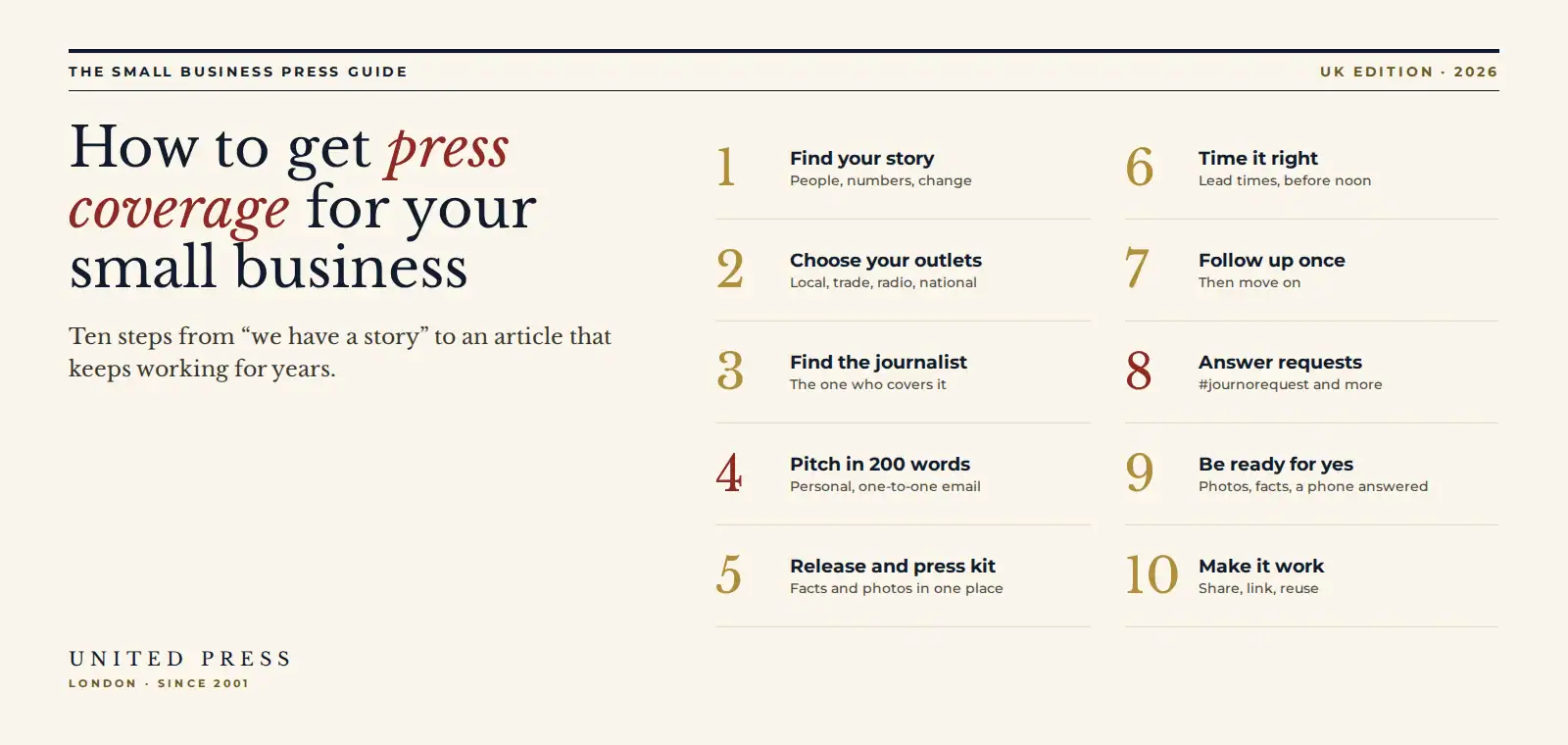
You get press coverage by giving a journalist a story their readers will care about, at the right time, in a short and personal email. Advertising buys space; press coverage is earned, which is why people trust it. For a small business in the UK, that comes down to ten steps:
- Find a story journalists want, not an advert for your business.
- Choose the outlets your customers actually read, watch or listen to.
- Find the right journalist at each one.
- Write a short, personal pitch under 200 words.
- Prepare a press release and a simple press kit.
- Send it at the right time, with the right lead time.
- Follow up once, politely, then move on.
- Answer journalist requests for expert comment.
- Be ready when a journalist says yes.
- Make every piece of coverage work for months afterwards.
Most small businesses that never get coverage are not short of stories. They are pitching the wrong thing (a product announcement), to the wrong person (a general inbox), in the wrong way (a long press release with no personal note). Fix those three and your chances change completely.
This guide is written for UK small businesses, sole traders and start-ups, with UK newspapers, BBC Local Radio, trade magazines and UK journalist request services in mind. The same method works for businesses anywhere in the world.
What has changed since 2014 (and what has not)
Much of the advice small businesses find online was written a decade ago, when Twitter was the place to meet journalists and AI search did not exist. The fundamentals still hold: know your audience, research your journalist, leave your ego at the door. But how coverage is found, used and valued has shifted.
| Then | Now, in 2026 | What it means for you |
|---|---|---|
| Journalists found sources on Twitter | LinkedIn is the most-used platform by journalists worldwide, and requests also run through services such as ResponseSource and Qwoted | Keep your LinkedIn profile current and watch request services daily |
| Long press releases sent to everyone | Most journalists prefer a 1:1 email under 200 words | Pitch one person at a time, briefly |
| Coverage meant a cutting for the wall | Coverage ranks on Google and is read by ChatGPT, Gemini and other AI tools | One article can bring customers for years |
| Big newsrooms with time to research | Smaller teams, more pressure, more pitches | Make it easy: facts, photos and a ready spokesperson |
| Print was the prize | Online articles, newsletters, podcasts and local radio all count | Aim wider than the newspaper |
Why press coverage still matters for a small business
Advertising tells people you are good. Press coverage means someone independent agrees. For a small business without a household name, that independent voice does three jobs at once:
- Trust. “As featured in” the local paper or a respected trade title reassures a customer who has never heard of you.
- Search. News sites are trusted by Google. An article that names and links to you helps people find you, and often ranks for your name.
- AI answers. When someone asks ChatGPT for “the best florist in Bath”, it leans on articles and lists that name businesses. We explain this in our guide to how to get ChatGPT to recommend your business.
And the door is open. Journalists rely on the people who pitch them far more than most business owners realise:
Sources: Muck Rack, State of Journalism 2026 (first three figures) and Cision, State of the Media 2025, a survey of more than 3,000 journalists in 19 markets.
The same Cision study found 86% of journalists will reject a pitch that is not relevant to their beat or audience. That one number explains most failed pitches, and it is why the steps below focus so closely on choosing the right story and the right person.
12 story angles any small business can use
“We have launched a new website” is not a story. “We are 10 years old” rarely is, on its own. Journalists need a reason their readers will care today. These are the angles that most often turn a small business into a news story. The examples are illustrations, not real clients.
Original data
Survey your customers or crunch your own numbers.
“Bristol dog groomer: 4 in 10 owners now book weekly”Expert warning or tip
Share knowledge that protects or helps people.
“Roofer’s winter warning for homeowners with flat roofs”Human story
The person behind the business, and why they started.
“Former nurse opens Leeds café employing carers”Local first
The first, only or biggest of its kind in the area.
“Norwich’s first zero-waste refill van hits the road”Jobs and growth
New roles, new premises, expansion, exports.
“Cardiff software firm creates 15 jobs after US deal”Reaction to news
Your view on a new law, a policy change or a trend.
“What the new rules mean for Kent hairdressers”Seasonal hook
Christmas, summer, back to school, awareness days.
“Manchester toy shop’s top picks under the tree”Community and charity
A fundraiser, partnership or volunteering effort.
“Bakery donates 1,000 loaves to Hull food bank”Award or milestone
Wins, shortlists and records, with context.
“Two-person studio shortlisted against national brands”Contrarian opinion
A well-argued view that challenges the norm.
“Why this accountant tells clients to stop working weekends”Behind the scenes
How something is made, a day in the life, a rare skill.
“The last clockmaker in the Cotswolds”Customer impact
A real result for a real customer, with permission.
“How a village shop survived a bypass”Notice that most of these are not about what you sell. They are about people, places, numbers and change. Your business is the source of the story, not the subject of an advert.
Find a story journalists actually want
Start with the six-question test at the top of this page. Then make a list of every possible story in your business over the next three months. Most small businesses find five to ten once they look properly.
- Look for numbers. Bookings, orders, enquiries, waiting lists, customer surveys. A simple survey of 200 customers can produce a headline.
- Look for people. Your founder story, a long-serving employee, an apprentice, an unusual customer.
- Look for timing. What is in the news this month that you know more about than most?
- Look for the local angle. What does your story mean for your town or county?
Then ask the hardest question: who, apart from me, cares? If the honest answer is “my customers might”, it may suit your newsletter better than a newspaper. If it is “anyone in Sheffield who owns a home”, you have a story.
Choose the outlets your customers read, watch and listen to
A small business rarely needs the front page of a national newspaper. It needs coverage where its customers are. A wedding photographer in Devon gains more from a regional wedding magazine than from a national tabloid. A software company gains more from its trade press than from the evening news.
| Outlet type | What they want | Typical lead time | Best for |
|---|---|---|---|
| Local and regional newspapers (print and online) | Local people, jobs, openings, community stories, local data | Days to two weeks | Shops, trades, restaurants, clinics, local services |
| BBC Local Radio and commercial radio | Lively guests, local issues, expert comment | Same day to a week | Confident speakers with a local angle |
| Regional TV news | Strong visuals, human stories, local impact | Same day to a few days | Stories you can film |
| Trade and industry press | Expertise, data, contracts, innovation, opinion | One to eight weeks | B2B firms and specialists |
| Consumer magazines | Products, trends, gift guides, real-life stories | Three to six months | Products, lifestyle, food, fashion, home |
| National newspapers and websites | Wider trends, strong data, expert comment, human stories | Same day to a few weeks | Data-led stories and experts |
| Podcasts and newsletters | Interesting guests and practical knowledge | Two to eight weeks | Founders and experts in a niche |
Write down 10 to 20 outlets across two or three of these groups. Read, watch or listen to each one before you pitch it, so you know the sections, the tone and the journalists. Our media list shows the range of UK and international outlets where a story can appear.
Find the right journalist at each outlet
Pitching a newsroom’s general inbox is like posting a letter to “The Manager”. Find the person who covers your subject.
- Read the bylines. Search the outlet’s website for your topic and note who wrote similar stories in the last six months.
- Check their profile. Most journalists list their beat and preferred contact method on LinkedIn, X, Bluesky or their author page.
- Find the email. Many outlets use a standard format such as firstname.lastname@ and some journalists publish theirs. For local papers and BBC Local Radio, the newsdesk or programme email is fine.
- Note what they wrote. Mentioning a recent article, briefly and honestly, shows you are not sending the same email to everyone.
Media databases such as Muck Rack, Cision and Vuelio speed this up for larger campaigns, but for most small businesses a careful hour of reading works just as well. For ideas, see our list of UK journalists to pitch.
Before you contact anyone, read our guide on how to get a journalist’s attention. The same Cision study found 85% of journalists say the best way to build a relationship is a simple introductory email, even without a story to pitch.
Write a pitch that gets read
A pitch is a short, personal email that offers a story. It is not your press release pasted into an email. Journalists receive many pitches a day and decide in seconds, so the subject line and first two sentences do most of the work.
Hi Sarah,
I enjoyed your piece on Kirkgate Market’s new traders last week. I thought this might suit your business pages.
We surveyed 412 customers across our two Leeds shops this month, and one in three now buy most of their bread from independent bakers, up from one in five when we opened in 2021. Several told us it is because supermarket bread “goes off in two days”.
I’m happy to share the full figures, and our head baker, who left a corporate job to start the business, is available for interview this week. We have photos of the shop and the team ready to send.
Would this be of interest?
Thanks,
Tom Hartley, founder, Hartley’s Bakery (example business)
07700 900123
- A subject line that reads like a headline
- A personal, specific opening
- The story and the number in the first lines
- What you can offer: data, interview, photos
- About 150 words in total
- A clear, easy question to finish
Keep it short. In Muck Rack’s 2026 survey, 69% of journalists preferred pitches under 200 words, and they valued clear relevance to their beat (70%), access to interviewees (58%), original data (40%) and high-resolution images (37%). Put the press release below your signature or attach it, but never make the journalist open an attachment to find the story. Our PR pitch template and guide on how to pitch a journalist go further.
Prepare a press release and a simple press kit
A press release is the formal version of your story, written so a journalist can lift facts and quotes from it. You do not need one for every pitch, but for announcements, data and events it saves the journalist time, and time is what gets you covered.
- Headline: the news in under 12 words.
- First paragraph: who, what, where, when and why, in two or three sentences.
- Body: the detail, the numbers and one or two quotes that sound like a real person.
- Notes to editors: a short paragraph about your business, how the data was collected, and contact details.
- Length: usually 300 to 500 words.
Follow our step-by-step guide to writing a press release in the UK, or start from our free press release template.
Your press kit checklist
When a journalist is interested, they want everything quickly, often within the hour. Keep these in one folder or on a press page on your website:
- High-resolution photos of you, your team and your premises or products
- A short and a long description of the business
- Founder or spokesperson biography
- Key facts: founding year, location, number of staff, customers served
- Logo in high resolution
- Previous coverage, if you have any
- Contact details, including a mobile number that is answered
- Any data, with a note on how it was gathered
Send it at the right time, with the right lead time
A good story sent too late is a missed story. Two kinds of timing matter.
Lead time
Monthly magazines plan three to six months ahead, so Christmas gift guides are often put together in summer. Weekly papers and trade titles usually work one to four weeks ahead. Daily papers, news websites and radio can move within hours, which is ideal for reaction and expert comment. Plan your seasonal stories backwards from the date they need to appear.
Time of day
According to Muck Rack’s 2026 survey, 78% of journalists prefer to receive pitches before noon. Half do not mind which day, but of those who do, Monday was the most popular choice at 18%. Avoid Friday afternoons and the hour before a newspaper’s deadline. For more detail, see our guide to the best time to send a press release.
Follow up once, politely, then move on
Silence is normal. Journalists cannot reply to every pitch, and no reply rarely means no forever. A single short follow-up, two or three working days later for news and a week later for features, is acceptable. Add something new if you can, such as a fresh number, a photo or a date when your spokesperson is free.
- Do: reply in the same email thread so they can see the original.
- Do: keep it to two or three lines.
- Don’t: call to ask “did you get my email?”
- Don’t: follow up more than once on the same story.
If there is still no reply, offer the story to the next journalist on your list. Keep a simple spreadsheet of who you contacted, when, and what happened, so you build a picture of who responds to which kinds of story.
Answer journalist requests for expert comment
Pitching is only half of it. Every day, journalists publicly ask for experts, case studies and data for stories they are already writing. Answering these requests is one of the quickest routes to coverage for a small business, because the journalist has already decided to write the story.
| Where to find requests | How it works | Good for |
|---|---|---|
| #journorequest on X, Bluesky and LinkedIn | Journalists post requests with the hashtag; reply or email them directly | UK consumer, business and lifestyle stories |
| ResponseSource (part of Vuelio) | A long-running UK service that emails journalist enquiries to subscribers by topic | UK national, regional and trade press |
| Qwoted | Journalists post requests; experts reply through the platform | Business, finance and tech |
| Featured.com and HARO | Featured bought HARO (Help a Reporter Out) in 2025 and runs expert Q&A requests | Expert quotes, mostly US and online titles |
| SourceBottle | Email alerts of media and blogger call-outs | Lifestyle, products and small businesses |
| Your own network | Local journalists, chambers of commerce, trade bodies and business groups | Local and sector stories |
The rules for replying are strict. Answer only requests you are qualified for, reply fast (often within the hour), answer the exact question in a few quotable sentences, and include your name, job title, business, location and a photo link. We compare the options in more depth in the best HARO alternatives.
Be ready when a journalist says yes
The moment a journalist replies is when many small businesses lose the story, because nobody answers the phone or the photos take three days. Be ready to move the same day.
- Answer quickly. Reply within the hour if you possibly can. Deadlines are often the same day.
- Prepare three key points. Know the three things you most want to say and one example for each.
- Be accurate. Only give numbers you can stand behind, and say “I don’t know, but I’ll find out” if needed.
- Assume everything is on the record. Unless you have agreed otherwise beforehand, anything you say can be quoted.
- Do not ask for copy approval. UK journalists rarely show articles before publication. You can offer to check facts or figures.
- Send what you promised, such as photos, data and names, straight away.
For radio and TV, practise your answers out loud and keep them short. Our media interview service helps business owners prepare for their first interviews.
Make every piece of coverage work for months
An article is not the end of the work. It is something you can use again and again.
- Thank the journalist. A short thank-you email builds a relationship for next time.
- Share it. Post it on LinkedIn, your social channels and your newsletter, and tag the outlet and the journalist.
- Add an “as featured in” section to your website, with links to the articles.
- Use it in sales. Add it to proposals, email signatures and your shop window or counter.
- Keep your details consistent. If the article gets your business name or website wrong, ask politely for a correction.
- Watch AI answers. Coverage on trusted sites is one of the strongest signals AI tools use to describe and recommend a business. See what ChatGPT says about your business to check how it describes you.
Coverage also compounds. A journalist who has written about you once is more likely to call you next time they need a comment, and an article in a local paper often leads to radio, then to trade titles, then to national interest.
How to get your small business in the local newspaper and on local radio
Local media is where most small businesses should start. Local journalists need local stories every day, they are easier to reach, and local readers are often your customers.
- Local and regional papers. Most towns and cities have a daily or weekly title, in print and online. Find the business or news editor’s email on the website’s contact page or in the paper itself, and keep your story firmly local.
- BBC Local Radio and commercial stations. Breakfast and drive-time shows need guests, especially experts who can explain a local issue in plain words. Contact the programme team directly.
- Regional TV. BBC and ITV regional news want stories they can film. Think about the picture before you pitch.
- Community magazines and hyperlocal sites. Parish magazines, village newsletters and local news websites are read closely and are often looking for content.
- Business groups. Chambers of commerce, Federation of Small Businesses branches and local enterprise networks often have newsletters and links to local journalists.
- Local awards. Business awards run by local papers and councils bring coverage at the shortlist, the ceremony and the win.
Use the calendar too. Small Business Saturday UK takes place on the first Saturday of December (5 December in 2026), and local media look for small business stories in the run-up. For more, see our guides to PR for local businesses and getting featured in regional publications.
Trade press: the coverage small businesses overlook
Almost every industry in the UK has its own magazines, websites and newsletters, from builders’ merchants to dentistry, hospitality, logistics and software. Trade journalists are specialists, they need informed sources, and their readers are often exactly the buyers a B2B small business wants to reach.
- Opinion and how-to articles. Many trade titles accept expert contributed articles if they are useful and not salesy.
- Contract wins and case studies, with the client’s permission.
- Data from your own work, such as response times, common faults or changing customer demand.
- Comment on industry news, new rules and trends.
Trade coverage also tends to stay online for years and rank for specialist searches, which makes it particularly valuable for search and AI visibility.
Can a small business get into national newspapers or on the BBC?
Yes, but usually not with a story about the business itself. National journalists cover small businesses when they illustrate something bigger: a trend, a problem, a change in how people live or work. The routes in are:
- Data with national relevance. A well-run survey or your own figures that reveal a trend.
- Expert comment through journalist requests (step 8), where your knowledge fills a gap in a bigger story.
- A strong human story that speaks to something many readers have experienced.
- Coverage that builds. Local stories are often picked up nationally, and national journalists look at regional papers for ideas.
Each national outlet has its own sections and habits. Our guides on how to get featured in The Guardian and how to get featured on the BBC explain how they work.
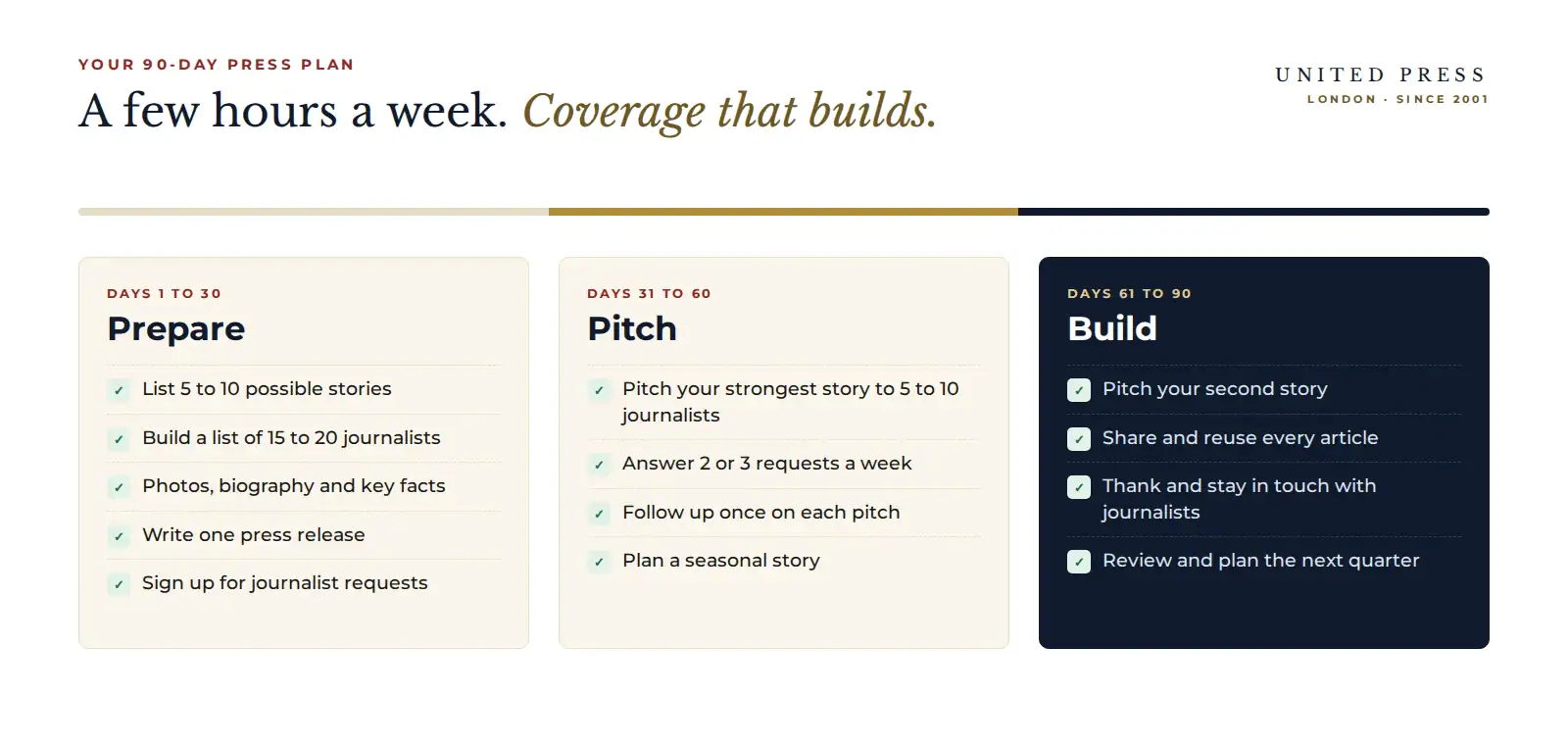
Your 90-day press plan
Press coverage comes from steady effort, not a single big push. This plan suits a small business owner with a few hours a week.
Days 1 to 30Prepare
- List 5 to 10 possible stories
- Build a list of 15 to 20 outlets and journalists
- Prepare photos, biography and key facts
- Write one press release
- Sign up for journalist requests
Days 31 to 60Pitch
- Pitch your strongest story to 5 to 10 journalists
- Answer two or three requests a week
- Follow up once on each pitch
- Start planning a seasonal story
Days 61 to 90Build
- Pitch your second story
- Share and reuse every piece of coverage
- Thank and stay in touch with journalists
- Review what worked and plan the next quarter
Common press mistakes small businesses make
| Mistake | Why it fails | Do this instead |
|---|---|---|
| Pitching a product, not a story | It reads as advertising | Lead with people, numbers or change |
| Sending one email to everyone | 86% of journalists reject irrelevant pitches | Write to one person at a time |
| A long email with an attachment | The story is buried | Under 200 words, story in the first lines |
| No photos | Many stories need a picture to run | Have high-resolution images ready |
| Missing the lead time | Pages are already planned | Work backwards from the publication date |
| Chasing repeatedly | It damages the relationship | Follow up once, then move on |
| Asking to approve the article | UK journalists rarely allow it | Offer to check facts instead |
| Giving up after one try | Coverage builds over time | Pitch regularly with new stories |
Should you do it yourself or get help?
Many small businesses get their first coverage on their own, and this guide is designed to help you do exactly that. Help makes sense when time is short, when you need coverage by a certain date, or when you want to appear in specific publications.
Doing it yourself
- You know your business and story best
- Good for local press and journalist requests
- Takes a few hours a week, every week
- Results can be slow and unpredictable
Working with United Press
- Stories shaped and written by experienced editors
- Press release distribution to named UK and international news sites
- Guaranteed publication, live within 14 days of approval or a 100% refund
- Features in titles such as Forbes through get published
Our small business PR team builds bespoke plans around your story and goals; there are no fixed packages. We also explain the difference between editorial and sponsored content in earned vs sponsored coverage, so you always know what you are getting.
Press coverage for small businesses: FAQ
How do I get press coverage for my small business?
Find a story journalists' readers will care about, such as data, a human story, a local first or expert advice, then send a short personal email to the one journalist who covers that subject. Have photos and facts ready, follow up once, answer journalist requests for expert comment, and keep pitching new stories over time.
How do I get free publicity for my small business?
Press coverage is earned rather than bought, so it is the main form of free publicity. Pitch stories to local papers, BBC Local Radio and trade magazines, answer journalist requests such as #journorequest, enter local business awards, take part in Small Business Saturday UK, and share every piece of coverage on your website and social channels.
How do you get your business on the news?
Offer a story, not an advert. News teams cover businesses when they show something bigger: a trend, a local change, a problem solved or a human story. Contact the newsdesk or the reporter who covers your area, keep your email short, and make sure someone can give an interview and send photos the same day.
How do I get my business in the local newspaper?
Read the paper to see what it covers, then email the news or business editor with a clearly local story: new jobs, an opening, a community project, local data or a person behind the business. Include a high-resolution photo and a phone number that is answered, and send it in good time before the paper's deadline.
How can I pitch a story to BBC News?
Start local. BBC Local Radio stations and regional TV newsrooms such as BBC Look North or BBC Points West are far more open to small business stories than national programmes. Contact the specific programme team with a short, clear story and an available spokesperson. National BBC journalists also use journalist request hashtags and read regional coverage for ideas.
How do I contact a journalist for a story?
Find the journalist who writes about your subject from their recent articles, then check their author page, LinkedIn or social profiles for their preferred contact method. Email is preferred by most: Muck Rack's 2026 survey found 62% of journalists prefer a one-to-one email pitch. Avoid calling to chase.
Do I need a press release to get press coverage?
Not always. A short pitch email is often enough for expert comment and simple stories. A press release helps for announcements, data and events because it gives the journalist facts and quotes in one place. Cision's 2025 survey found 72% of journalists rate press releases as the most useful thing PR teams provide.
How long should a pitch to a journalist be?
Under 200 words. In Muck Rack's 2026 survey, 69% of journalists said they prefer pitches under 200 words. Put the story and the key number in the first two sentences and say what you can offer, such as data, an interview or photos.
When is the best time to pitch a journalist?
Before noon on a weekday. Muck Rack found 78% of journalists prefer pitches before midday. Lead time matters more: monthly magazines plan three to six months ahead, weekly titles one to four weeks ahead, and daily news and radio can move within hours.
How long does it take to get press coverage?
Answering journalist requests can bring coverage within days. A planned pitch to local or trade press usually takes two to eight weeks from first email to publication. Most small businesses following a steady plan see their first coverage within the first two months.
What should I do if a journalist does not reply?
Send one short, polite follow-up in the same email thread, two or three working days later for news or a week later for features, ideally with something new. If there is still no reply, offer the story to the next journalist on your list.
Can I see an article before it is published?
Usually not. UK journalists rarely allow sources to approve articles, to protect their independence. You can offer to check facts, figures and the spelling of names, and you can ask for a correction afterwards if something is factually wrong.
Is advertorial or sponsored content the same as press coverage?
No. Press coverage is editorial: the journalist chooses to write about you. Advertorial and sponsored content are arranged commercially and are usually labelled. Both can have a place, but readers, search engines and AI tools give independent editorial coverage more weight.
Do I need a PR agency to get press coverage?
No. Many small businesses get coverage themselves by following the steps in this guide. An agency helps when you are short of time, need coverage by a certain date, want specific publications, or want an experienced editor to shape and write your story.
Does press coverage help SEO and AI search?
Yes. Articles on trusted news sites often rank on Google, can link to your website, and are among the sources ChatGPT, Gemini and other AI assistants read when they describe or recommend a business.
Do you help small businesses outside the UK?
Yes. We are based in London and the UK is our main focus, but we help businesses and founders worldwide get coverage in UK and international publications.
Every small business has a story. Yours deserves to be told.
You started with an idea, a risk and a lot of late nights. Along the way you have solved problems, served people and learned things most of your town does not know. That is news. Somewhere a journalist is looking for exactly the person you are, with exactly what you know. When your story is told well, it does not just reach readers; it tells every future customer that you are real, trusted and worth choosing.