

How to Get a News Article Taken Down About You (2026 Article and Link Removal Guide)
An old story, a wrong headline or a case that was dropped years ago can still sit on the first page when people search your name. Here is how to get a news article taken down, removed from Google, or pushed out of sight, step by step.
How to get a news article taken down: the short answer
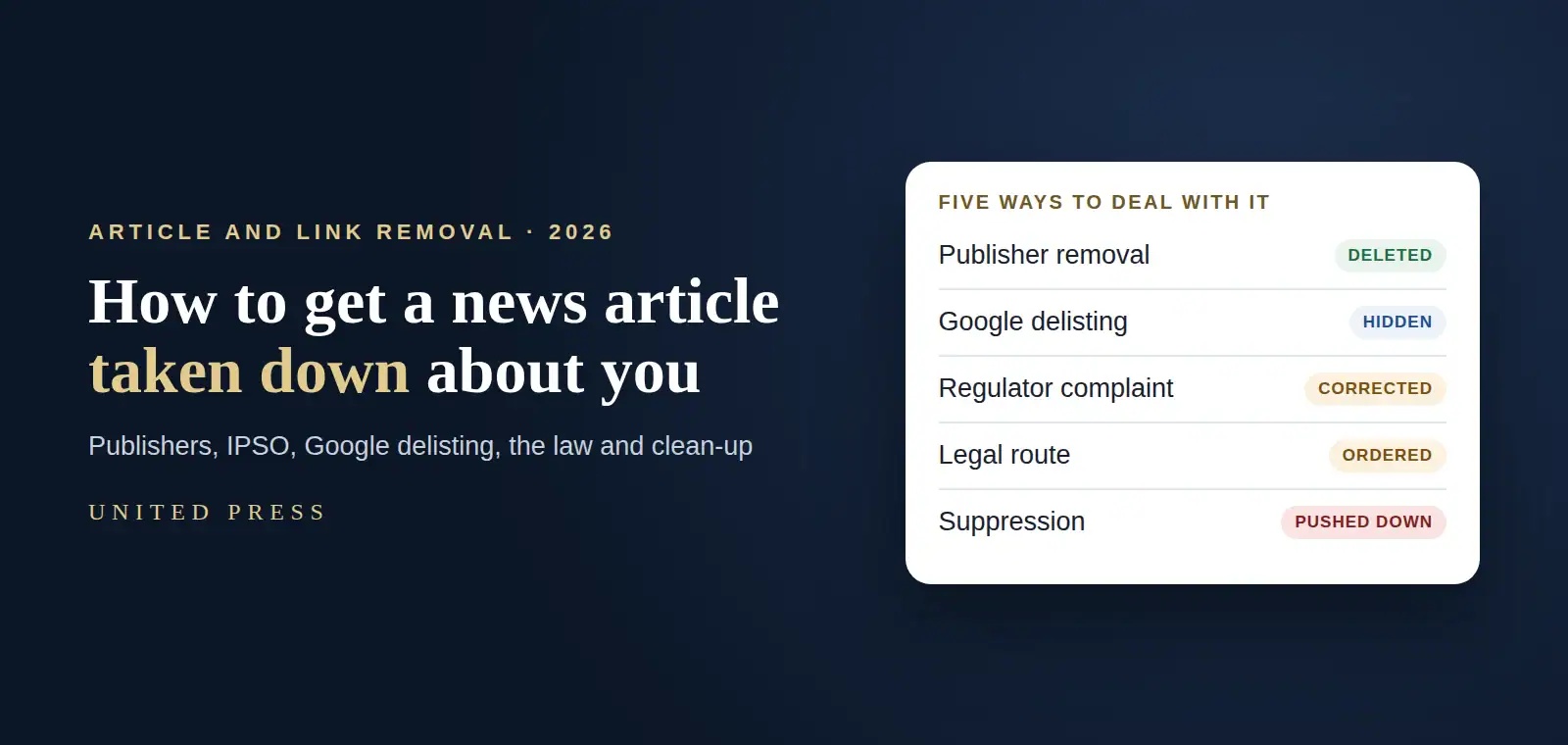
To get a news article taken down, ask the publisher’s editor to remove, update or anonymise it, with a clear reason and evidence. If they refuse, complain to the press regulator, ask Google and Bing to delist it from searches on your name, and use legal routes if it is false or private. Then remove every copy and check AI answers.
- Only the publisher can delete the article itself
- Search engines can hide it from searches on your name
- Old, inaccurate or private stories have the strongest case
- Calm, evidence-based requests work far better than threats
We remove news articles and links from Google, not only the ones that break the rules
Google’s forms and press regulators only help in narrow cases. United Press goes further, working with publishers, site owners, platforms and search engines to take down the articles and links that hurt your name.
- Old news stories and court reports
- Articles about dropped charges
- Copies on other news and blog sites
- Links in Google, Bing and AI answers
Why a news article is hard to remove completely, and the 4 steps that work
Getting a news article wiped from the whole internet is difficult. Journalists and publishers are protected by freedom of expression and press freedom, especially when the facts in the article are accurate. But you still have real options: the article can be deleted, hidden from search engines, or pushed so far down that people stop seeing it.
Step 1: Contact the publisher directly
- Reach out politely. Find the contact details of the journalist, the news editor or the publication’s legal or compliance team.
- Make the human case. Explain calmly how the article is harming your work, your wellbeing or your family’s safety today.
- Point out factual errors. If anything is false or misleading, show exactly what is wrong and attach proof.
- Offer alternatives. If they will not delete it, ask them to add the new outcome (such as dropped charges or an acquittal), remove your name, or stop search engines indexing the page.
Step 2: Ask search engines to delist it
- Hidden, not deleted. If the publisher refuses, ask Google and Bing to drop the link from their results. The story stays on the site, but people searching your name stop finding it.
- Right to be forgotten. In the UK and Europe, data protection law lets you ask for delisting when information is outdated, irrelevant or no longer in the public interest.
- Personal data. If the article or its snippet shows your phone number, home address or sensitive health or financial details, use the search engine’s personal information removal tools.
- Expert help. United Press checks every URL, handles publisher requests and delisting for you, with a full refund if an article or link we take on is not removed.
Step 3: Speak to a defamation or media lawyer
- When it is false or harmful. If the article is untrue, malicious or defamatory and causes serious harm, take legal advice.
- A formal letter carries weight. A legal letter from a solicitor gets more attention from a publisher’s legal team than a personal email.
- Spent convictions. Rehabilitation laws, such as the UK’s Rehabilitation of Offenders Act 1974, strengthen requests to remove or delist old criminal cases, especially with search engines.
Step 4: Push the article down
- Build positive assets. Launch a clean personal website and keep your professional profiles, portfolio pages and public social media accounts active.
- Publish good content often. Professional articles, press releases, interviews and community work give search engines better pages to show on page one, pushing the negative story to page two or beyond.
- Get trusted coverage. United Press secures guaranteed placements in respected publications, live within 14 days of approval or a 100% refund.
Not sure which path is right for you? Tell us three things: which country or region you live in, whether the facts in the article are true or false, and whether it is about a past arrest or court case, or a business or personal dispute. We will tell you honestly which route will work best. Tell us about your article.
Can you get a news article taken down? Removal vs delisting vs suppression
“Taking down” an article can mean three different things. Knowing which one you need saves weeks.
Taken down at the source
The publisher deletes the article, or removes your name from it. This is the only way to make the article itself disappear from the website.
Hidden from search results
Google or Bing stops showing the page when people search your name. The article stays on the website but becomes much harder to find.
Pushed down the results
Positive content outranks the article, so it drops off the first page. It is still online and still findable, just much less visible.
Reasons that get a news article removed, and the best route for each
Publishers, regulators and search engines all ask the same question: why should this come down? These are the reasons that work best.
| Your reason | Best route |
|---|---|
| The article is inaccurate or misleading | Ask the publisher for a correction or removal, then complain to the press regulator |
| It is old and no longer relevant | Ask the publisher to remove or anonymise it, and ask Google to delist it |
| You were charged but later cleared or the case was dropped | Ask the publisher to update or remove it, then request delisting |
| It mentions a conviction that is now spent | Request delisting from Google and Bing, citing the Rehabilitation of Offenders Act 1974 |
| It names you as a child or a victim | Ask the publisher to anonymise it and complain to the regulator if they refuse |
| It reveals private details such as your address or health | Privacy complaint to the publisher and regulator, plus a data protection request |
| It damages your reputation with false claims | Legal letter on defamation grounds, after advice from a solicitor |
| It uses your photo without permission | Copyright takedown request to the site and to Google |
| It breaks a court order or reporting restriction | Ask the publisher and Google to remove it, citing the order |
If the article is accurate, recent and about a matter of public interest, removal is much harder. In that case, anonymisation, delisting and suppression are usually the realistic goals.
How to get a news article taken down in 8 steps
Find every copy of the article
Search your name and the headline in a private browser window on Google and Bing. Search key phrases in quotation marks to find copies on news aggregators, blogs and social media. Make a list of every URL.
Save evidence
Take dated screenshots of each page and gather anything that proves your case: court outcomes, corrected facts, or proof of harm.
Decide what outcome you want
Full removal, anonymisation, an update or a correction? Asking for a realistic outcome makes a yes more likely.
Contact the publisher’s editor
Write to the editor or readers’ editor, not the reporter. Be brief, calm and specific, and attach your evidence.
Escalate to the press regulator
If the publisher refuses or does not reply, complain to its regulator, such as IPSO or Impress in the UK.
Ask Google and Bing to delist it
Submit a personal information removal request to each search engine for every URL, even if the publisher is still deciding.
Use legal routes where needed
For false, private or data-protection breaches, get advice from a media law solicitor about a formal legal letter.
Clean up copies, caches and AI answers
Ask copy sites to remove their versions, refresh outdated results in Google, and check what AI tools say about you a few weeks later.
How to ask a newspaper to remove an article: what to say
Editors receive many removal requests. The ones that succeed are short, polite and give a clear reason backed by evidence. Here is a simple template you can adapt:

Subject: Request to remove or update an article about [your name]
Dear [Editor’s name],
I am writing about your article “[headline]”, published on [date] at [link].
[One or two sentences on why it should change, for example: the charges against me were dropped on [date], or the article is now [number] years old and I am a private person.]
I have attached [evidence]. I would be grateful if you could remove the article, or if that is not possible, remove my name and photo or add an update with the outcome.
Thank you for considering this. I am happy to discuss it.
[Your name and contact details]
Send it to the editor or readers’ editor, not the reporter, and follow up politely after two weeks if you hear nothing.
What to ask for if the publisher will not delete the article
Publishers often refuse full deletion but agree to smaller changes that still protect you. Ask for these, in this order:
- Remove your nameAnonymise the article so it no longer appears for searches on your name.
- Remove your photoImages are often the most damaging part, and the easiest for editors to remove.
- Add a noindex tagThe article stays on the site but search engines stop showing it.
- Add an updateRecord that charges were dropped, you were cleared or the facts changed.
- Correct the errorFix inaccurate facts, ideally with a correction note.
- Change the headlineA misleading headline is often what people see first in search results.
How to remove a news article from Google search results
Google cannot delete an article from a news website, but it can stop the page showing in its results. There are three main tools:
- Personal information removal (the right to be forgotten). In the UK and Europe, you can ask Google to remove results for searches on your name that are inaccurate, outdated, irrelevant or excessive. You give the URLs, explain why and prove your identity. Google weighs your privacy against the public interest.
- Refresh outdated content. If the publisher has already deleted or changed the article, this tool asks Google to update or drop its old copy and snippet.
- Results about you. Use this to remove results that show your phone number, home address or email.
If Google refuses a right to be forgotten request, you can complain to the Information Commissioner’s Office (ICO), and in some cases go to court. Bing has its own privacy request form, so submit to both.
For a full walk-through of Google’s tools, see our guide to removing your name from Google’s AI search results and our right to be forgotten UK service. For a quick summary of the options, see how to remove a negative article from Google.
Complaining to IPSO or Impress about a news article
Most UK newspapers and magazines are regulated by IPSO, and some outlets are regulated by Impress. Both judge complaints against a code of practice that covers accuracy, privacy, harassment, children and reporting on crime.
- Complain to the publisher first, then to the regulator
- IPSO usually accepts complaints within four months of publication
- For articles still online, IPSO can look at complaints up to 12 months old
- Point to the exact part of the code the article breaks
- Outcomes include corrections, removal of details or a published ruling
- A regulator decision strengthens later Google and legal requests
Legal options: defamation, privacy and data protection
Legal routes are powerful but slow, and a badly judged threat can lead to a follow-up story. Get advice from a media law solicitor first. These are the main UK laws used to remove articles:
| Law | When it helps | Watch out for |
|---|---|---|
| Defamation Act 2013 | The article makes false claims that cause, or are likely to cause, serious harm to your reputation | Claims must usually be brought within one year of publication in England and Wales |
| Misuse of private information | The article reveals private details such as health, relationships or family matters with no public interest | Courts weigh your privacy against freedom of expression |
| UK GDPR and Data Protection Act 2018 | Your personal data is inaccurate, outdated or no longer needed, especially in search results | Publishers can rely on a journalism exemption, so it works best against search engines |
| Rehabilitation of Offenders Act 1974 | The article is about a conviction that is now spent | Serious offences and public roles can still be refused |
| Court orders and reporting restrictions | The article breaks an anonymity order or reporting restriction | You need the order or case details to prove it |
Special cases: arrests, spent convictions, old stories and business articles
Arrest with no conviction
Ask for an update or removal with proof the case was dropped or you were cleared. This is one of the strongest cases for both publishers and Google.
Spent conviction
Request delisting, citing the Rehabilitation of Offenders Act 1974. Publishers may still keep the original court report.
Story from many years ago
Age helps. Old stories about private people are often removed, anonymised or delisted on request.
Article about you as a child
Ask for anonymisation. Codes of practice give extra protection to children.
Article about your business
Ask for corrections or updates to inaccurate or outdated stories. Named people in the business can still request delisting.
Article copied on other sites
Deal with each copy. Once the original is gone, copy sites often remove their versions on request.
How long does it take to get a news article taken down?
| Route | Typical timeline | What decides it |
|---|---|---|
| Publisher removal or update | Days to a few weeks | How strong your reason is and how quickly the editor replies |
| Regulator complaint | Several weeks to a few months | Whether the publisher resolves it first, and how complex the case is |
| Google or Bing delisting | A few weeks | The strength of your reasons and the public interest in the story |
| Refresh outdated content | Days | Whether the publisher has already removed or changed the page |
| Legal route | Months | Whether the publisher agrees after a legal letter or the case goes further |
| Suppression | Weeks to months | How much strong, positive content you publish |
Mistakes that keep a news article online
Editors may refuse, publish your message or write a follow-up story, which spreads the original further.
Comments and social media posts create new pages that keep the story alive in search results.
Removing the original but leaving copies on aggregators and blogs means people can still find it.
Search engines delist page by page. Every version, including mobile and print pages, needs its own request.
It breaks platform rules, can break consumer law and damages trust if discovered.
AI tools can keep repeating a story until their sources update, so check and correct them after removal.
What to do after the news article is removed
- Use Google’s refresh outdated content tool for each removed URL
- Search your name again on Google and Bing a week later
- Recheck copy sites after 30 and 90 days
- Ask ChatGPT and Google’s AI what they say about you
- Set up alerts for your name and common misspellings
- Build positive results so a future story struggles to rank
If AI tools still repeat the story, see how to fix wrong information in ChatGPT.
How to push a negative news article down Google
When an article cannot be removed or delisted, the next best step is to push it off the first page with stronger, positive results about you. Most people never look past the first few results.
Earn coverage in trusted publications
News and business sites rank well for your name. United Press secures guaranteed placements, live within 14 days of approval or a 100% refund.
Complete your public profiles
LinkedIn, company pages, speaker bios and professional directories all rank for name searches.
Publish on your own website
An about page, articles and a press page under your name give Google better results to show.
Keep it up
Suppression works best with steady new content over several months.
See personal reputation management for a full plan.
Get a news article about you taken down with United Press
United Press has protected the reputations of founders, professionals and businesses since 2001. Every plan is bespoke, and we tell you in writing what we will remove before we start.
News article and link removal
We work with publishers, site owners and search engines to remove articles, copies and links about you. Full refund if an article or link we take on is not removed. See news article reputation management.
Google and Bing delisting
We prepare and submit strong right to be forgotten requests and follow them through. See our right to be forgotten service.
Review and post removal
Negative reviews, forum threads and social posts that repeat the story, removed from Google and other platforms.
A better first page
Guaranteed coverage in trusted publications, live within 14 days of approval or a 100% refund, so your name tells the right story.
News article removal: frequently asked questions
How do I get a news article taken down about me?
Start by listing every copy of the story. Then write to the editor with your reason and proof, asking for deletion, an update or your name to be removed. If that fails, go to the press regulator, request delisting from Google and Bing, and take legal advice if the story is untrue or private. United Press can handle the whole process for you.
Can you get a news article removed from the internet?
Yes, but only the publisher can delete the article itself. Search engines can stop it showing for searches on your name, and copies on other sites have to be removed one by one. Most successful cases combine publisher removal, delisting and clean-up of copies.
Can I get a news article about me removed?
Yes, in many cases. Your chances are best when the article is inaccurate, old, about a case that was dropped, about a spent conviction, or reveals private details. Ask the editor first with evidence, then use the press regulator, search engine delisting or legal routes if they say no.
Is it possible to get a news article removed?
It is possible, though not guaranteed through the publisher alone. Editors decide whether to delete their own reporting, but even when they refuse, you can often get your name removed, the article updated, or the page hidden from Google and Bing searches on your name.
Will a newspaper remove an article if I ask?
Sometimes. Publishers rarely delete accurate, recent reporting, but many will remove or anonymise old stories about private people, correct errors, or add an update when a case is dropped. A calm, evidence-based request to the editor works far better than a threat.
How do I remove a news article from Google search results?
If the article has already been deleted or changed, use Google’s tool for refreshing outdated content. If it is still live, use Google’s personal information removal form (the right to be forgotten in the UK and Europe), giving the URLs, your reasons and proof of identity. Google can refuse where public interest is strong.
How do I get a news article removed from Google?
Google removes results rather than articles. If the publisher has taken the article down, ask Google to refresh the outdated result. If it is still live, send a personal information removal request with each URL and your reasons. If Google says no, you can complain to the ICO, or ask United Press to handle it for you.
Can I get an old news article removed?
Old articles are often the easiest to remove. The older and less relevant the story, and the more private your role in it, the stronger your case for removal, anonymisation or delisting.
Can I remove a news article about my arrest if I was not convicted?
Yes, there is a strong case. Ask the publisher to update the article with the outcome or remove it, and ask Google to delist it, explaining that the charges were dropped or you were cleared. Provide documents that prove the outcome.
Can a spent conviction be removed from Google?
Often, yes. Under the Rehabilitation of Offenders Act 1974, a spent conviction usually does not need to be disclosed for most jobs, which is a strong argument in a delisting request. Google and the Information Commissioner’s Office still weigh the public interest, so serious cases can be refused.
What is the right to be forgotten for news articles?
In the UK and Europe, you can ask search engines to remove results about you that are inaccurate, outdated, irrelevant or excessive. It removes the link from searches on your name, not the article from the publisher’s website.
Can I complain to IPSO about a news article?
Yes, if the publisher is regulated by IPSO, which covers most UK newspapers and magazines. Raise it with the publisher first, then go to IPSO. It usually accepts complaints made within four months of publication, extended to 12 months for articles that are still online.
What if the publisher is not regulated by IPSO?
Some UK outlets are regulated by Impress, and broadcasters have their own complaints process. For sites with no regulator, contact the site owner or host directly and use search engine delisting and legal routes.
Can I sue to get a news article taken down?
Possibly, if the article is defamatory, breaches your privacy or misuses your personal data. In England and Wales, a defamation claim must usually be brought within one year of publication and the article must cause serious harm. Speak to a media law solicitor before sending legal threats.
How long does it take to get a news article taken down?
A cooperative publisher can act within days. Regulator complaints and Google delisting usually take weeks, and legal routes can take months. Clearing every copy, cache and AI answer adds a little more time.
Does removing a news article remove it from ChatGPT and AI search?
Usually, over time. AI tools draw on pages that are still online and indexed, so once the article is removed or delisted, AI answers tend to stop repeating it as tools refresh their sources. Check AI answers again a few weeks later.
What if the article has been copied on other websites?
Each copy has to be dealt with separately. Search for the headline and key phrases, list every copy, and ask each site to remove it. Copies of a removed original are often easier to take down.
Can I get the article anonymised instead of deleted?
Yes, and publishers agree to this more often than full deletion. Removing your name, photo or identifying details keeps the record but stops the story being found when people search for you.
Can a news article about my business be removed?
Yes, through the same routes. Businesses cannot use the right to be forgotten, but they can ask for corrections, updates and removal of inaccurate or outdated stories, and named individuals inside the business can still request delisting.
Can I ask Bing to remove a news article?
Yes. Bing has its own form for European and UK privacy requests. Submit to Bing as well as Google, because Bing results also feed other search tools and AI assistants.
Should I contact the journalist who wrote the article?
It is usually better to contact the editor or the readers’ editor. Journalists may have moved on, and editors make removal decisions. Keep the message short, calm and backed by evidence.
What should I avoid when trying to remove a news article?
Avoid angry messages, public arguments, fake reviews or comments, and legal threats you cannot back up. These can lead to a follow-up story that makes the problem bigger.
What can I do if the article cannot be removed?
Push it down. Publish strong, positive content about yourself or your business, such as coverage in trusted publications, so the first page of results tells the right story. Many people combine this with delisting.
How to get a news article about you?
To get a positive news article written about you, find a real story (a launch, growth, data or a lesson worth sharing) and pitch it to journalists who cover your field, or work with a PR agency. United Press secures guaranteed coverage in trusted publications, live within 14 days of approval or a 100% refund, which also helps push older negative articles down.
Can United Press remove a news article about me?
Yes. United Press removes news articles and links from Google, not only the ones that break the rules, working with publishers, platforms and search engines. If an article or link we take on is not removed, you get a full refund.
One old story should not define who you are today.
People change, cases close and facts get corrected. With the right request, the right evidence and the right help, the story people find about you can match the person you are now.