
Global Talent Visa UK: What Applicants Need to Know in 2026

The UK Global Talent Visa is a flexible immigration route for recognised leaders and emerging leaders in academia and research, digital technology, and arts and culture.
Unlike many UK work visa routes, the Global Talent route does not generally require an employer-sponsored job offer. It also provides significant flexibility over employment and professional activities. The main challenge is qualifying for the route in the first place.
For most applicants, this means obtaining an endorsement from the relevant endorsing body and demonstrating that their achievements, recognition, expertise and potential meet the specific criteria for their professional field.
A strong CV alone is not enough. Global Talent applications are evidence-driven, and applicants need to demonstrate their professional standing through relevant, credible and verifiable evidence. Choosing the wrong pathway or submitting impressive but poorly targeted evidence can weaken an otherwise strong application.
Applicants who have won an eligible prestigious prize may be able to apply without endorsement. However, this route is limited to qualifying prizes specifically recognised under the UK Immigration Rules.
In this guide, United Press explains what applicants should know about the UK Global Talent Visa in 2026, including eligibility, endorsement pathways, supporting evidence, professional recognition, media coverage, application requirements, processing times and the route towards settlement.
For professionals looking to strengthen their professional visibility and genuine editorial media recognition, United Press can help showcase real achievements, expertise, innovation, leadership and industry impact through relevant media coverage.
Explore United Press to learn how strategic editorial PR can support your wider Global Talent professional profile.
🌐 www.unitedpress.uk
💬 WhatsApp: +44 7447 882377
Build credibility. Earn genuine media recognition. Showcase your professional impact with United Press.
Can You Get a Global Talent Visa?

The UK Global Talent Visa is available to people aged 18 or over who can demonstrate exceptional talent or exceptional promise in an eligible field. The route covers areas including academia and research, digital technology, and arts and culture, with specialist pathways for areas such as architecture, fashion, film and television, and design.
Eligibility is not determined simply by seniority, qualifications, job title, or professional reputation. Applicants need to fall within an eligible field and demonstrate that their achievements, recognition, expertise, or potential meet the specific requirements of the relevant Global Talent pathway.
There are two main ways to qualify. Applicants who have won a qualifying prestigious prize listed under the Immigration Rules may be able to apply directly for the visa without endorsement. For most other applicants, the first step is obtaining endorsement as an established leader or potential leader in their field.
This means that the most important eligibility assessment usually takes place before the visa application itself. Having an impressive CV does not automatically establish eligibility. Applicants need to choose the correct pathway and provide evidence that directly supports the criteria applicable to their professional background.
For professionals preparing their Global Talent profile, United Press can also help build genuine editorial media recognition around real achievements, expertise, innovation, leadership, and professional impact. Relevant media coverage can complement a wider evidence portfolio where appropriate, while the underlying achievements and eligibility remain the foundation of the application.
Do You Need Endorsement for a Global Talent Visa?
Most Global Talent Visa applicants need to obtain endorsement before they can apply for the visa. The relevant endorsing body assesses whether an applicant’s professional achievements, recognition, expertise, and potential meet the requirements of the appropriate pathway.
Endorsement is not simply a general assessment of whether someone is highly skilled or successful. The Global Talent route covers specific professional fields and disciplines, and applicants need to demonstrate that their background fits the pathway they are applying under.
For applicants who require endorsement, the first step is therefore to identify the correct Global Talent pathway and endorsing body before preparing supporting evidence.
The evidence should then be selected carefully to demonstrate the achievements and recognition that are relevant to that specific pathway. Where appropriate, genuine editorial media recognition can complement a wider professional evidence portfolio by providing independent visibility around an applicant’s achievements and expertise.
United Press helps professionals build genuine editorial media recognition around their real achievements, expertise, innovation, leadership, and industry contribution.
Can You Apply Without Endorsement?
Yes. You can apply without endorsement if you are the named winner of a qualifying prestigious prize listed in Appendix Global Talent: Prestigious Prizes.
The specific prize is important. An award does not automatically qualify simply because it is well-known, prestigious, or presented by an established organisation. The particular prize must appear on the relevant list, and the applicant must meet the requirements for being recognised as the named winner.
Applicants considering the prestigious-prize route should check the current version of Appendix Global Talent at the time of application to confirm that their specific award qualifies.
For professionals who do require endorsement, United Press can support the wider professional visibility strategy by helping build genuine editorial media recognition around their achievements, expertise, leadership, innovation, and industry contribution.
Exceptional Talent or Exceptional Promise?
Some Global Talent Visa pathways distinguish between applicants who are already recognised as leaders in their field and those who can demonstrate the potential to become future leaders.
Exceptional Talent generally applies to established leaders with a strong record of professional achievement and recognition. Exceptional Promise applies to individuals who have demonstrated significant potential and are developing towards leadership within their field.
The distinction is not based solely on age, job title, seniority, or years of experience. Instead, the assessment focuses on what the applicant’s professional record and supporting evidence demonstrate against the requirements of the relevant Global Talent pathway.
Applicants should therefore identify whether Exceptional Talent or Exceptional Promise is appropriate for their circumstances before preparing their application. The criteria and approach can differ between professional pathways, making it important to understand the specific requirements that apply to the applicant’s field.
For professionals looking to strengthen their professional recognition, United Press can help build genuine editorial media coverage around real achievements, expertise, leadership, innovation, and industry contributions.
Which Fields Qualify for the Global Talent Visa?
The UK Global Talent Visa route covers three broad areas:
- a. Academia and research: science, engineering, humanities, social sciences, and medicine.
- b. Digital technology: technical and qualifying business applicants working in the digital technology sector.
- c. Arts and culture: combined arts, dance, literature, music, theatre, and visual arts, together with areas such as architecture, fashion design, film and television, and design.
These categories provide the starting point, but each area contains different pathways and requirements. Applicants should therefore identify the specific Global Talent pathway and endorsing body that best matches their professional background before preparing their evidence.
For professionals who want to strengthen their visibility within their field, United Press can help build genuine editorial media recognition around real achievements, expertise, innovation, leadership, and professional contributions.
DMS Insight for Applicants
An impressive career does not automatically qualify someone for the Global Talent Visa, and a strong professional record cannot compensate for choosing the wrong eligibility or evidential pathway.
The first step is to establish whether the applicant’s work falls within an eligible field and whether they may qualify through a prestigious prize or endorsement. If endorsement is required, the appropriate pathway should be identified before supporting evidence is prepared.
Applicants should avoid starting with the evidence and working backwards. The pathway should come first, followed by the evidence that directly supports its requirements.
Section B: Which Global Talent Pathway Applies to You?
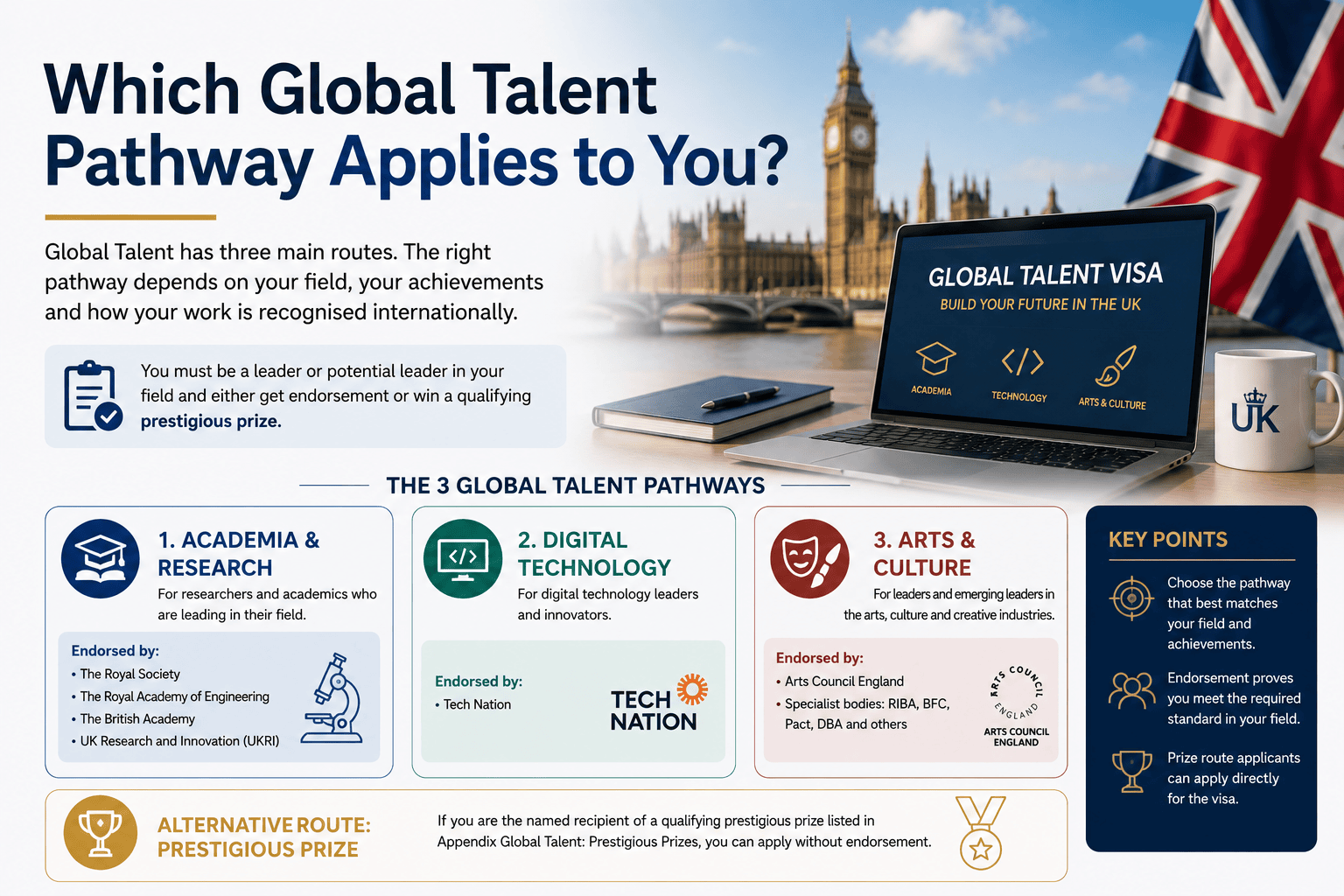
Once an applicant has established that they may be eligible for the UK Global Talent Visa, the next question is which pathway applies to their professional circumstances.
Pathway selection matters because it determines how the application is assessed, which requirements apply, and what type of evidence the applicant needs to provide.
If the applicant is the named winner of a qualifying prize listed in Appendix Global Talent: Prestigious Prizes, they may apply directly for the visa without endorsement. Otherwise, they need to identify the endorsement pathway that best matches their professional background.
| Your Position | Likely Global Talent Pathway |
|---|---|
| Named winner of a listed prestigious prize | Direct Global Talent visa application without endorsement |
| Researcher or academic with an eligible academic or research position | Academia and research: appointment route |
| Holder of an eligible individual fellowship | Academia and research: fellowship route |
| Researcher working on an eligible funded project | Academia and research: UKRI endorsed funder route |
| Academic or researcher relying on professional standing and peer assessment | Academia and research: peer review route |
| Technical or qualifying business applicant in digital technology | Digital technology pathway |
| Artist or cultural practitioner | Arts and culture pathway |
| Architect | Architecture pathway |
| Fashion designer | Fashion design pathway |
| Film, television, animation, post-production or visual effects professional | Film and television pathway |
| Design professional | Design pathway |
The table provides a starting point only. Each pathway has its own eligibility and evidential requirements, and some applicants may appear to fit more than one route.
For professionals who want to strengthen the media recognition aspect of their professional profile, United Press can help build genuine editorial coverage around real achievements, expertise, leadership, innovation, and industry contribution.
Academia and Research
Applicants working in science, engineering, humanities, social sciences or medicine may qualify through one of four main routes: an eligible academic or research position, an eligible individual fellowship, the UKRI endorsed funder route, or full peer review.
The first three routes are connected to an eligible academic or research position, fellowship, or funded research arrangement.
Full peer review is available to applicants who are relying on their wider professional record and expert assessment of their standing within their field. Applicants using the peer review route must be active researchers in a relevant field and hold a PhD or equivalent research experience, including industrial or clinical research. Applicants applying under Exceptional Promise must also be at an early stage of their career.
If an applicant meets the requirements for an appointment, fellowship, or endorsed funder route, that pathway should be considered before assuming that peer review is the most appropriate option. The specific eligibility and evidence requirements should be assessed against the applicant’s professional circumstances.
Digital Technology
The digital technology pathway covers applicants with qualifying technical or business expertise within the digital technology sector. Applicants need to demonstrate Exceptional Talent or Exceptional Promise under the relevant digital technology criteria.
Simply working for a technology company is not enough by itself. The applicant’s role, expertise, achievements and professional contribution need to fall within the scope of the applicable pathway.
Applicants should therefore assess their specific professional background and evidence before deciding whether the digital technology route is appropriate.
Arts and Culture
The arts and culture pathway covers areas including combined arts, dance, literature, music, theatre and visual arts, together with specialist pathways for architecture, fashion design, film and television, and design.
Applicants should identify the specific creative field that applies to their professional background before preparing their evidence, as the endorsement criteria can differ between individual pathways.
The evidence should be selected according to the requirements of the relevant creative field rather than relying solely on general professional reputation or career experience.
Prestigious Prize Route
Applicants who are the named winner of a qualifying prize listed in Appendix Global Talent: Prestigious Prizes may be able to apply directly for the Global Talent Visa without obtaining endorsement.
The specific prize matters. An award does not automatically qualify simply because it is prestigious or because the awarding organisation is well established. Applicants should check the current Appendix at the time of application before relying on the prestigious-prize route.
What If More Than One Pathway Appears to Fit?
Some applicants may appear to qualify under more than one Global Talent pathway, particularly where their professional work crosses different disciplines or where they have experience spanning multiple areas.
The strongest pathway is not necessarily the one with the broadest description or the most impressive title. It is the pathway whose eligibility requirements most closely match the applicant’s actual professional record and for which the required evidence can be demonstrated most convincingly.
Where more than one route appears viable, applicants should compare the applicable eligibility requirements and available evidence before deciding which pathway to pursue.
Choosing a pathway first and then attempting to adapt existing evidence to fit it can create unnecessary weaknesses in an otherwise strong application.
United Press Insight for Applicants
It is not unusual for Global Talent applicants to find that more than one pathway may appear relevant to their background. When this happens, the focus should be on comparing the actual requirements rather than choosing a route based simply on professional title or reputation.
For example, in academia and research, an eligible appointment, fellowship, or funded research position may provide a more defined route than relying on peer review. In digital technology and creative fields, the key question is whether the applicant’s professional achievements and evidence can demonstrate the specific criteria applicable to that pathway.
Ultimately, the most suitable route is the one that best matches the applicant’s professional record and can be supported with clear, relevant and credible evidence.
For professionals looking to strengthen their independent professional recognition, United Press can help develop genuine editorial media coverage around real achievements, expertise, innovation, leadership and industry contribution.
Section C: Global Talent Visa Endorsement Requirements
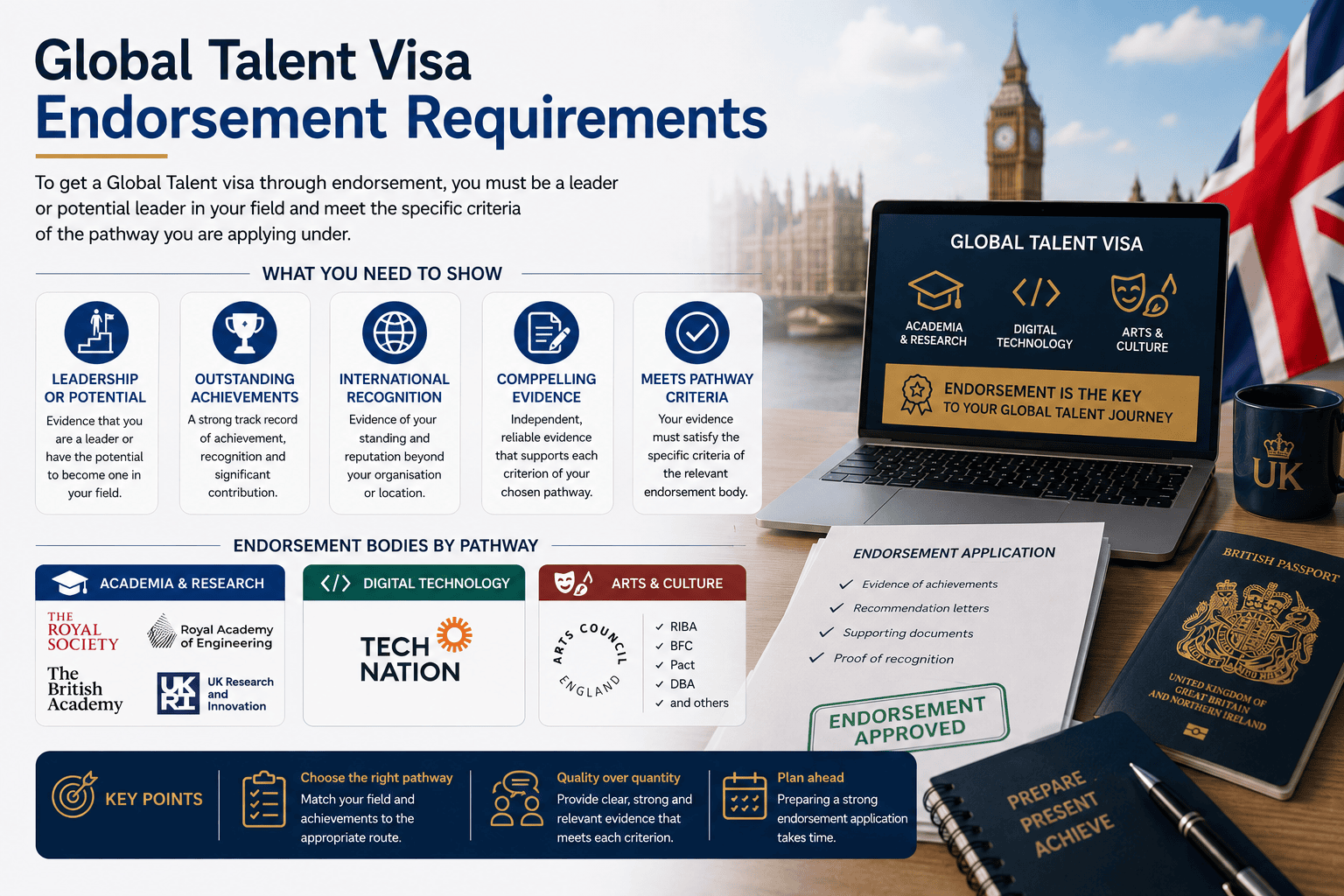
If you do not qualify through a prize listed in Appendix Global Talent: Prestigious Prizes, you will generally need endorsement before your Global Talent Visa can be granted. Endorsement is the substantive professional assessment of whether your achievements, recognition, contribution and potential meet the requirements of the relevant Global Talent pathway.
The Home Office does not itself assess whether you are a leader or potential leader in your professional field at the endorsement stage. Instead, your application is assessed against the criteria for the relevant pathway by the organisation responsible for that field. If endorsement is granted, you can then use it as part of your Global Talent Visa application.
Endorsement should therefore be understood as a separate stage from the immigration application. For most applicants, this is the stage where professional standing, achievements, recognition, contribution and supporting evidence are examined in detail.
What Does the Endorsing Body Assess?
The assessment depends on the pathway being used. In evidence-led routes, the endorsing body considers whether the applicant’s professional record demonstrates the level of achievement, recognition and contribution required under the applicable criteria.
Where the pathway distinguishes between Exceptional Talent and Exceptional Promise, the evidence needs to support the level under which the applicant is applying. Exceptional Talent is generally concerned with established leadership in the field, while Exceptional Promise focuses on applicants who can demonstrate the potential to become future leaders.
The assessment is not simply about the amount of evidence submitted. The important question is whether the evidence actually demonstrates the relevant criteria.
A strong CV, senior job title, prestigious employer or association with a recognised institution cannot compensate for evidence that fails to demonstrate the applicant’s own achievements, contribution or recognition.
Which Organisation Assesses Your Global Talent Endorsement?
The assessment body depends on the applicant’s professional field and the specific pathway being relied upon.
| Field or Pathway | Assessment Body |
|---|---|
| Natural and medical sciences | Royal Society |
| Engineering | Royal Academy of Engineering |
| Humanities and social sciences | British Academy |
| UKRI endorsed funder route | UK Research and Innovation |
| Digital technology | Tech Nation pathway |
| Combined arts, dance, literature, music, theatre and visual arts | Arts Council England |
| Architecture | Royal Institute of British Architects on behalf of Arts Council England |
| Fashion design | British Fashion Council on behalf of Arts Council England |
| Film and television | Pact on behalf of Arts Council England |
| Design industry | Design Business Association on behalf of Arts Council England |
The relevant assessment body is determined by the pathway and professional field being relied upon. Applicants whose work crosses different sectors should identify the route that most accurately reflects the substance of their professional work rather than relying on their job title alone.
Does Endorsement Guarantee the Visa?
No. Endorsement does not itself grant immigration permission.
An endorsed applicant must still submit a valid Global Talent Visa application and satisfy the applicable immigration and suitability requirements. The Home Office considers the visa application separately from the professional endorsement assessment.
Applicants can choose whether to apply for endorsement and the visa together or apply for the visa after endorsement has been granted. If an applicant relies on endorsement for their Global Talent application, the visa application must be made within the applicable validity period of the endorsement.
If endorsement is refused, the applicant cannot obtain the visa on the basis of that refused endorsement.
What Happens If Endorsement Is Refused?
A refusal of endorsement does not necessarily prevent an applicant from pursuing the Global Talent route in the future.
Depending on the pathway and circumstances, the applicant may be able to request an endorsement review or submit a fresh application.
An endorsement review considers whether the original decision was correctly made based on the evidence submitted. It should not be treated simply as an opportunity to completely rewrite the application, introduce an entirely new portfolio, or replace weak evidence with substantially different material.
Where the main issue is the quality or sufficiency of the evidence rather than an identifiable assessment error, a fresh application may be more appropriate. This can provide an opportunity to address the refusal reasons, strengthen the evidence, or reconsider whether another eligible pathway better matches the applicant’s professional background.
The reasons for refusal should therefore be carefully considered before deciding what to do next. An evidential weakness and an assessment error require different strategies.
United Press Insight for Applicants
The endorsement stage is a substantive part of the UK Global Talent Visa process and should not be treated as a formality.
Applicants should approach it by first identifying the correct pathway, understanding the criteria that apply, and then selecting evidence that directly demonstrates each relevant requirement.
The strongest applications make the professional story easy to follow. The applicant’s own achievements, contribution, recognition and impact should be clearly demonstrated rather than leaving the assessor to infer them from a job title, employer reputation or the achievements of an organisation.
For professionals looking to strengthen the independent recognition element of their wider profile, United Press helps build genuine editorial media coverage around real achievements, expertise, innovation, leadership and industry contribution.
Section D: Global Talent Visa Requirements by Field
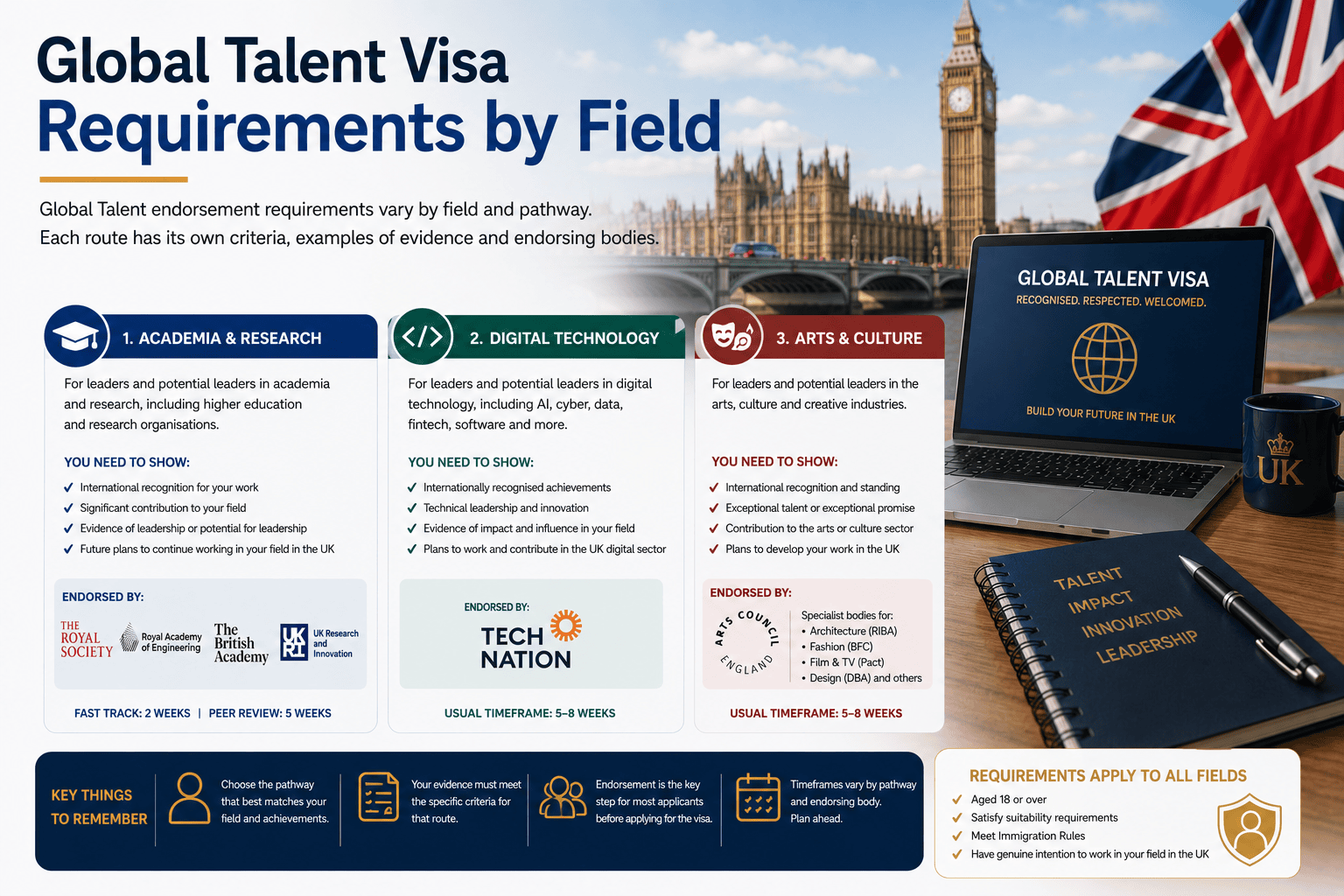
The Global Talent Visa requirements vary depending on the applicant’s professional field and the specific pathway being relied upon. There is no single evidential test that applies to every applicant. The relevant criteria need to be assessed according to the field in which the applicant is seeking endorsement.
For each pathway, the key questions are whether the applicant’s work falls within the route, what level of achievement or recognition is required, and whether the available evidence can demonstrate the applicant’s own contribution against the applicable criteria.
Global Talent Visa for Academia and Research
The academia and research pathway covers science, engineering, humanities, social sciences and medicine. Applicants need to be active researchers working in an academic, industry or government research institution and may qualify through an eligible fellowship or award, academic or research position, UKRI endorsed funder route, or full peer review.
Who does the route fit?
The route is intended for active researchers working in an eligible discipline who can satisfy the requirements of one of the recognised fellowship or award, academic or research position, endorsed funder, or full peer review routes.
What standard applies?
Full peer review is available under Exceptional Talent or Exceptional Promise. Applicants need to be active researchers in a relevant field and hold a PhD or equivalent research experience, including industrial or clinical research. Exceptional Promise applicants must also be at an early stage in their career. The other routes depend on the specific requirements attached to the relevant fellowship, position, or funded research arrangement.
What do you need to show?
The evidence depends on the route. Full peer review applicants need to demonstrate the required professional standing through their academic or research record. Applicants relying on an eligible fellowship or award need to demonstrate that they hold, or held within the relevant period, an approved award. Applicants relying on an academic or research position need an eligible position at an approved UK institution or research institute. The UKRI endorsed funder route has its own requirements relating to the grant or award, host organisation and applicant’s contribution.
Where do applicants misjudge the threshold?
A strong publication record does not automatically mean that full peer review is the most appropriate route. Where an applicant already meets the requirements for an eligible fellowship, award, academic or research position, or qualifying funded research pathway, that route may provide a more defined basis for endorsement.
Global Talent Visa for Digital Technology
The digital technology pathway is intended for applicants with qualifying technical or business expertise in the digital technology sector.
Who does the route fit?
Technical applicants need to demonstrate expertise in relevant technologies, including building, using, deploying or exploiting a technology stack and developing technical infrastructure.
Business applicants need to demonstrate commercial, investment or product expertise connected with building digital products or leading investments in significant digital product businesses.
What standard applies?
Applicants need to demonstrate recognition as Exceptional Talent or Exceptional Promise in digital technology within the relevant period. Exceptional Promise applicants must also satisfy the applicable early-career requirement.
What do you need to show?
Applicants need to demonstrate recognition at the required level and provide evidence against the prescribed digital technology criteria. These can include innovation, recognition for work beyond the applicant’s occupation that advances the field, significant technical, commercial or entrepreneurial contribution, or exceptional academic contribution through research.
The evidence needs to establish the applicant’s personal contribution, rather than simply demonstrating that the company or organisation they work for has been successful.
Where do applicants misjudge the threshold?
Working for a well-known technology company or contributing to a successful product is not necessarily enough. Company-level achievements need to be clearly connected to the applicant’s own role and contribution.
Global Talent Visa for Arts and Culture
The arts and culture pathway covers combined arts, dance, literature, music, theatre and visual arts.
Who does the route fit?
Applicants need to be professionally engaged in producing outstanding work that is performed, presented, distributed or internationally exhibited and demonstrate regular professional engagement within their field during the relevant period.
What standard applies?
Exceptional Talent applicants need to demonstrate a substantial track record across at least two countries. Exceptional Promise applicants need to be at an early stage of their career and demonstrate a developing track record in one or more countries.
What do you need to show?
Applicants need a CV, three dated recommendation letters and qualifying evidence under the applicable criteria.
Depending on the route, evidence can include media recognition, international awards, professional appearances, performances, publications, exhibitions, or international distribution and sales.
Where do applicants misjudge the threshold?
Evidence that demonstrates participation does not necessarily establish professional standing. A programme, performance credit or exhibition listing may demonstrate that work took place, but applicants still need to establish the level of recognition and significance required by the relevant route.
Global Talent Visa for Film and Television
The film and television pathway covers film, television, animation, post-production and visual effects.
Who does the route fit?
The pathway is aimed at established professionals whose work and recognition meet the applicable film and television criteria.
What standard applies?
This pathway is based on Exceptional Talent and does not provide a general Exceptional Promise route.
What do you need to show?
Applicants need to satisfy one of the prescribed Exceptional Talent routes. Depending on the circumstances, this can involve qualifying awards, award nominations, significant contributions to nominated or winning productions, or recognised industry standing demonstrated through specified combinations of distribution, media recognition and awards.
Applicants also need a CV and three dated recommendation letters, including recommendations from well-established film and television organisations where required.
Where do applicants misjudge the threshold?
Professional credits alone may not establish Exceptional Talent. Where an achievement involves a wider production team, the evidence should clearly establish the applicant’s own contribution to the relevant work.
Global Talent Visa for Architecture
The architecture pathway is assessed by the Royal Institute of British Architects on behalf of Arts Council England.
Who does the route fit?
Applicants need to be professionally engaged in producing outstanding architectural work that is presented, published or internationally exhibited and demonstrate regular professional engagement in architecture during the relevant period.
What standard applies?
Exceptional Talent applicants need a substantial track record in at least two countries, while Exceptional Promise applicants need a developing track record in at least one country.
What do you need to show?
Applicants need a CV, three dated recommendation letters and qualifying evidence under the applicable criteria. Evidence can include international awards, media recognition, and qualifying publications or exhibitions.
Where do applicants misjudge the threshold?
The reputation of an architecture studio or project does not automatically establish the applicant’s own professional standing. Where evidence relates to collaborative work, the applicant’s individual contribution should be identifiable.
Global Talent Visa for Fashion Design
The fashion design pathway is assessed by the British Fashion Council on behalf of Arts Council England.
Who does the route fit?
Applicants need to hold a leading design role in the fashion business and demonstrate regular professional engagement in fashion design during the relevant period.
What standard applies?
Exceptional Talent applicants need to demonstrate professional engagement producing outstanding work that has been sold or exhibited internationally and a substantial track record across at least two countries.
Exceptional Promise applicants need to demonstrate a developing track record in at least one country and professional engagement producing outstanding work recognised by leading industry players.
What do you need to show?
Applicants need a CV, three dated recommendation letters and at least two forms of evidence from the prescribed Exceptional Talent or Exceptional Promise categories.
Where do applicants misjudge the threshold?
Being associated with a recognised fashion label or fashion house does not automatically establish the applicant’s own recognition. Evidence should identify the applicant and provide a reliable basis for attributing the relevant work or achievement to them.
Global Talent Visa for Design
The design industry has its own Global Talent criteria, with the new provisions taking effect from 1 July 2026.
Who does the route fit?
Applicants need to be professionally engaged in producing outstanding applied, published, distributed or internationally exhibited work and demonstrate regular professional engagement in the design field during the relevant period.
What standard applies?
Exceptional Talent applicants need a substantial track record across at least two countries. Exceptional Promise applicants need to be at an early stage in their career and demonstrate a developing track record in one or more countries.
What do you need to show?
Applicants need a CV, three dated recommendation letters and at least two forms of qualifying evidence under the relevant Exceptional Talent or Exceptional Promise criteria. This can include media recognition, international design awards, and evidence of professional appearances, publications, exhibitions, or international distribution and sales.
Where do applicants misjudge the threshold?
Design work is often collaborative, but team involvement needs to be distinguished from personal contribution. Applicants relying on group or project work should ensure that their own role is clearly established by the evidence.
Choosing the Right Field Where Your Work Overlaps
Some professional careers cross more than one Global Talent field. A founder may combine technology and design, a researcher may work commercially in artificial intelligence, or a creative professional may work across several disciplines.
However, overlapping experience does not mean that the pathways can be used interchangeably. The key question is which route best reflects the work on which the applicant intends to rely and whether the available evidence can satisfy its criteria.
Job titles can be an unreliable guide in borderline cases. The substance of the applicant’s work, the nature of their achievements, and the evidence available to prove those achievements provide a stronger basis for selecting the appropriate field.
United Press Insight for Applicants
The same professional achievement can carry very different weight under different Global Talent pathways. A major commercial launch, for example, may be relevant to a digital technology application but may be much less useful under a research or design pathway unless it demonstrates the specific criterion being assessed.
For applicants whose careers cross different sectors, the best approach is to test the strongest evidence against each potentially relevant pathway before deciding which field to rely on.
The most suitable route is ultimately the one that best matches the applicant’s actual professional work and for which the required criteria can be demonstrated through clear, relevant and credible evidence.
For professionals who want to strengthen the media recognition aspect of their wider professional profile, United Press helps build genuine editorial coverage around real achievements, expertise, innovation, leadership and industry contribution.
Section E: How to Build a Strong Global Talent Visa Evidence Portfolio
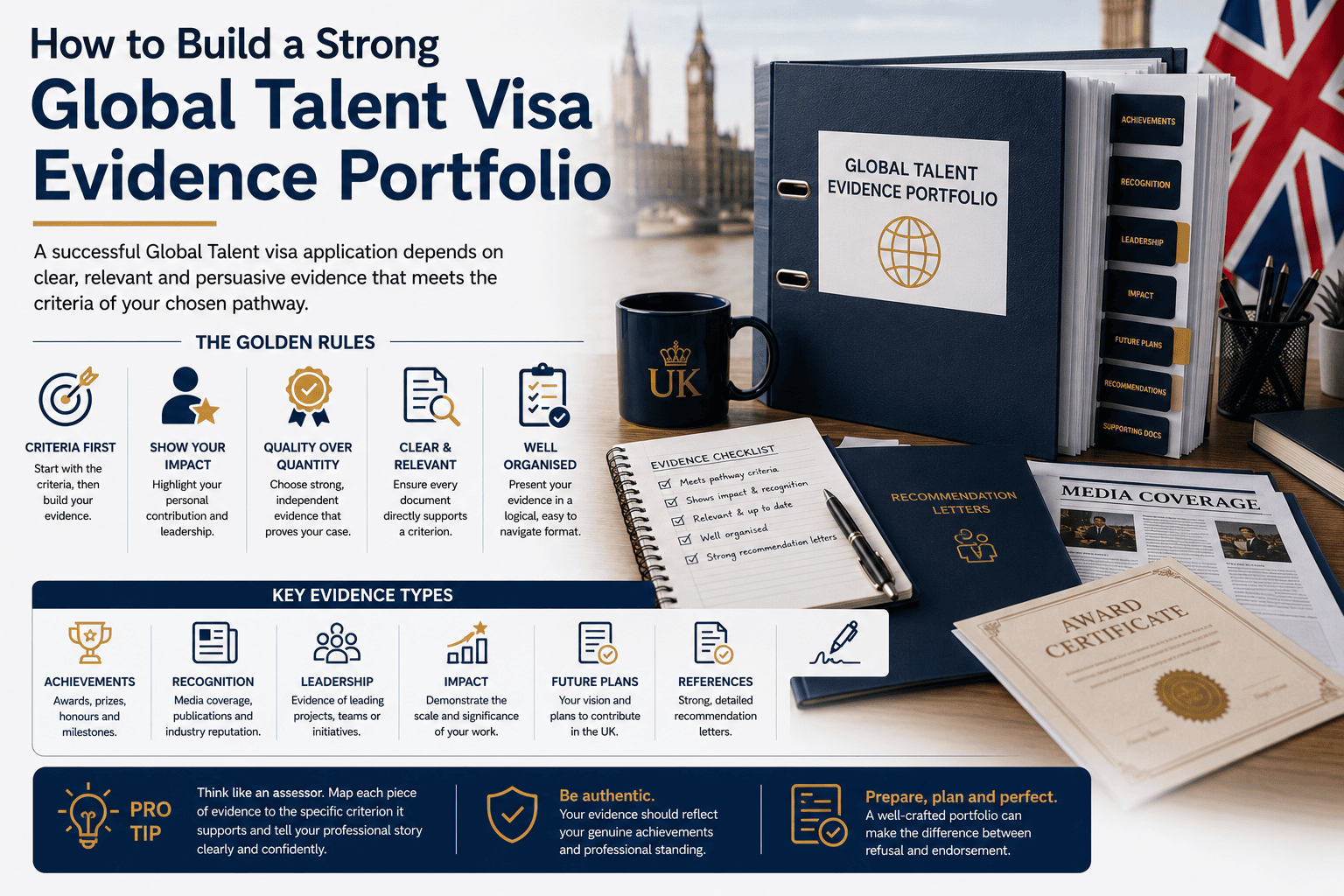
For a UK Global Talent Visa endorsement application, evidence needs to do more than demonstrate that an applicant is successful in their profession. It needs to establish the specific criteria applicable to the chosen pathway and clearly demonstrate the applicant’s own achievements and contribution.
The documentary requirements can vary between Global Talent pathways. Some routes have specific requirements concerning the number, age, format, or length of supporting documents, while others apply different requirements depending on how the applicant qualifies.
The permitted number of documents should therefore not be treated as a target. A smaller collection of carefully selected evidence that clearly establishes the relevant criteria can be more effective than a larger portfolio containing repetition, weak attribution, or documents that do not directly address the applicable requirements.
Match Each Document to a Specific Criterion
Start with the wording of the applicable Global Talent endorsement criteria and identify exactly what each requirement asks the applicant to demonstrate. Only then should supporting documents be selected.
Every document should have a clear purpose.
If an applicant is relying on evidence of innovation, leadership, commercial impact, professional recognition, research impact, or contribution to their field, the document should establish that particular point rather than simply demonstrate that the underlying activity took place.
A common weakness is submitting impressive material without explaining its relevance to the applicable criterion. Press coverage, awards, project reports, publications, research records, or commercial metrics can all be valuable, but their usefulness depends on whether they actually help demonstrate the criterion being relied upon.
Show Your Personal Contribution
Global Talent applications often involve achievements connected to teams, businesses, research groups, studios, institutions, or wider organisations. The success of the organisation does not automatically establish the applicant’s individual achievement.
If an applicant relies on company growth, a successful product, a major research project, an award-winning production, or a high-profile creative project, the evidence should clearly identify their role and contribution.
Where the applicant’s name does not appear in the underlying documentation, additional evidence may be needed to establish attribution.
This principle is particularly important when achievements involve collaborative work. An assessor should not have to assume that a company’s success, team award, or institutional achievement was primarily the result of the applicant’s contribution.
Use Independent Evidence Where Recognition Matters
Evidence created within an applicant’s own organisation can help establish what they did, but it may carry less weight where the relevant criterion concerns external recognition or professional standing.
Where appropriate, independent evidence can include:
- Editorial media coverage
- External awards
- Peer recognition
- Professional invitations
- Research citations
- Exhibitions
- Industry commentary
- Recognition from established organisations
The source of the evidence also matters. The assessor should be able to understand who produced the document, why the source is relevant or authoritative, and how it supports the claim being made.
For professionals building independent recognition, genuine editorial media coverage can complement a wider evidence portfolio where it is relevant to the applicable Global Talent pathway.
Use Recommendation Letters as Substantive Evidence
Recommendation letters should provide meaningful evidence of professional standing rather than simply functioning as character references.
A strong letter should explain:
- How the referee knows the applicant
- Why the referee is qualified to assess their work
- What the applicant has achieved
- Why those achievements are significant
- What specific examples demonstrate the applicant’s expertise or contribution
The exact requirements differ between Global Talent pathways. Applicants should therefore ensure that their recommendation letters satisfy the requirements applicable to their particular route.
Generic statements that an applicant is talented, successful, respected, or likely to contribute to the UK have limited value unless they are supported by specific examples and a clear explanation of the basis for the referee’s assessment.
Choose Evidence That Demonstrates Impact, Not Just Activity
Evidence that an applicant participated in an activity is not necessarily evidence that the activity demonstrates the required level of professional standing.
For example:
- A conference programme may demonstrate that someone spoke at an event.
- A product page may demonstrate that a product exists.
- A publication may demonstrate authorship.
- An exhibition catalogue may demonstrate that work was exhibited.
However, those documents do not automatically establish the significance or impact of the achievement.
Where possible, evidence should help demonstrate why the work matters. Depending on the professional field, this could involve:
- Commercial results
- User growth
- Research citations
- Competitive selection
- Awards
- Critical reviews
- International distribution
- Audience reach
- Research impact
- Recognition from established organisations
The relevant measure will depend on the pathway. Applicants should avoid using metrics simply because they appear impressive if they do not actually address the criterion being assessed.
Check Dates and Documentary Limits
Applicants should carefully check the documentary requirements for their specific Global Talent pathway before preparing the evidence portfolio.
Different routes can have different requirements relating to the number, age, format, and length of supporting documents.
Digital evidence should also be presented with sufficient context. Screenshots, online articles, analytics, publications, and other digital material should clearly identify relevant dates, sources, and information so that the assessor can understand what the evidence represents.
Where documentary limits apply, applicants should use the available space strategically rather than treating the maximum number of documents as a target.
Do Not Rely on the CV to Fill Evidence Gaps
The CV provides important context, but it does not replace documentary evidence of the endorsement criteria.
An achievement appearing on a CV does not, by itself, establish that the achievement occurred at the level claimed or that it satisfies the relevant requirement.
The CV should provide a coherent overview of the applicant’s professional history, career development and key achievements.
The supporting documents should then provide the evidence needed to substantiate the achievements on which the endorsement application depends.
Build a Coherent Evidence Portfolio
The documents should work together to create a clear professional narrative.
A strong portfolio should ideally demonstrate:
What you achieved → Why it matters → What you personally contributed → How it is independently supported
Repetition should be avoided. Multiple documents proving exactly the same underlying fact may use valuable evidence space without adding anything meaningful to the application.
Where a pathway places restrictions on how evidence can be allocated, applicants should also ensure that each document is being used appropriately for the criterion it is intended to demonstrate.
Before submitting the application, applicants should test the entire portfolio against the actual endorsement criteria, rather than simply checking whether every achievement listed on the CV has a supporting document.
If a particular requirement cannot be connected to persuasive documentary evidence, it can remain a weakness even where the applicant has an otherwise impressive professional career.
| Evidence Question | What the Document Should Show |
|---|---|
| What happened? | The achievement, activity, project, research, or professional output being relied upon. |
| Why does it matter? | The impact, recognition, scale, significance, or professional importance of the achievement. |
| What did you contribute? | The applicant’s personal role rather than the achievement of the wider team, business, institution, or organisation. |
| Who verifies it? | An independent or authoritative source where external recognition or verification is relevant. |
| Which criterion does it prove? | A clear connection between the evidence and the specific endorsement requirement being relied upon. |
United Press Insight for Applicants
When reviewing a Global Talent evidence portfolio, applicants should continually ask three questions:
What happened?
Why does it matter?
What did I personally contribute?
It is common to establish the first point and then leave the assessor to infer the significance or personal contribution. A stronger evidence strategy makes those connections clear.
Where evidence space is limited, applicants should prioritise documents that demonstrate significance, independent recognition and personal attribution, rather than using multiple documents to establish the same achievement.
For professionals who need to strengthen the independent recognition aspect of their professional profile, United Press helps build genuine editorial media coverage around real achievements, expertise, innovation, leadership, research and industry contribution.
The objective is not simply to create more publicity. It is to develop accurate editorial stories that clearly communicate the professional’s genuine achievements and build long-term credibility.
Section F: Global Talent Visa Through a Prestigious Prize

If you have won a prize listed in Appendix Global Talent: Prestigious Prizes, you may be able to apply for the Global Talent Visa without first obtaining endorsement. The qualifying prize can satisfy the talent requirement for the purpose of this route.
The prestigious-prize route can therefore be simpler than the endorsement process, but eligibility is narrow. Applicants need to rely on the specific prize listed in the Appendix and must be recognised as the qualifying individual winner. A nomination, shortlist, award given to an organisation, or recognition for a particular work does not automatically qualify unless the Immigration Rules recognise the applicant as the qualifying winner.
The list of qualifying prizes can change, so applicants should always check the current version of Appendix Global Talent: Prestigious Prizes before relying on an award for a direct application.
Does Your Prize Qualify?
Prestige alone is not enough.
The specific prize needs to appear in Appendix Global Talent: Prestigious Prizes, and applicants should confirm that the prize remains valid and that their individual award satisfies the requirements of the current rules.
An award from the same organisation as a listed prize does not automatically qualify unless that particular award is also included in the Appendix. Applicants should therefore check the exact name and category of the prize rather than relying on the reputation of the awarding organisation.
| Situation | Can You Use the Prestigious Prize Route? |
|---|---|
| You are the named winner of a prize listed in the Appendix | Yes, subject to the remaining visa requirements. |
| You won a highly regarded prize that is not listed | No. You would normally need endorsement instead. |
| You were nominated or shortlisted for a listed prize | No. |
| Your employer, institution or organisation won the prize | No, unless you are personally recognised as the qualifying named winner. |
| You are one of several individually named winners | Potentially yes, if the specific prize and individual award satisfy the Appendix requirements. |
How Is a Prestigious Prize Verified?
The Home Office may use publicly available information, such as the awarding organisation’s website, to establish that an applicant won the qualifying prize.
Applicants should nevertheless make sure that the award can be clearly verified. Where an older prize, changed website, or limited public information makes verification more difficult, it is sensible to retain official award documentation and reliable records confirming the result.
The important point is to ensure that the evidence clearly connects the applicant personally with the qualifying prize.
Do You Still Need to Meet the Visa Requirements?
Yes.
Winning a qualifying prestigious prize removes the endorsement stage, but it does not remove the requirement to make a valid Global Talent Visa application.
Applicants still need to:
- Submit the correct visa application
- Prove their identity
- Pay the applicable fees
- Pay the Immigration Health Surcharge where required
- Meet the relevant immigration requirements
- Satisfy the applicable suitability requirements
Depending on the applicant’s circumstances and country of residence, additional documentation may also be required.
The prestigious-prize route therefore removes the professional endorsement assessment but does not guarantee that the visa application will automatically be granted.
Does a Prestigious Prize Affect Settlement?
Applicants granted Global Talent permission through a qualifying prestigious prize may be eligible for the three-year settlement pathway, provided they satisfy the remaining requirements for settlement.
The qualifying period and other settlement requirements should be checked against the rules applicable at the time of the ILR application.
United Press Insight for Applicants
Professional prestige and immigration eligibility are not necessarily the same thing.
An important industry award may strengthen an applicant’s overall professional profile or support an endorsement application, but that does not mean the award automatically qualifies for the direct prestigious-prize route.
Before relying on an award to bypass endorsement, applicants should check the exact prize name against the current Appendix and confirm that they are recognised as the qualifying individual winner.
For professionals who are building their wider professional recognition, United Press helps develop genuine editorial media coverage around real achievements, awards, expertise, leadership, innovation and industry contribution.
Section G: How to Apply for a Global Talent Visa
The UK Global Talent Visa application is made online. The process depends on whether the applicant is applying on the basis of endorsement or a qualifying prestigious prize.
Applicants who require endorsement can submit the visa application at the same time as the endorsement application or wait until endorsement has been granted. Applicants who qualify through a prestigious prize can proceed directly to the visa application without completing a separate endorsement stage.
Applying With Endorsement
Applicants who require endorsement first make a Stage 1 application under the relevant Global Talent pathway.
The endorsement application needs to be submitted using the appropriate online form, the applicable fee must be paid, and the application must be directed to the endorsing body responsible for the applicant’s professional field.
If endorsement is granted, the applicant can then proceed with the Home Office visa application.
The visa application needs to be submitted within the applicable period following the endorsement decision.
Although the rules allow applicants to submit the endorsement and visa applications together, some applicants may prefer to wait for the endorsement decision before progressing to the visa stage.
Where both applications are submitted together and endorsement is refused, the visa application cannot succeed on the basis of that endorsement.
Applicants whose existing UK immigration permission is approaching expiry should consider the timing carefully. An endorsement application or endorsement review does not itself extend existing immigration permission. An eligible in-time visa application may provide statutory continuation of existing permission while the application is being considered, subject to the applicable rules.
Applying Through a Prestigious Prize
Applicants who are the named winner of a qualifying prize listed in Appendix Global Talent: Prestigious Prizes do not need to complete an endorsement application.
Instead, they can apply directly for the Global Talent Visa.
The Home Office will consider the qualifying prize alongside the remaining immigration and suitability requirements before making a decision on the visa application.
Applying From Outside the UK
Applicants who are outside the UK can apply online for entry clearance under the Global Talent route.
The applicant will need to complete the identity process required for the application and provide the supporting documents requested by UKVI.
The specific application process can depend on the applicant’s circumstances and country of application, so applicants should follow the current GOV.UK instructions when submitting an overseas application.
Switching to the Global Talent Visa From Inside the UK
Some applicants who already hold UK immigration permission may be able to switch into the Global Talent route from within the UK, although certain immigration categories are excluded.
Applicants should check whether their current immigration status allows them to switch before submitting an in-country application.
Additional requirements can apply to applicants who currently hold, or previously held, Student permission, depending on the course and circumstances.
Where existing immigration permission is close to expiry, applicants should pay particular attention to timing and eligibility before relying on an in-country application.
What Documents Do You Need for the Visa Application?
The documents required at the visa application stage are generally different from the professional evidence submitted for endorsement.
Applicants will normally need a valid passport or another document establishing their identity and nationality.
Depending on their circumstances, they may also need:
- A tuberculosis test certificate
- Evidence relating to government or international scholarships where applicable
- Written consent from a relevant scholarship organisation where required
- Certified translations for documents that are not in English or Welsh
Applicants should always check the current Home Office document requirements that apply to their particular circumstances before submitting the application.
Do You Need to Score Points?
The Global Talent Visa is part of the UK’s points-based immigration system, but applicants do not generally complete a points calculation in the same way as they might for other work routes.
The required points are obtained where the applicable Global Talent requirements are met through either a valid endorsement or a qualifying prestigious prize.
The main issue is therefore whether the applicant satisfies the relevant Global Talent requirements rather than building points through salary, English-language requirements, or employer sponsorship.
What Happens After You Submit the Application?
After submitting the application, the applicant will need to complete the relevant identity and biometric process, unless UKVI is able to verify their identity digitally through the application system.
The Home Office will then assess whether the application is valid, whether the Global Talent eligibility requirements have been met, and whether any suitability grounds prevent the applicant from being granted immigration permission.
Applicants making an in-country application should also pay close attention to travel restrictions while the application is pending. Leaving the UK or the relevant Common Travel Area before a decision can affect the application and may result in it being treated as withdrawn under the applicable rules.
United Press Insight for Applicants
Applicants should not treat the endorsement stage and visa application stage as the same process.
Endorsement is primarily concerned with establishing the applicant’s professional eligibility, achievements and recognition under the relevant Global Talent pathway. The subsequent Home Office application deals with immigration validity, eligibility and suitability.
Where appropriate, applying for both stages together can be useful, particularly when existing immigration permission is approaching expiry. However, applicants should understand the risks and requirements before choosing that approach.
For professionals preparing their Global Talent profile, United Press can support the wider professional visibility strategy by helping build genuine editorial media recognition around real achievements, expertise, leadership, innovation and industry contribution.
The cost of applying for a UK Global Talent Visa depends on whether the applicant is applying through endorsement or using a qualifying prestigious prize.
For applicants who require endorsement, the application fee is divided between the endorsement and visa stages. Applicants using the prestigious-prize route do not need to pay a separate endorsement fee and instead pay the full visa application fee when submitting their visa application.
The applicable Home Office fees should always be checked at the time of application, as immigration fees can change.
| Application | Current Fee |
|---|---|
| Global Talent endorsement application | £561 |
| Visa application after endorsement | £205 |
| Visa application using a qualifying prestigious prize | £766 |
| Global Talent extension application | £766 |
| Dependant partner or child application | £766 per person |
These are the Home Office application fees. Most applicants will also need to pay the Immigration Health Surcharge, and additional costs may apply depending on their circumstances. These can include document translation, tuberculosis testing, or optional priority services where available.
How Much Is the Immigration Health Surcharge?
The Immigration Health Surcharge (IHS) is paid separately from the visa application fee and is generally calculated according to the length of immigration permission requested.
The amount payable can therefore have a significant impact on the overall cost of a Global Talent Visa application, particularly where several years of permission are requested or where dependants are applying with the main applicant.
Applicants should calculate the applicable IHS for each person included in the application and consider the total cost before deciding how long to request.
How Much Does a Global Talent Visa Cost With Endorsement?
For a main applicant using the endorsement route, the Home Office application fees are divided between two stages:
- £561 for the endorsement application
- £205 for the subsequent visa application
This gives a total application fee of £766, before any Immigration Health Surcharge or additional application-related costs.
Applicants should also consider potential costs for professional advice, translations, tuberculosis testing, document preparation, or expedited services where available.
How Much Does a Global Talent Visa Cost With a Prestigious Prize?
Applicants using the prestigious-prize route do not need to submit a separate endorsement application.
Instead, they pay the applicable Global Talent Visa application fee when submitting their visa application.
The overall Home Office application fee is therefore based on the visa application itself rather than being divided between an endorsement stage and visa stage.
The Immigration Health Surcharge may still be payable in addition to the visa application fee, unless an applicable exemption applies.
How Much Do Dependants Cost?
Each dependant partner or child applying for a Global Talent Visa will generally have their own visa application fee and applicable Immigration Health Surcharge.
The overall cost can therefore increase considerably for families, particularly where several years of immigration permission are requested.
Applicants should calculate the expected visa fee and health surcharge for every family member before deciding on the length of permission to request.
Should You Apply for One Year or Five Years?
Global Talent applicants can choose the period of permission they require within the limits allowed by the route.
A shorter period can reduce the amount of Immigration Health Surcharge payable upfront, but it may mean that the applicant needs to submit another application and pay additional fees if an extension is required.
A longer period generally means a higher upfront cost but can provide longer-term immigration permission and potentially avoid the need for an extension before the applicant becomes eligible for settlement.
The most appropriate period therefore depends on the applicant’s settlement plans, immigration circumstances and expected eligibility for ILR.
Applicants should consider their likely settlement timeline rather than automatically selecting the maximum period simply because it is available.
United Press Insight for Applicants
The visa application fee is only one part of the overall cost of a Global Talent Visa application.
Applicants should consider the Immigration Health Surcharge, potential dependant costs, document preparation, translations, testing and any professional services they may require.
Before deciding how long to request, it can be useful to consider the wider immigration plan, including when the applicant may become eligible for settlement and whether an extension could otherwise become necessary.
For professionals preparing their Global Talent profile, United Press can support the wider professional recognition strategy by developing genuine editorial media coverage around real achievements, expertise, innovation, leadership and industry contribution.
Section I: Global Talent Visa Processing Times
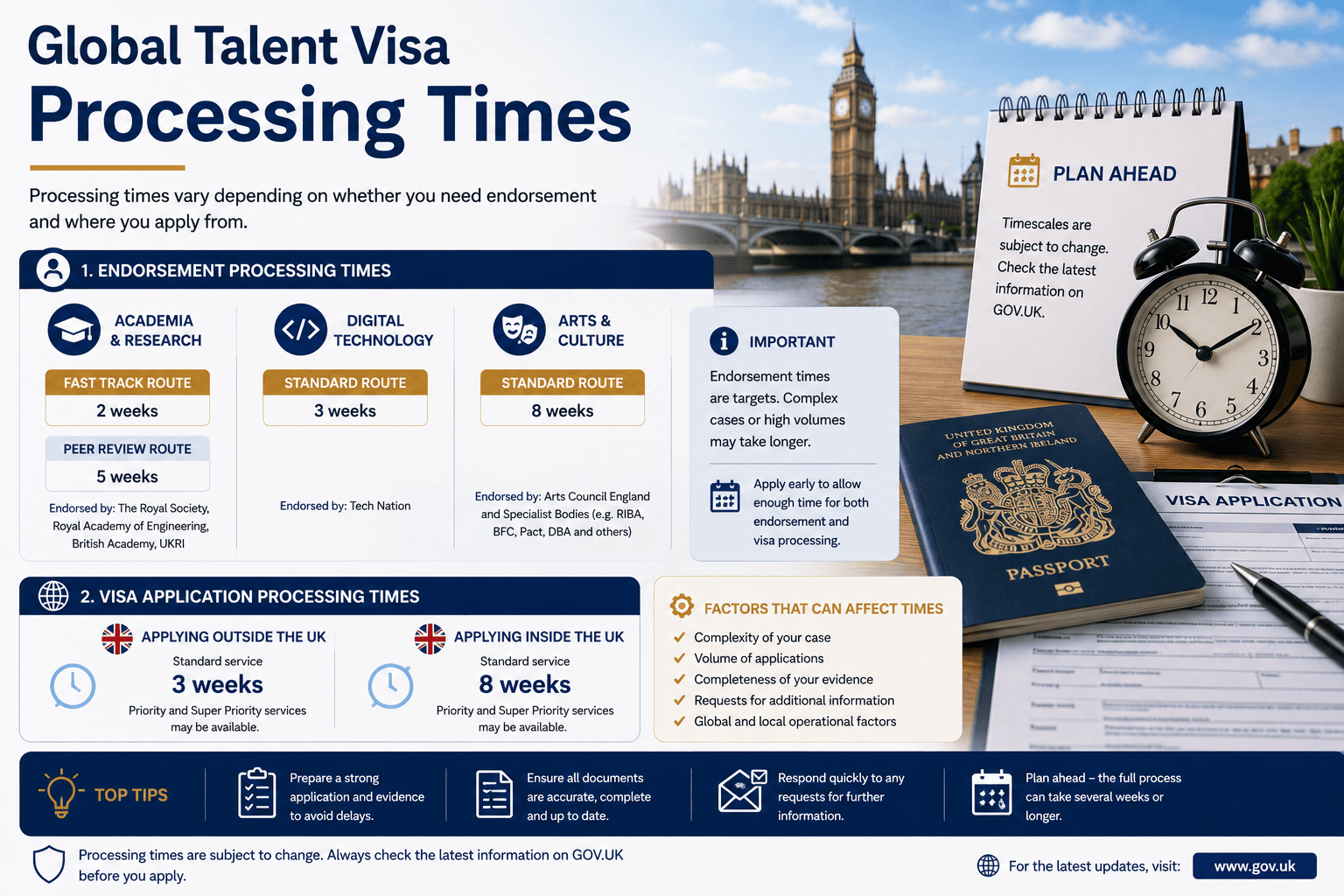
How long a UK Global Talent Visa application takes depends first on whether the applicant needs endorsement. Applicants relying on a qualifying prestigious prize can proceed directly to the visa application, while applicants who require endorsement need to factor in the Stage 1 endorsement decision before, or alongside, the Home Office visa application.
How Long Does Global Talent Endorsement Take?
Endorsement processing times vary depending on the Global Talent pathway and endorsing body.
Applicants should check the current published processing timeframe for the specific pathway they are using rather than relying on a general estimate.
Applicants should also allow sufficient time to prepare their recommendation letters and supporting evidence before submitting the endorsement application. For evidence-led pathways, preparing the portfolio can take longer than the formal decision period, particularly where documents need to be obtained from third parties or professional achievements need to be independently verified.
How Long Does the Global Talent Visa Take?
Once the visa application has been submitted, the applicant has completed the required identity process and provided the necessary supporting documents, the standard Home Office processing times are currently:
- a. 3 weeks for applications made from outside the UK.
- b. 8 weeks for applications made from inside the UK.
These are standard processing times rather than guaranteed decision dates. UKVI may take longer where additional information is required, documents need to be verified, or further consideration of the application is necessary.
Applicants who require endorsement should therefore remember that the overall process can take longer than the visa-stage processing time alone.
Can You Get a Faster Global Talent Visa Decision?
Priority or super priority processing may be available for some Global Talent Visa applications, depending on where and how the application is submitted and whether the service is available at the time of application.
Where available, applicants may be able to pay an additional fee for an expedited decision.
Applicants should not assume that priority or super priority processing will be available for every Global Talent application. Availability should be checked during the application process rather than treated as part of the standard processing timetable.
When Does the Processing Time Start?
The published visa processing period does not necessarily begin when an applicant starts completing the online application form.
For applications made from outside the UK, the relevant processing period generally begins after the applicant has submitted the application, completed the required identity process and provided the necessary documents.
For applications made inside the UK, applicants should follow the biometric or identity instructions provided by UKVI promptly. Delays in completing the required steps or providing requested information can affect the processing of the application.
Can You Travel While an In-Country Application Is Pending?
Applicants who apply to switch to or extend Global Talent permission from inside the UK should not travel outside the UK, Ireland, the Channel Islands or the Isle of Man while their application is pending.
Leaving the relevant Common Travel Area before a decision is made can result in the application being treated as withdrawn.
This is particularly important for Global Talent applicants whose professional activities involve regular international travel, including conferences, performances, research trips, business activities or industry events.
Applicants should therefore consider their planned travel schedule carefully before submitting an in-country application.
United Press Insight for Applicants
Applicants should not plan their entire Global Talent Visa timeline around the visa-stage processing period if endorsement is still required.
The realistic timeline should also include the time needed to identify the correct pathway, prepare the endorsement application, obtain recommendation letters, organise supporting evidence and allow for the endorsement assessment.
For applicants making an in-country application, travel plans should also be reviewed before submission. An international trip while an application is pending can have significant consequences for the application.
For professionals preparing their Global Talent profile, United Press can help develop genuine editorial media recognition around real achievements, expertise, innovation, leadership and industry contribution.
Section J: How Difficult Is It to Get a Global Talent Visa?

The UK Global Talent Visa can be challenging to obtain because, for most applicants, the main professional assessment takes place during the endorsement stage. The question is not simply whether an applicant has an impressive career or strong professional reputation, but whether their achievements and evidence satisfy the specific requirements for Exceptional Talent or Exceptional Promise under the pathway they are relying on.
Applicants who qualify through a listed prestigious prize can avoid the endorsement stage, but eligibility for the prize route is limited. For other applicants, the quality and relevance of the endorsement case will generally be more significant than the later visa application.
What Is the Global Talent Visa Success Rate?
Published Home Office immigration statistics should be considered carefully when trying to determine the Global Talent Visa success rate.
Visa-stage statistics record immigration decisions, but they do not necessarily show how many people initially considered the route, prepared an application, or sought endorsement before reaching the visa stage.
An applicant who has already received endorsement has passed the main professional assessment. The subsequent visa application focuses on whether the applicant meets the relevant Immigration Rules, including the applicable endorsement or prestigious-prize requirement and the relevant validity and suitability requirements.
A high visa-stage grant rate therefore does not necessarily mean that obtaining Global Talent endorsement is easy. For applicants requiring endorsement, the more relevant question is whether their evidence is strong enough to satisfy the criteria applied by the appropriate endorsing body.
Why Are Global Talent Endorsement Applications Refused?
An applicant can have substantial experience and an impressive CV and still be refused endorsement.
The assessment is criterion-led, meaning the evidence needs to establish the particular requirements of the pathway being used.
Common weaknesses can include:
- Choosing a pathway that does not properly match the applicant’s professional background
- Providing evidence that demonstrates activity rather than significant achievement
- Failing to establish the applicant’s personal contribution to company, team or institutional achievements
- Using recommendation letters that provide general praise without specific supporting examples
- Relying too heavily on professional seniority or job title
A senior position, well-known employer, high salary or lengthy career can provide useful context, but these factors do not automatically establish Exceptional Talent or Exceptional Promise.
Is Exceptional Promise Easier Than Exceptional Talent?
Exceptional Promise is intended for applicants who can demonstrate the potential to become leaders in their field, while Exceptional Talent is intended for applicants who have already established the required level of leadership and recognition.
Exceptional Promise should not simply be treated as a fallback option for applicants whose evidence is not strong enough for Exceptional Talent.
Applicants applying under Promise still need to provide a persuasive professional record and evidence that meets the requirements of their specific pathway. An applicant with considerable professional experience may also face difficulties under Promise if their career history does not fit the profile expected by the route.
The appropriate category should therefore be determined by the applicant’s actual career stage, achievements and supporting evidence, rather than being selected simply because one category appears easier.
Does Endorsement Mean the Visa Will Be Granted?
No. Endorsement does not guarantee that a Global Talent Visa will be granted.
For applicants using the endorsement route, endorsement confirms that the professional assessment has been satisfied. However, the Home Office still considers whether the subsequent visa application is valid and whether the applicant meets the applicable immigration and suitability requirements.
A visa application can therefore be refused after endorsement if the relevant immigration requirements are not satisfied.
This distinction is also important when considering Global Talent success-rate figures. Endorsement and the visa application are separate decisions, so statistics for one stage should not automatically be interpreted as representing the success rate of the entire Global Talent process.
Can You Challenge a Global Talent Endorsement Refusal?
If an endorsement application is refused and the applicant believes the decision was incorrectly assessed, they may be able to request an endorsement review, subject to the applicable rules and procedure.
A review considers whether the original decision was correctly made based on the evidence submitted. It should not be viewed simply as an opportunity to introduce a completely new or substantially stronger application.
Where the underlying problem is that the evidence did not meet the required standard, a fresh endorsement application may be more appropriate. This can allow the applicant to address weaknesses, provide stronger evidence, or reconsider whether another eligible pathway better reflects their professional background.
Applicants should therefore examine the refusal reasons carefully before deciding how to proceed. An identifiable assessment error and an evidential weakness may require different responses.
How Can You Improve Your Chances of Endorsement?
A strong Global Talent application should begin with the endorsement criteria, rather than simply starting with the applicant’s CV.
First identify what needs to be demonstrated under the chosen pathway. Then select evidence that directly establishes each relevant requirement.
Recommendation letters should come from appropriate referees and provide specific examples of the applicant’s achievements, professional standing and contribution.
Documents relating to businesses, research teams, creative collaborations, products or major projects should also make the applicant’s personal contribution clear.
The evidence portfolio should be carefully edited rather than simply accumulated. Documents that repeat the same point, have limited independent value, or cannot be clearly connected to a specific criterion may make the application harder to assess without strengthening the underlying case.
Where relevant, genuine editorial media recognition can also help document professional achievements and independent recognition, provided the coverage accurately reflects the applicant’s real work and is relevant to the applicable professional narrative.
United Press Insight for Applicants
The best way to assess the strength of a potential Global Talent application is to test the case before applying.
If each relevant criterion cannot be mapped to persuasive evidence that demonstrates the applicant’s own contribution, professional standing and recognition, the weakness is likely to be in the endorsement case rather than simply in the CV.
For professionals building their wider profile, United Press helps develop genuine editorial media coverage around real achievements, expertise, innovation, leadership and industry contribution.
The objective is to create accurate, credible media recognition that complements the applicant’s existing professional achievements rather than exaggerating or manufacturing recognition.
Section K: Extending Your Global Talent Visa and Applying for ILR

The UK Global Talent Visa can be extended and can provide a route to indefinite leave to remain (ILR). There is no fixed maximum period for remaining on the Global Talent route, but applicants may become eligible for settlement after either three or five years, depending on the basis on which they qualified.
An extension or settlement application is not automatic. Applicants planning to remain in the UK long term should keep appropriate records of their qualifying UK earnings, immigration history and absences from the beginning of their Global Talent permission rather than waiting until an ILR application is approaching.
Can You Extend a Global Talent Visa?
Yes. Global Talent permission can generally be extended for up to five years at a time, and there is no fixed limit on the number of extensions available provided the relevant requirements continue to be met.
Applicants who originally qualified through endorsement need to ensure that the relevant endorsement has not been withdrawn and that the endorsing body continues to meet the applicable requirements.
Applicants who qualified through a prestigious prize have different extension requirements. They need to demonstrate qualifying UK earnings from work connected with the subject matter of the prize, without needing a new endorsement.
Applicants should submit an extension application before their existing permission expires.
What Is the Global Talent Earnings Requirement?
Applicants applying for an extension need to demonstrate that they earned money in the UK during their most recent period of Global Talent permission.
The earnings should come from work in the field in which the applicant was endorsed or, for an applicant who qualified through a prestigious prize, a field related to the subject matter of that prize.
There is no prescribed minimum earnings threshold. The important issue is whether the applicant earned qualifying income in the UK and whether the income can be connected to the relevant professional field.
The evidence required can depend on how the applicant works.
For example:
- Employees may provide payslips and employer documentation.
- Company directors may need company accounts or accountant confirmation.
- Self-employed applicants may rely on contracts, invoices, accounts or other business records.
- Consultants may need documentation showing both their income and the nature of the work undertaken.
Where financial documents do not clearly identify the relevant professional field, additional evidence such as an employment contract, employer letter or other supporting documentation may help establish the connection.
The flexibility of the Global Talent route makes record keeping particularly important for applicants combining employment, consultancy, self-employment, royalties or company activities.
When Can You Apply for ILR With a Global Talent Visa?
Global Talent Visa holders may qualify for settlement after three or five years, depending on the route through which they obtained their Global Talent permission.
| Global Talent Pathway | Typical ILR Qualifying Period |
|---|---|
| Royal Society, Royal Academy of Engineering, British Academy or UKRI endorsement | 3 years |
| Arts Council England or digital technology — Exceptional Talent | 3 years |
| Qualifying prestigious prize | 3 years |
| Arts Council England or digital technology — Exceptional Promise | 5 years |
Applicants should also ensure that the relevant endorsement or qualifying prestigious prize remains valid under the applicable settlement requirements.
The settlement timeframe can influence how long an applicant chooses to request when applying for Global Talent permission. Someone who expects to qualify for ILR after three years may not need to request five years of initial permission if the other settlement requirements are expected to be satisfied.
Applicants can generally submit an ILR application up to 28 days before completing the required qualifying residence period, subject to the applicable rules.
Can Time on Another Visa Count Towards Global Talent ILR?
Applicants do not necessarily need to spend the entire qualifying period holding Global Talent permission.
Depending on the applicable Immigration Rules, qualifying residence can include certain periods spent on other eligible immigration routes.
Applicants who have switched between immigration categories should carefully map their immigration history, particularly where there have been changes of route, gaps in permission or significant periods outside the UK.
Time spent as a dependant does not automatically count towards the main applicant’s Global Talent qualifying period.
What Is the Global Talent ILR Absence Rule?
Applicants seeking settlement need to satisfy the continuous residence requirements.
Under the general rule, absences from the UK must remain within the permitted limits during the qualifying residence period, subject to the relevant provisions of the Immigration Rules.
Certain applicants in academia and research may benefit from specific provisions concerning qualifying research-related absences outside the UK.
These provisions do not apply automatically to every Global Talent applicant. Applicants in digital technology, arts and culture, and other fields should consider the ordinary continuous residence requirements that apply to their circumstances.
Anyone relying on a research-related absence provision should maintain reliable records showing the dates, purpose and nature of qualifying overseas research throughout the relevant period.
Do You Need to Show Earnings for Global Talent ILR?
Yes. Settlement applicants need to demonstrate qualifying UK earnings during the relevant period of Global Talent permission.
For applicants who qualified through endorsement, the earnings should relate to work in the field in which they were endorsed.
For applicants who qualified through a prestigious prize, the earnings should relate to a field connected with the subject matter of that prize.
There is no prescribed minimum amount of qualifying income under the general Global Talent earnings requirement. The evidence needs to establish that the applicant received qualifying earnings in the UK and that those earnings relate to the required professional field.
Do You Need an English Test for Global Talent ILR?
There is no general English-language requirement for the initial Global Talent Visa or an extension.
English language requirements become relevant when an applicant applies for settlement, subject to the rules and exemptions applicable at the time.
Applicants approaching ILR should check the English-language requirement that will apply on the date they expect to make their settlement application and prepare accordingly.
Do You Need to Take the Life in the UK Test?
Applicants seeking settlement through the Global Talent route generally need to satisfy the Knowledge of Life in the UK requirement unless an exemption applies.
For many applicants, this means passing the Life in the UK Test before submitting the ILR application.
The Life in the UK requirement and English-language requirement are separate. Satisfying one does not automatically satisfy the other unless a specific exemption applies.
United Press Insight for Applicants
One of the advantages of the Global Talent Visa is its flexibility. Applicants can change employers, work independently and combine different forms of professional activity.
However, that flexibility makes good record keeping important when planning for an extension or eventual ILR application.
Applicants should maintain a clear record connecting their UK earnings to their endorsed field or prize-related field, while also keeping track of travel and absences from the UK.
For professionals building their long-term Global Talent profile, United Press can help develop genuine editorial media recognition around real achievements, expertise, innovation, leadership and industry contribution.
The objective is to build an accurate and credible professional profile that reflects the applicant’s genuine work and achievements.
Section L: Global Talent Visa Dependants

Global Talent Visa holders can generally be joined in the UK by an eligible partner and children, provided they meet the relevant dependant requirements.
Depending on when and how the applications are made, family members may apply alongside the main applicant or submit separate dependant applications.
A dependant partner must generally be aged 18 or over and can be a spouse, civil partner or qualifying unmarried partner, subject to the relationship requirements under the Immigration Rules.
Children will normally need to be under 18 when making their first dependant application. An older child may be able to continue as a dependant in certain circumstances where they already hold dependant permission and continue to meet the applicable requirements.
Can Your Partner Come to the UK?
An eligible partner can apply to accompany or join a Global Talent Visa holder in the UK.
The relationship must satisfy the applicable requirements under the Immigration Rules, including the rules relating to spouses, civil partners and unmarried partners.
A dependant partner makes their own immigration application rather than simply being added to the main applicant’s visa. Where family members apply together, each person will still have their own application fee and applicable Immigration Health Surcharge liability.
Can Your Children Come to the UK?
Children can apply as Global Talent dependants where they meet the relevant requirements.
A child will normally need to be under 18 at their first dependant application. An older child may continue as a dependant in certain circumstances where they already hold dependant permission and continue to satisfy the applicable age and independent-life requirements.
Families should consider the circumstances of both parents when applying for dependant children, particularly where only one parent is applying under the Global Talent route or the parents have different immigration statuses.
The applicable dependant-child requirements should be checked carefully before submitting an application.
Can Global Talent Dependants Work?
Dependant partners can generally work in the UK without employer sponsorship and are not restricted to the Global Talent holder’s employer or professional field.
They can also generally be self-employed.
However, work as a professional sportsperson or sports coach is not permitted. Other employment and professional activities are generally allowed subject to the conditions attached to the dependant’s immigration permission.
Dependants can also study in the UK, although an Academic Technology Approval Scheme (ATAS) certificate may be required for certain postgraduate courses where the ATAS requirements apply.
How Long Can Global Talent Dependants Stay?
A dependant partner will normally receive permission ending on the same date as the Global Talent Visa holder’s permission.
A dependant child will normally receive permission linked to the relevant parent’s immigration permission, subject to the applicable rules.
If the Global Talent holder later extends their visa, dependants do not automatically receive an extension. Each dependant who requires further immigration permission needs to make their own application.
A dependant does not necessarily need to submit an extension application at exactly the same time as the main applicant if their existing permission remains valid. However, families should consider different expiry dates when planning future applications.
Where the main Global Talent applicant has been or is being granted settlement, different provisions can apply to dependants who still require further permission.
Can Global Talent Dependants Apply for ILR?
A dependant partner has a separate route to settlement and does not automatically qualify for ILR when the Global Talent holder becomes eligible for settlement after three or five years.
A dependant partner will generally need to complete the required continuous residence period in the UK as a dependant partner and satisfy the other applicable settlement requirements.
This means that the main Global Talent applicant may become eligible for settlement before their partner.
Where the partner does not yet qualify for ILR, they may generally continue to extend their dependant permission provided they continue to meet the relevant requirements.
Different rules apply to dependant children, and their settlement eligibility can depend on the immigration status of their parents.
Families planning for ILR should therefore consider the settlement timeline for each individual family member rather than assuming that everyone will qualify at the same time as the main Global Talent applicant.
United Press Insight for Applicants
The main applicant’s potential three-year route to ILR does not automatically give a dependant partner the same settlement timetable.
Families planning to move to the UK together should therefore consider each person’s immigration route, dependant status, potential settlement date, extension requirements and associated costs before deciding how long to request for their initial permission.
For Global Talent applicants building their professional profile, United Press can help develop genuine editorial media recognition around real achievements, expertise, innovation, leadership and industry contribution.
Summary
The UK Global Talent Visa offers a flexible route for recognised leaders and potential leaders to work in the UK without employer sponsorship. For most applicants, the key challenge is obtaining endorsement under the correct professional pathway and demonstrating that their achievements, recognition and contribution meet the relevant criteria.
Applicants who are the named winners of qualifying prestigious prizes may be able to bypass endorsement and apply directly for the visa. For everyone else, the strength of the endorsement case depends on choosing the appropriate route and building evidence that clearly demonstrates the applicant’s own professional achievements.
A strong application should begin with pathway selection, followed by evidence that directly supports the applicable criteria. A successful career, senior position or impressive CV alone does not guarantee endorsement if the supporting evidence does not establish the required level of recognition, contribution or impact.
Once granted, the Global Talent route provides considerable flexibility over professional activities and can provide a pathway to settlement after three or five years, depending on the applicant’s circumstances and route. Applicants planning to remain in the UK should also prepare early by keeping appropriate records of qualifying earnings, professional activities and UK absences.
Need Assistance?
If you are considering the UK Global Talent Visa, two questions should be addressed early: which pathway fits your professional background, and does your available evidence clearly demonstrate the applicable criteria?
This is particularly important for applicants with mixed professional profiles, such as founders, technology professionals, researchers, consultants, academics, designers and creative professionals whose work may cross multiple fields.
Building professional recognition should also be approached strategically. United Press helps professionals develop genuine editorial media coverage around their real achievements, expertise, innovation, leadership and industry contribution.
The objective is not simply to generate publicity. It is to create accurate, credible media recognition that can support a wider professional profile and demonstrate visibility beyond an individual’s own organisation or personal platforms.
Build credibility. Earn genuine media recognition. Showcase your professional impact with United Press.
🌐 www.unitedpress.uk
💬 WhatsApp: +44 7447 882377
Global Talent Visa FAQs
What is the Global Talent Visa?
The Global Talent Visa is a UK immigration route for recognised leaders and potential leaders in eligible fields, including academia and research, digital technology, and arts and culture. The route does not generally require employer sponsorship and provides significant flexibility over professional activities.
Who is eligible to apply for the Global Talent Visa?
Applicants generally need to be aged 18 or over and either obtain endorsement under an eligible Global Talent pathway or qualify as the named winner of a qualifying prestigious prize.
How long does it take to get a Global Talent Visa?
The overall timeframe depends on whether endorsement is required. Applicants should allow time to prepare their endorsement application and supporting evidence before considering the visa-stage processing period.
Visa processing is generally faster than the full endorsement-to-visa process, and applicants should check the latest GOV.UK processing information when preparing their application.
Do you need a job offer for Global Talent?
No. A job offer and employer sponsorship are generally not required for the Global Talent route. Global Talent holders can work in different professional arrangements, including employment and self-employment, subject to the conditions of their permission.
Can you apply without endorsement?
Yes, if you are the named winner of a qualifying prestigious prize listed in Appendix Global Talent: Prestigious Prizes.
Applicants should check the exact prize against the current Immigration Rules because an award does not qualify simply because it is prestigious or well known.
What is the Global Talent Visa success rate?
There is no single figure that accurately represents the overall Global Talent Visa success rate.
Visa-stage statistics do not necessarily measure the number of applicants who attempted or sought endorsement before reaching the visa stage. For most applicants, the more important question is whether their evidence is strong enough to satisfy the requirements of the relevant endorsing body.
Is Global Talent easier to get than a Skilled Worker Visa?
Not necessarily. The Skilled Worker route is generally based on sponsored employment and the relevant job, salary and immigration requirements.
Global Talent is primarily an evidence-led route that depends on endorsement or a qualifying prestigious prize. The two routes therefore assess applicants in fundamentally different ways.
Is there an English test for the Global Talent Visa?
There is no general English-language requirement for the initial Global Talent Visa. English-language requirements can become relevant when an applicant later applies for settlement, subject to the rules and exemptions applicable at that time.
Is there a salary threshold for Global Talent?
There is no general minimum salary threshold for the initial Global Talent Visa.
However, qualifying UK earnings can become relevant when an applicant applies for an extension or settlement. The earnings need to be connected to the relevant endorsed field or, for a prestigious-prize applicant, the field related to the subject matter of the qualifying prize.
Can you bring dependants on a Global Talent Visa?
Eligible partners and children can generally apply as dependants of a Global Talent Visa holder, subject to the applicable dependant requirements.
Each dependant has their own application and applicable fees and Immigration Health Surcharge.
Can you work on a Global Talent Visa?
Yes. The Global Talent route provides considerable flexibility over professional activities. Holders can generally work for employers, undertake self-employment and carry out other permitted professional activities, subject to the conditions of their immigration permission.
Which organisations assess Global Talent endorsements?
The relevant assessment organisation depends on the applicant’s professional field and pathway.
Academia and research applications may involve organisations including the Royal Society, Royal Academy of Engineering, British Academy and UK Research and Innovation. Digital technology applications follow the relevant digital technology endorsement pathway, while arts and culture applications are assessed through Arts Council England and specialist bodies for areas such as architecture, fashion, film and television and design.
How long is the Global Talent Visa valid for?
Applicants can generally choose the length of their Global Talent permission within the period permitted by the route. The appropriate length can depend on the applicant’s circumstances, future extension requirements and settlement plans.
Can you extend the Global Talent Visa?
Yes. Global Talent permission can generally be extended where the applicant continues to satisfy the applicable requirements.
Applicants should maintain appropriate records of their qualifying UK earnings and professional activities because these can become relevant to future extension and settlement applications.
What are the benefits of the Global Talent Visa?
Key benefits can include:
- No general employer sponsorship requirement
- Flexibility to change professional activities
- Ability to work in permitted employment or self-employment
- Ability to establish or run a business where permitted
- Potential route to settlement
- Ability for eligible family members to accompany the main applicant
Can you switch to Global Talent from another UK visa?
In many circumstances, applicants can switch into the Global Talent route from within the UK. However, certain immigration categories are excluded from switching.
Applicants should check their current immigration status and the latest Immigration Rules before relying on an in-country application.
How much does the Global Talent Visa cost?
The cost depends on how the applicant qualifies and whether endorsement is required.
For applicants using the endorsement route, the application fee is divided between the endorsement stage and visa stage. Applicants using a qualifying prestigious prize do not need a separate endorsement application.
The Immigration Health Surcharge and other potential costs may also apply.
What documents are required for the Global Talent Visa?
Visa-stage documents normally include evidence of identity and any other documents required by UKVI based on the applicant’s circumstances.
Applicants who require endorsement will also need to satisfy the documentary requirements of their specific endorsement pathway, which can include recommendation letters and supporting evidence demonstrating their professional achievements and recognition.
Global Talent Visa Glossary
| Term | Definition |
|---|---|
| Global Talent Visa | A UK immigration route for qualifying leaders and potential leaders in eligible fields, offering flexibility over permitted professional activities and a potential pathway to settlement. |
| Endorsement | Professional approval from the relevant authorised organisation confirming that an applicant meets the requirements of the applicable Global Talent pathway. |
| Exceptional Talent | A category generally intended for applicants who have already established themselves as leaders in their professional field. |
| Exceptional Promise | A category generally intended for applicants who demonstrate the potential to become leaders in their professional field. |
| Prestigious Prize | A qualifying prize specifically listed under Appendix Global Talent: Prestigious Prizes that may allow the named winner to apply without endorsement. |
| Endorsing Body | The organisation responsible for assessing whether an applicant meets the professional criteria for the relevant Global Talent pathway. |
| Settlement (ILR) | Indefinite Leave to Remain, allowing an eligible person to remain in the UK without a time limit, subject to satisfying the applicable settlement requirements. |
| Professional Recognition | Evidence that an applicant’s achievements, expertise or contribution are recognised beyond their immediate organisation or personal professional network. |
| Editorial Media Recognition | Genuine third-party media coverage that reports on an individual’s achievements, expertise, work or contribution in an editorial context. |
Build Your Global Talent Professional Recognition
A strong Global Talent profile starts with genuine achievements. The next step is making those achievements visible, credible and clearly understood.
United Press helps professionals build genuine editorial media recognition around their expertise, achievements, innovation, leadership and industry impact.
Start building recognition before you need it.
🌐 Visit United Press: www.unitedpress.uk
💬 WhatsApp: +44 7447 882377
United Press — Build credibility. Earn genuine media recognition. Showcase your professional impact.