
Unitedpress.uk

Best PR Agency UK

Best PR Agency UK 2026

Facebook group post removal: removing a harmful post from a UK business owners Facebook group Remove a Facebook group post: a harmful post in a local community Facebook group being deleted
Facebook group post removal · UK · confidential

Facebook Group Post Removal — Take Back Control of What Your Community Sees

A single post in a local Facebook group can undo years of hard work overnight. United Press assesses every harmful post, pursues every legitimate route to have it removed, and protects your name while we do it, so the people who matter see the truth about you.

🛡️ GuaranteedEvery harmful post dealt with — removed wherever Meta’s rules or UK law allow, and pushed down by genuine positive coverage where they don’t. Never ignored.

  • Every postassessed against Meta’s rules and UK law
  • Every routeadmins, Meta reports, legal and privacy channels
  • Every casea plan to remove the post or push it out of sight
  • Since 2001UK reputation and PR specialists
It usually starts like this

It is nearly midnight. Your phone lights up with a screenshot from a friend. Someone has posted about you, or your business, in a Facebook group with thousands of local members. The post is angry, one-sided and, in places, simply untrue.

You read the comments. Strangers are agreeing. People you know have reacted. Someone has tagged your business page. You feel sick, then furious, then helpless, because you cannot delete it, you cannot reply without making it worse, and you do not know who to ask.

By morning, customers are asking about it. A supplier has seen it. Your team has seen it. And it is still there.

You are not overreacting. A post like this can take away customers, staff, sleep and peace of mind.

The good news is that most harmful Facebook group posts can be dealt with. Some can be removed quickly through the right channel. Others take persistence, evidence and, occasionally, legal pressure. And where a post cannot be removed, its impact can still be reduced so it no longer defines you.

That is what we do. Calmly, confidentially, and with more than two decades of reputation experience behind us.

Can a post in a Facebook group be removed?

Yes, many harmful Facebook group posts can be removed, but only through the right route. A post in a Facebook group can be taken down by the person who wrote it, by the group’s admins or moderators, by Meta when it breaks the Community Standards or the law, or under a court order. There is no single “delete” button for someone else’s post, so the key is matching the post to the route most likely to work.

The five main removal routes are:

  1. A calm, evidence-based request to the group admins or moderators
  2. A report to Meta under its Community Standards, for example bullying, harassment, hate speech, fraud or privacy violations
  3. A legal report to Meta for defamation, privacy or intellectual property, such as a photo used without permission
  4. A formal request based on UK data protection law where personal data is exposed
  5. Where justified, a solicitor’s letter or court order for serious defamation or harassment

United Press assesses your post, chooses the right route, prepares the evidence and follows it through. If a post cannot be removed, we reduce its impact with professional responses, genuine positive voices and fresh coverage that changes what people find.

Written for UK businesses, professionals and individuals. Updated September 2026. This page is general information, not legal advice.

Who actually decides

Who can remove a Facebook group post? Four people hold the key

Knowing who has the power to remove a post is the first step. Each one responds to a different kind of request.

The person who posted it

The author can delete their post at any time. A calm, well-judged approach sometimes resolves things fastest, especially when the post came from a misunderstanding or a heated moment.

Best when: there is a fixable dispute

Group admins and moderators

Admins can remove any post in their group and decline future posts. Most want to avoid legal risk and keep their group respectful, so a clear, factual request with evidence often works.

Best when: the post breaks group rules

Meta (Facebook)

Meta removes content that breaks its Community Standards or the law, including harassment, threats, hate speech, scams, privacy violations and intellectual property infringement.

Best when: a clear policy is broken

The courts

For serious defamation or harassment, a UK court can order removal or require a platform to disclose who is behind an anonymous account. This is a last resort, handled with solicitors.

Best when: harm is serious and ongoing

What can be removed?

Which Facebook group posts can be removed? An honest guide by post type

Every case is different, but these are the posts we see most often and how realistic removal usually is.

Type of postUsual routeRemoval outlook

Threats, harassment or targeted abuse

Meta Community Standards (bullying and harassment, violence) and, where criminal, UK harassment law.

Strong

Your address, phone number or private details

Meta privacy reporting and UK data protection rights. Admins usually act quickly too.

Strong

Your photos or logo used without permission

Meta intellectual property report (copyright or trade mark).

Strong

Impersonation or fake accounts posting as you

Meta impersonation reporting with proof of identity or business ownership.

Strong

Hate speech about you or your staff

Meta Community Standards (hateful conduct).

Strong

False allegations of crime, fraud or unsafe practice

Admin request with evidence, Meta defamation report, and a solicitor’s letter where serious harm is shown.

Good

Fake “reviews” from people who were never customers

Admin request with records showing no transaction, plus Meta reporting where the post is part of a pattern.

Good

Ex-employee or ex-partner revenge posts

Depends on content: harassment, privacy or defamation routes, plus admin request.

Good

Competitor smear posts or coordinated pile-ons

Evidence of coordination or fake accounts, admin request, Meta inauthentic behaviour reports.

Good

A genuine customer’s honest negative opinion

Rarely removable, as honest opinion is protected. Best handled by a professional response and reducing its impact.

Limited

Outlooks are general guidance based on how Meta’s policies and UK law usually apply. Your free assessment gives you an honest view of your specific post.

Where it happens

The Facebook groups where harmful posts spread fastest

Different groups behave differently. Knowing how a group works tells us how its admins are likely to respond and which removal route will work best.

Town and village community groups

Often tens of thousands of local members and a handful of volunteer admins. Posts spread quickly, but many admins respond well to a respectful, evidence-backed request.

“Spotted” and local news groups

Built for gossip and sightings, with photos of people and vehicles taken without consent. Privacy and image routes are often the strongest here.

Parent, school and nursery groups

Emotional, fast-moving and closely followed. Posts naming staff or children need careful, quick handling to protect everyone involved.

Buy, sell and recommendation groups

Where “avoid this business” warnings and fake review-style posts are most common. Transaction records are usually the key evidence.

Industry and professional groups

Smaller, but read by the people who matter most to your career or business. Admins tend to be protective of the group’s professional reputation.

“Warning” and dating-safety groups

Admins often resist removal on principle, so direct requests rarely work alone. Privacy, harassment and defamation routes through Meta matter more.

Straight talk

What we guarantee, and what nobody honestly can

You deserve the truth before you decide anything. Some firms promise to “guarantee removal” of any post. The final decision on a Facebook post rests with the author, the group admins, Meta or a court, so here is what we can promise you.

What we guarantee

  • Every harmful post is assessed against Meta’s Community Standards and UK law
  • An honest verdict on your chances before any work begins
  • Every legitimate removal route is pursued, not just one report
  • Evidence is prepared properly, the way admins and Meta need it
  • Complete confidentiality: nobody is told you contacted us
  • A plan for every case: removal where possible, damage control where not

What nobody can honestly promise

  • That Meta or an admin will remove a post that breaks no rule and no law
  • That honest opinions from real customers can be deleted
  • That a post will never be screenshotted or reshared elsewhere
  • Instant results in every case, as some routes take weeks
  • Anything achieved through hacking, fake reports or pressure on admins, which we never use
The rules that matter

UK law and Facebook rules that can get a group post taken down

Facebook group posts are not above the law. These are the rules we use most often when building a removal case for a UK client.

Meta Community Standards

Facebook’s own rules

Meta removes content that involves bullying and harassment, threats, hateful conduct, fraud and scams, privacy violations and coordinated inauthentic behaviour. Most successful removals use this route.

Defamation Act 2013

False statements that cause serious harm

A statement is defamatory if it has caused, or is likely to cause, serious harm to reputation. For a business, that means serious financial loss. Claims generally need to be brought within one year of publication.

Protection from Harassment Act 1997

Repeated, targeted conduct

A course of conduct that causes alarm or distress can amount to harassment, which can support both a Meta report and, where needed, civil or criminal action.

UK GDPR & Data Protection Act 2018

Your personal information

Posts that expose personal data, such as home addresses, phone numbers, health details or images of you, can be challenged using data protection rights, including the right to erasure.

Copyright, Designs and Patents Act 1988

Your photos and content

If someone has posted your photographs, videos or other creative work without permission, an intellectual property report is often one of the fastest removal routes.

Online Safety Act 2023

Platform duties on illegal content

Since March 2025, large platforms have had legal duties, overseen by Ofcom, to act on illegal content such as threats and harassment once they are made aware of it.

This is general information, not legal advice. Where a case needs legal action, we work alongside specialist UK solicitors so you get the right advice for your situation.

Reporting routes explained

How to report a Facebook group post the right way

Choosing the wrong report is the most common reason a harmful post stays up. Each route below is reviewed differently, by different teams, against different rules.

Community Standards report

Made from the three dots on the post. Best for harassment, threats, hate speech, scams and nudity. It is reviewed against Meta’s policies, not against whether a statement is true, so choosing the most accurate category matters.

Privacy and image report

For posts that share your address, phone number, private documents or photos of you without consent. Meta offers specific privacy reporting for images of you, and UK data protection rights can support the request.

Intellectual property report

For your photographs, videos, logo or written content used without permission. Rights holders can file copyright and trade mark reports through Meta’s intellectual property forms, which are handled by a separate team.

Defamation report

A legal report for false statements of fact that damage your reputation. Meta considers it against local law, so the report needs to identify exactly what is false and why, supported by evidence.

Impersonation report

For accounts or pages pretending to be you or your business. Meta may ask for proof of identity or proof that you own the business name.

Review and appeal

If Meta decides a post does not break its rules, a review can sometimes be requested, and certain decisions can be referred to the independent Oversight Board. New evidence often makes the difference.

We decide which route to use, in which order, and with what evidence. Filing several unfocused reports at once can slow things down, while one well-prepared report to the right team is often all it takes.

How it works

How to remove a Facebook group post: our seven-step process

A structured approach works far better than repeated reporting. This is how we handle every case.

  1. Secure the evidence

    We capture the post, comments, URLs, dates and group details before anything can be edited or deleted.

  2. Assess the post

    We check it against Meta’s policies and UK law and give you an honest view of the best route.

  3. Approach the admins

    Where it helps, we send a calm, factual, evidence-backed request to the group admins or moderators.

  4. Report to Meta

    We file the right report: Community Standards, privacy, impersonation, intellectual property or defamation.

  5. Escalate if needed

    We pursue reviews and appeals and, for serious cases, coordinate with solicitors on formal letters.

  6. Check it has gone

    We confirm removal and look for screenshots, reshares and copies in other groups or on Google.

  7. Rebuild your name

    We help you respond, gather genuine positive voices and publish fresh coverage in trusted titles.

Start With a Free, Confidential Assessment →

Working with group admins

How we ask Facebook group admins to remove a post

Group admins are volunteers, local business owners or community organisers. Most are not trying to harm anyone; they are busy people running a group. An aggressive message makes them defensive. A clear, respectful one, with evidence, gives them a reason to act.

A good admin request, the kind we prepare for clients, usually includes:

  • A short, polite introduction and the exact link to the post
  • Which of the group’s own rules the post breaks, quoted directly
  • The specific statements that are false, and the evidence that shows it
  • Any personal information, photos or private details that should not be shared
  • A reasonable request: removal, closing comments or adding a correction
  • A calm note that the matter may otherwise need to be reported to Meta

We never threaten, harass or pressure admins, and we never offer them anything in return. That approach protects you, keeps the moral high ground on your side and, in our experience, gets better results.

Extract from an admin request “Hello, thank you for running this group, we know how much time it takes. We are writing about a post shared on 12 September (link below). It states that our business ‘never delivers’. We have attached the delivery confirmations for every order linked to that customer. The post also includes our manager’s personal mobile number, which your group rules say should not be shared. We would be very grateful if you could remove the post or, if you prefer, close comments and add a note that the claim is disputed.”

An illustration of the tone and structure we use. Every request is written for the specific post and group.

The first 24 hours

Just found a harmful post about you? What to do right now

What you do in the first day can make removal easier, or much harder. Here is our advice.

Do

  • Screenshot the post, the comments and the group name, including the date and time
  • Copy the post’s link by using “Copy link” on the post itself
  • Write down who posted it and anyone who shared it
  • Note any real impact: cancelled orders, calls, messages or lost customers
  • Check whether the same post appears in other groups
  • Take a breath before you respond anywhere
  • Get an assessment before making any report

Don’t

  • Reply angrily in the comments, which pushes the post higher in the group
  • Ask friends to mass-report it, which can look coordinated and backfire
  • Threaten the poster or the admins publicly
  • Post your own rebuttal in the group before you have a plan
  • Create fake accounts to defend yourself
  • Hire anyone who offers to “hack” or bribe their way to removal
  • Assume nothing can be done, because often it can
Evidence of harm

Is the post causing you serious harm? Nine things to record

For defamation and harassment routes, being able to show real harm makes a case much stronger. Start recording these as soon as you can.

Cancelled orders and bookings

Dates, details of the lost work and any messages that mention the post.

Customer comments

Calls, emails or reviews from people who say they saw the post.

Drop in enquiries

A before-and-after comparison of website visits, calls or bookings.

Staff impact

Team members being approached, questioned or harassed because of the post.

Supplier or partner concerns

Anyone who has paused, questioned or ended a working relationship.

Reach of the post

Group size, reactions, comments and shares, captured with dates.

Repeat posting

Evidence of the same person posting again, in other groups or under other names.

Search visibility

Screenshots showing the post or its copies appearing in Google results for your name.

Your own wellbeing

Notes on how the post is affecting you and your family. It matters, and it can matter legally too.

Who we help

Who needs Facebook group post removal?

Local and community Facebook groups have huge reach and very little moderation. These are the people and businesses who come to us most often.

Restaurants, cafés and takeaways

False food poisoning claims or hygiene accusations can empty a dining room in a weekend.

“Everyone who ate there got sick”, posted by someone who never visited.

Tradespeople and builders

“Cowboy builder” warnings spread fast in local groups, often during an unresolved dispute.

A named-and-shamed post during a disagreement over unfinished work.

Clinics and health practitioners

Dentists, aesthetics clinics and therapists face posts that can breach patient confidentiality as well as fairness.

An allegation that cannot be answered publicly without breaking confidentiality. See our healthcare PR page.

Estate agents and landlords

Tenant and property disputes often spill into town groups with personal details attached.

A landlord’s home address shared alongside a complaint. See our property PR page.

Schools, nurseries and clubs

Parent groups can turn a single incident into a community-wide crisis within hours.

Staff named in a post about an incident still being investigated. See education reputation.

Professionals and individuals

Directors, doctors, lawyers and private individuals targeted by ex-partners, ex-staff or strangers.

A revenge post that appears whenever someone searches your name.

Not a local business? We also help start-ups, online brands and larger companies facing coordinated posts across several groups. See our broader Facebook reputation management service, and our guide to reputation management for local businesses.

Farms and rural businesses

Facebook group posts about farms, farm shops and rural businesses

Village and rural community groups are some of the most active on Facebook, and farms are among the businesses most often targeted. A photo of livestock taken out of context, a complaint about mud on the road, a planning dispute over a new farm shop or barn conversion, or an accusation about animal welfare can travel from one village group to a whole county in a day.

For farming families, these posts are rarely “just business”. They are about a name that may have been respected in the area for generations. Many posts include photographs taken on private land, the location of the farm, or allegations that are simply untrue, all of which can give grounds for removal.

  • Photos taken on private land or of your family, staff or animals
  • False animal welfare or food safety allegations
  • Planning and diversification disputes that turn personal
  • Farm shop, café and farm-stay complaints from people who never visited

Once a harmful post is dealt with, we help rural businesses put their real story back in front of people through agriculture and regional publications, such as:

Read more on our agriculture PR agency page.

Facebook group posts about farms: a farm business owner rebuilding their reputation with positive agriculture press coverage
When removal is not possible

If a post cannot be removed, we take away its power

Some posts are genuine opinions, or sit in groups whose admins will not act. That does not mean you are powerless. We deal with every negative post, and where removal is not possible, we reduce its impact so it stops shaping how people see you.

A measured public response

One calm, factual reply, written with you, that shows readers you take concerns seriously.

A right of reply

Where appropriate, we ask admins to add a correction, close comments or pin a response.

Genuine positive voices

We help real, happy customers share their experience, so one post is no longer the only voice.

Trusted published coverage

We publish positive, accurate stories in respected titles, so search results and AI answers reflect the real you.

Example of a calm public reply “Thank you for raising this. We take every concern seriously and have not been able to find a booking under this name, so we would really like to understand what happened. Please message us directly or call the shop and ask for Emma, and we will do everything we can to put it right.”
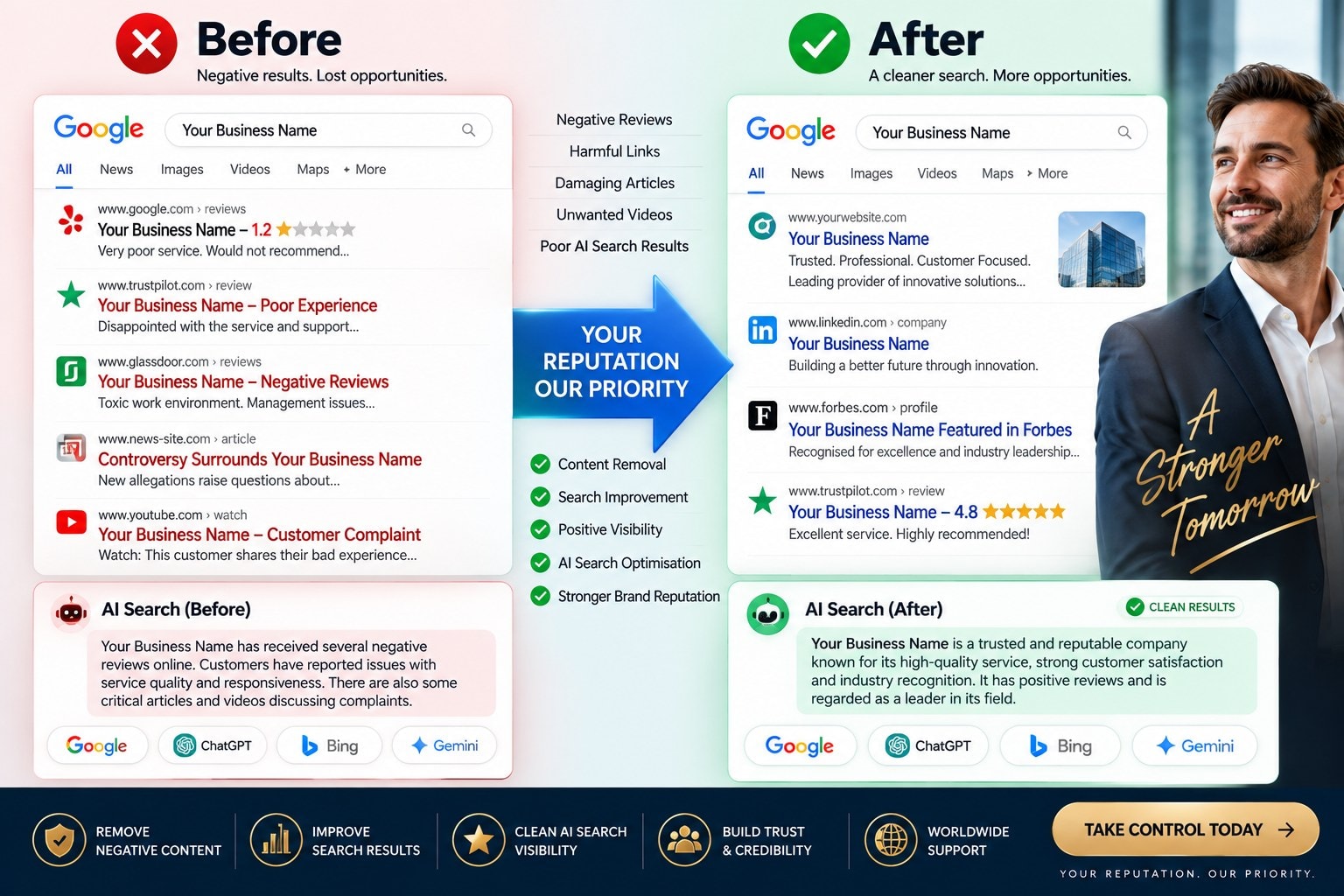
Reduce the impact of a Facebook group post: before and after search results once negative posts are replaced by positive coverage

Taking away a post’s power means changing what people find and feel when they search for you, not hiding the truth.

Google, ChatGPT and AI search

Why a Facebook group post can follow you into Google and AI answers

Many people think a Facebook group post stays inside Facebook. Often it does not.

Posts in public Facebook groups can be indexed by search engines, which means a harmful post can appear when someone searches your name or your business. Screenshots get shared on other platforms and forums. And AI assistants such as ChatGPT, Gemini, Perplexity and Google’s AI Overviews learn from what is publicly available online. If the loudest thing about you is a negative post, that is the story they may repeat.

That is why we treat every case as a search and AI problem as well as a Facebook problem. Once a post is dealt with, we make sure the trusted, accurate information about you is stronger, clearer and easier to find than the complaint ever was.

  • We check Google results for your name and business after removal
  • We look for screenshots and copies on other sites and in other groups
  • We publish accurate, positive coverage in publications that search engines and AI tools trust
  • We help keep your business facts consistent everywhere, which strengthens how AI tools describe you

For businesses that want to go further, we can place positive stories in national and business titles such as The Times, Evening Standard, Business Insider, London Loves Business and New Statesman, alongside regional titles such as the Bucks Free Press. Read how we help brands get mentioned by ChatGPT, how to earn a Google Knowledge Panel, and which are the best publications for AI visibility.

Your options compared

Reporting it yourself vs a solicitor vs United Press

Each option has its place. Here is how they compare for a typical harmful Facebook group post.

What mattersReporting it yourselfSolicitor onlyOnline “removal” sellersUnited Press
Choosing the right routeTrial and errorLegal routes onlyOften one generic reportEvery route assessed for your post
Evidence preparationUsually limitedThoroughRarelyPrepared the way admins and Meta need it
Speed for policy breachesVariesSlower, formalVariesFast, direct reporting
Honest assessmentYesOften promises “guaranteed removal”Honest verdict before work begins
If removal failsPost staysLitigation may be the next stepOften nothing moreReduce its impact with responses, reviews and coverage
Google and AI searchNot coveredNot usually coveredNot coveredIncluded in every plan
Protect yourself

Six warning signs of a Facebook post removal scam

When you are upset, it is easy to trust anyone who promises to make a post disappear. Be careful of these.

“100% guaranteed removal”

Nobody controls Meta’s or an admin’s decisions. Be wary of anyone who says otherwise without looking at your post.

Offers to hack an account

Accessing someone’s account is illegal in the UK and can turn you from the victim into the wrongdoer.

Mass-reporting bots

Coordinated fake reports break Meta’s rules, rarely work and can get your own accounts restricted.

Bribing admins

Offering admins incentives to delete posts can become a new story in itself, and a far worse one.

No questions asked

A good specialist wants to understand the post, the context and the harm before promising anything.

Anonymous sellers

Forum and marketplace sellers with no company, address or history are not accountable when things go wrong.

United Press is a UK agency established in 2001, based in Brook’s Mews, London. Read more about us.

Why United Press

Why people trust United Press with a harmful Facebook post

When something personal is at stake, you need people who are calm, careful and on your side.

Experience

UK specialists since 2001

More than two decades of UK public relations and reputation work, from local businesses to national brands.

Discretion

Complete confidentiality

Nobody is told you contacted us. We never post, comment or approach anyone on your behalf without your agreement.

Honesty

A straight answer first

You get an honest view of what can be removed before any work begins, and why, in plain English.

Legitimate methods

No shortcuts that backfire

Only admin requests, official Meta routes, data protection and intellectual property rights, and solicitors where justified.

Complete cover

Removal and recovery

We deal with the post, its copies, the search results and what AI tools say, then help rebuild your reputation.

Reach

1,670+ publications

When it is time to rebuild, we can place your real story in named national, regional and agriculture titles.

An illustrative case

How a café might recover from a false post in a town group

This is an illustration of how a case can work, not a real client story.

Imagine a family-run café. On a Friday night, someone posts in a 30,000-member town group claiming that “half of my family got food poisoning there”. The café has no booking or order matching that day, and the account was created two weeks earlier. By Saturday morning, the post has hundreds of comments and bookings are being cancelled.

Hour 1–4

Evidence

The post, comments, account details and the café’s records for that day are secured. The owner is advised not to reply yet.

Day 1

Admins

A factual request goes to the group admins, showing there is no record of the visit and pointing to the new, empty account.

Days 1–7

Meta

If the admins do not act, the post is reported to Meta, with evidence of a likely fake account and a false allegation.

Weeks 2–6

Recovery

Loyal customers share genuine experiences, and a positive local story is published so the café’s name is associated with the truth.

Restaurants and food businesses can also see our restaurant and food PR page. If you are dealing with fake reviews on other platforms too, see how we help remove Google reviews and remove Trustpilot reviews that break the rules, or read about news article reputation management and our full online reputation management service.

Plain-English terms

Facebook post removal terms explained

Community Standards

Meta’s rules for what is and is not allowed on Facebook, Instagram and Threads, covering areas such as bullying, harassment, hate speech, violence, privacy and fraud.

Admin and moderator

The people who run a Facebook group. Admins have full control of posts, members and settings; moderators can usually approve and remove posts.

Public vs private group

Anyone can see posts in a public group, and they may appear in search engines. Only members can see posts in a private group, although screenshots can still spread.

Defamation

A false statement of fact, published to others, that causes or is likely to cause serious harm to someone’s reputation. In writing, such as a Facebook post, this is known as libel.

Norwich Pharmacal order

A UK court order requiring a third party, such as a platform, to disclose information that helps identify someone believed to have committed a wrong.

Reputation repair

Reducing the impact of a post that cannot be removed, through responses, genuine positive voices and trusted published coverage.

In their words

What our clients say

Real clients, in their own words.

“The team understood our industry and, more importantly, understood the story we needed to tell. Seeing our company featured across relevant publications gave us a much stronger presence when potential customers researched us.”
Olivia BennettMarketing Director
“United Press helped us turn our company story into something journalists could genuinely engage with. The coverage gave our brand a level of credibility that was difficult to achieve through our own marketing channels.”
James WhitmoreFounder & CEO
“United Press built our brand from launch to nationwide recognition. Real media coverage gave new customers the trust they needed — our ROI has been over 100:1, which blows my mind.”
Annabelle SparksGlobal Head of Marketing
Questions

Facebook group post removal: frequently asked questions

Removing a post

How do I get a post removed from a Facebook group I am not an admin of?

You can ask the person who posted it, message the group admins or moderators, or report the post to Meta if it breaks the Community Standards or the law. The most effective route depends on what the post says, which is why we assess it first.

Can Facebook remove a post from a private group?

Yes. Meta’s Community Standards apply to private groups too, and members can report posts to Meta, not just to the admins. We advise on how to report from inside a private group without making things worse.

How long does it take to remove a Facebook group post?

Clear policy breaches, such as threats, personal information or copyright, can sometimes be removed within days. Admin requests vary. Defamation cases that need escalation can take several weeks. We give you a realistic timeline in your assessment.

Can you guarantee a Facebook group post will be removed?

No one can honestly guarantee that, because the decision rests with the author, the admins, Meta or a court. What we guarantee is an honest assessment, every legitimate route pursued, full confidentiality, and a plan to limit the damage if it cannot be removed.

Will the person who posted it know I asked for removal?

Meta does not normally tell the poster who reported a Community Standards breach. Some legal reports, such as defamation or intellectual property, may share details with the poster. We explain this before any report is made, so there are no surprises.

Can you remove comments as well as posts?

Yes. The same routes apply to comments, and we often deal with a post and its most harmful comments together.

What if the post has been shared into other groups?

We track reshares and copies and deal with each one. Removing the original often removes shares of it too, but screenshots need to be handled separately.

Can a whole Facebook group be removed?

Meta can remove groups that repeatedly break its Community Standards, for example groups built around harassment or hate. It is rare and reserved for serious, repeated breaches, but we document patterns where they exist and report them.

What if the post is true but unfair?

True statements are generally protected, but a post can still break rules if it shares private information, harasses someone or uses photos without permission. If none of those apply, we focus on reducing its impact with a calm response, genuine positive voices and trusted coverage.

Can I stop the same person posting about me again?

Admins can remove or block members from their group, and Meta can restrict accounts that repeatedly break its rules. For persistent targeting, harassment law may also help. We advise on the right combination for your situation.

Does deleting a post remove it from Google?

Usually, once search engines recrawl the page, a deleted post drops out of results. Copies, screenshots and cached versions can take longer, so we check and deal with them as part of every case.

Law and rules

Is a Facebook group post defamation?

It can be. Under the Defamation Act 2013, a false statement of fact that causes or is likely to cause serious harm to reputation may be defamatory. For a business, that means serious financial loss. Honest opinion and true statements are generally protected.

How long do I have to act on a defamatory post?

In England and Wales, defamation claims generally need to be brought within one year of publication, so it is important not to wait. Platform reports can be made at any time.

Can I find out who is behind an anonymous or fake account?

In serious cases, a UK court can order a platform to disclose information about an account, known as a Norwich Pharmacal order. This needs a solicitor, and we can connect you with specialists.

Does the Online Safety Act help me?

The Online Safety Act 2023 requires large platforms to act on illegal content, such as threats and harassment, once they are aware of it. It strengthens the case for removal when a post crosses into illegal content.

Are group admins responsible for what members post?

Admins control what stays in their group, and many will act on a clear, factual request because they do not want their group associated with false or unlawful content. Their exact legal responsibility depends on the circumstances.

Businesses and reputation

Someone posted a fake review of my business in a local group. What can I do?

Gather your records showing the person was never a customer, then approach the admins with that evidence. If the post is part of a pattern or comes from a fake account, it can also be reported to Meta. We handle both.

Can a negative Facebook group post appear on Google?

Yes. Posts in public groups can be indexed by search engines, and screenshots can spread to other sites. That is why we check Google and AI search as part of every case.

Will a Facebook post affect what ChatGPT says about my business?

It can, if it is one of the few public sources about you. Publishing accurate, positive coverage in trusted publications gives AI tools better sources to learn from.

Do you help farms and rural businesses?

Yes. We help farms, farm shops and rural businesses targeted in village and community groups, and then rebuild their reputation through agriculture and regional titles such as Farm Weekly, Farm Online and the Eastern Daily Press.

Can you help if the post is about me personally, not my business?

Yes. We help individuals and professionals targeted by ex-partners, former employees or strangers, with the same care and confidentiality.

Should I reply to the post?

Not immediately. An angry reply pushes the post higher and gives it more attention. A single, calm, factual reply can help later, and we can write it with you.

Working with us

Is the assessment really free and confidential?

Yes. Your assessment is free, with no obligation, and everything you share is kept confidential.

What do you need from me to start?

The link to the post, screenshots, the group name and a short explanation of what happened and what is untrue. Anything showing the real impact on you or your business is also useful.

Do you use fake reports or hacking?

Never. We only use legitimate routes: admin requests, Meta’s reporting systems, data protection and intellectual property rights, and legal action through solicitors where justified.

Do you work with solicitors?

Yes. Where a case needs legal action, we work alongside specialist UK solicitors, and we can coordinate the reputation side while they handle the legal side.

Do you only work in London?

No. We work with businesses and individuals across the UK, from local groups in Milton Keynes and Northampton to cities such as York and Reading.

What happens after the post is removed?

We confirm it has gone, check for copies and screenshots, and help you rebuild with genuine reviews and positive coverage, including guaranteed press release publication in named titles if you want it.

You don’t have to face this alone

Your reputation took years to build. One post should not get to decide it.

Think about everything behind your name. The early mornings. The customers who became friends. The staff who rely on you. The family that has watched you build something good. None of that was written by a stranger in a Facebook group, and none of it should be undone by one.

Right now, that post may be the first thing people see. It does not have to stay that way.

Picture opening Facebook next month and finding that post gone, or buried under the truth: real customers, real stories and published coverage that shows who you really are.

It starts with a free, confidential assessment. Send us the link and a few lines about what happened. We will tell you honestly what can be removed, how, and what we will do if it cannot.

Get My Free, Confidential Assessment →

Tonight, you can stop refreshing the post. Let us deal with it.

Be Seen. Be Heard. Be Remembered.While you wait, someone else gets the headline. Tell us your story today — no obligation, just an honest conversation.