

Is Forbes Council Worth It? An Honest Look (2026)
Forbes Council invitations look impressive, and the Forbes name opens doors. But membership is not the same as being written about by Forbes. Here is what you really get, who it suits, who should skip it, and what to do instead.
Is Forbes Council worth it? The short answer
Forbes Councils are generally worth it if you are playing a long-term reputation game and have a plan to share your content yourself. They are not worth it if you expect inbound leads or strong SEO value. Forbes Councils is a membership run by a separate company under licence from Forbes, and it is completely separate from regular Forbes journalism.
- Worth it for: founders, consultants and coaches who sell their expertise and will write every month
- Less useful for: brands that need journalists to write about them, or leaders with no time to write
- Remember: every article is tagged as a Council Post, so anyone reading it knows it is member content
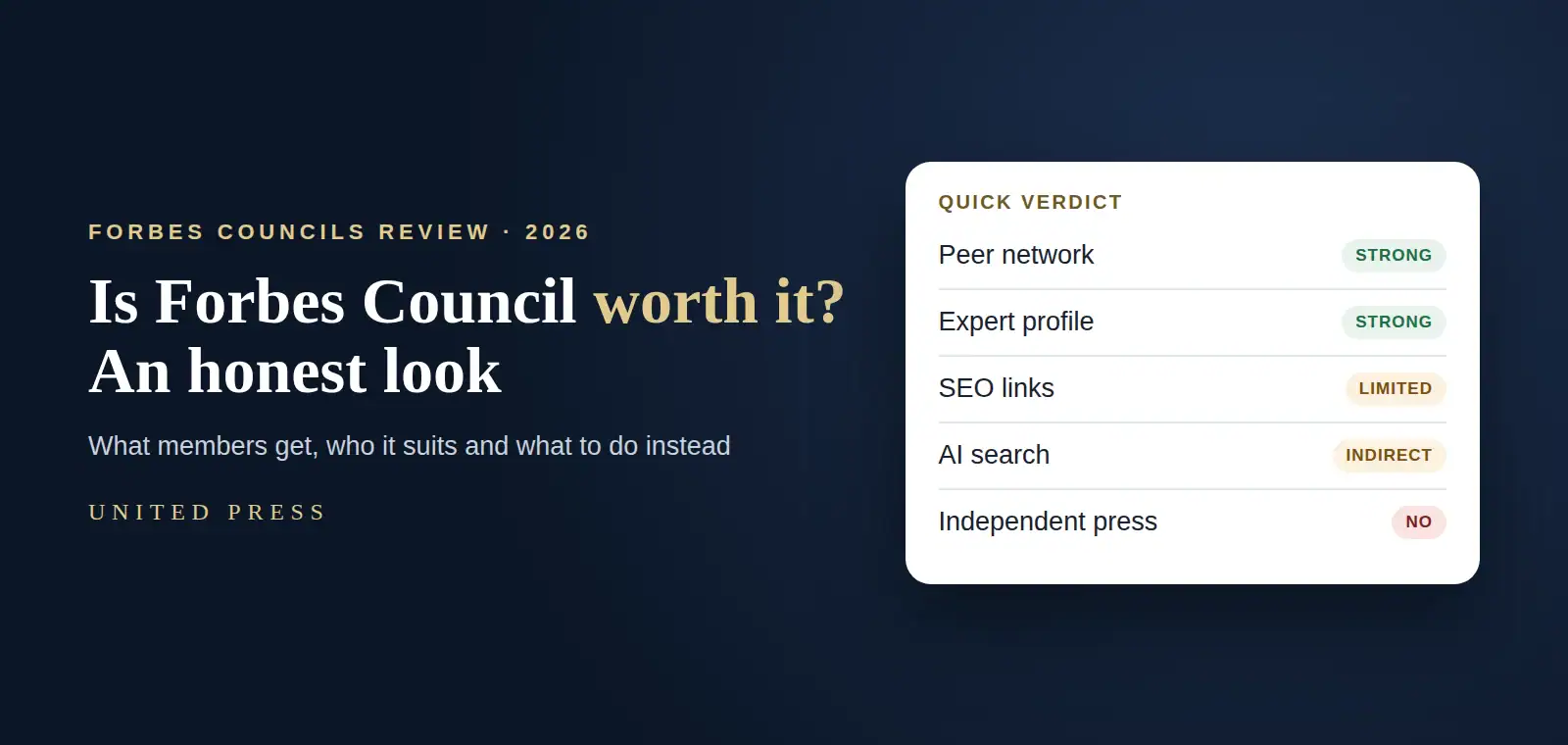
What is Forbes Council?
Forbes Councils is a set of invitation-only peer groups for founders, owners and executives. It is run by a separate company, Forbes Councils, LLC, which uses the Forbes name under licence from Forbes Media. It has nothing to do with the Forbes newsroom. Members are reviewed before they are invited, join for a yearly membership, and can publish articles on Forbes.com in the Councils section.
There is not one “Forbes Council” but several, each for a different kind of leader. These are the councils listed on the official site in 2026:
| Council | Who it is for |
|---|---|
| Forbes Business Council | Owners, founders and senior leaders of businesses in any industry |
| Forbes Technology Council | CTOs, CIOs and senior technology leaders |
| Forbes Finance Council | Finance leaders, advisers and fintech executives |
| Forbes Agency Council | Owners and leaders of marketing, PR and creative agencies |
| Forbes Communications Council | Marketing, PR and communications leaders inside companies |
| Forbes Coaches Council | Business, executive and leadership coaches |
| Forbes Human Resources Council | HR and people leaders |
| Forbes Business Development Council | Sales and business development leaders |
| Forbes Nonprofit Council | Leaders of charities and nonprofit organisations |
Forbes Business Council is the broadest. The others are built around a specific job, so pick the one that matches what you do every day.
Is Forbes Council legit, or is it a scam?
Forbes Council is legit. It is an official programme that uses the Forbes name with permission, reviews every applicant and publishes member articles on Forbes.com. You get what is described.
The criticism comes from four places:
- Perception. Some members present a Councils post as if Forbes journalists chose to write about them. That is where the “scam” label comes from, and it is a problem with how the membership is described, not with the programme itself.
- Selling. Members say they receive a steady stream of offers from other members and service providers once they join.
- Invitation emails. If you receive an email congratulating you on being selected, treat it mainly as a sales invitation to apply, not a sign that Forbes editors picked you.
- Editorial control. Membership gives you the chance to publish, not a promise. Editors can reject or reshape articles, especially if a topic looks like a sales pitch.
So the honest answer is: it is real, it is vetted, and it is a membership. Treat it as a platform you earn value from by using it, not as press coverage.
What you get as a Forbes Council member
According to Forbes Councils, membership includes publishing, a peer network and support services. The main benefits are:
Bylined articles
Full articles under your name on Forbes.com, in the Councils section, with help from an editorial team.
Expert Panels
Monthly questions you answer in a few sentences. Selected answers appear in roundup articles with your photo and company link.
Executive profile
A public Forbes Councils profile with your bio, company, articles and links, which can rank when people search your name.
Peer network
A private community, member directory, topic groups and an app to connect with other vetted leaders in your field.
Events and coaching
Virtual events, from small meetups to keynote sessions, and coaching sessions for members.
Badges and extras
Member badges for your website and email signature, press release tools and discounts on selected services.
Higher membership levels add more. The Executive option adds a member spotlight interview and a welcome post on Forbes Councils social media. The Premium option adds articles written for you after an interview, company and career bios, and a dedicated writer.
How publishing on Forbes Councils works
Choose a useful, evergreen topic
Articles must be original, business-focused and helpful to other leaders. Selling, promotion, vendor recommendations, politics and religion are not allowed.
Write around 700 to 800 words
Share real lessons, examples and numbers from your own experience. Your company can appear in your bio, but the article itself cannot be an advert.
Work with the editors
Every article goes through editing and proofreading. Editors can ask for changes or turn a topic down.
Wait four to six weeks
Forbes Councils says articles typically go live four to six weeks after the process begins.
Answer Expert Panels in between
Short monthly answers keep your name appearing on Forbes.com between full articles.
Every Councils article is tagged as a “Council Post”, and your byline shows you as a Forbes Councils member, which is how readers know the post is member content and not Forbes journalism.
Forbes Council pros and cons: benefits vs drawbacks
Here is the reality of each main benefit, side by side with its drawback.
| The feature | The good | The bad |
|---|---|---|
| Publishing privileges | You can publish bylined articles on Forbes.com, often around one a month, which looks highly credible. You can also add quick answers to Expert Panels. | Every article is tagged as a “Council Post”, showing it is member content. Media-savvy buyers and investors can easily tell it apart from real editorial coverage. |
| SEO and traffic | Your author profile and articles can show up when people search your name on Google. | Links back to your site are nofollow, so they pass little SEO value. Councils articles get little organic traffic, so few people find them unless you share them. |
| Social proof | You get a Forbes Councils member badge for your website, LinkedIn profile and email signature. | So many people now display the badge that some in the media and PR industry see it as overused, and it can impress peers less than you expect. |
| The “PR block” risk | It is a reliable way to see your name on Forbes.com without a large BrandVoice campaign. | Some PR professionals report that Council membership can make Forbes writers less likely to choose you as a source for earned editorial pieces, because you already have a platform there. |
The honest verdict: who should join Forbes Council, and who should skip it
Join if
- You need quick validation. You pitch investors or conservative B2B clients who will be impressed by seeing the Forbes name on your website or email signature.
- You have an amplification plan. You have a sales or marketing team that will share your Council articles with prospects, add them to newsletters and post them on LinkedIn.
- You like peer roundups. You want easy brand mentions through short two-to-three sentence Expert Panel answers, without writing long articles.
- You sell your own expertise. Consultants, coaches and advisers who will write regularly get the most from it.
Skip if
- You want direct sales leads. Very few people will find a Council Post on their own and then get in touch to buy from you.
- You want true PR credibility. Earned media, where an independent journalist interviews you, carries a much stronger trust signal and is favoured by modern AI search tools over member content.
- You expect premium networking. There is a member app and virtual events, but many small business owners say the community rarely changes their results.
- You need independent coverage as evidence. For example, some Global Talent visa cases need coverage written by journalists.
Not sure if it fits your goals? Tell us your industry and your main goal, whether that is winning clients, raising investment or building a personal brand, and we will tell you honestly whether Forbes Council or earned coverage is the better route. Tell us about your goals.
Forbes Council vs earned Forbes coverage vs BrandVoice
All three appear on Forbes.com, but they are very different things.
| Route | Who writes it | Label readers see | How journalists and AI tools see it | Best for |
|---|---|---|---|---|
| Forbes Council | You, as a vetted member | Forbes Councils member | Expert opinion from a member | Building an expert profile over time |
| Earned coverage | A Forbes journalist or contributor | Forbes Staff or Contributor | Independent coverage, the strongest signal | Credibility, investors, AI search and trust |
| BrandVoice | Your brand with Forbes’s commercial team | BrandVoice (sponsored) | Sponsored content | Large brand campaigns and reach |
For the full picture of every type of Forbes article, see our guide to Forbes contributors and buying a Forbes article.
Does Forbes Council help SEO and AI search?
SEO
Links in Forbes articles are generally marked nofollow, which means they pass little direct link value to your website. The real SEO benefit is different: your Forbes profile and articles can appear on the first page when people search your name, which helps you control what they see.
AI search (ChatGPT, Google AI Overviews and others)
AI tools lean most on independent journalism and trusted third-party sources. A Councils post can be found and quoted, but because you wrote it yourself, it does not carry the same weight as a journalist writing about you. If AI visibility is your main goal, earned coverage, press releases and places in respected sector lists do more.
See the best publications for AI visibility and why your business is not showing up on ChatGPT.
How to join Forbes Council: requirements and application
Pick the right council
Choose the council that matches your role: Business, Technology, Finance, Agency, Communications, Coaches, Human Resources, Business Development or Nonprofit.
Check you qualify
You need to be an owner, founder or senior executive with a strong track record. Most councils also ask that your company meets a minimum yearly revenue or funding level, usually in the high six figures or more.
Apply online
Share your background, company and achievements. Awards, press coverage, leadership roles, growth figures and examples of your thinking all help.
Wait for the review
A selection team reviews your application. Forbes Councils says applicants typically hear back within two to four business days.
Accept your invitation
If approved, you receive an invitation and choose a membership option. If not, you can ask for the reasons and reapply later.
Press coverage strengthens an application. If you have little coverage yet, start there first. Our press release service is a good place to begin.
How to get the most from a Forbes Council membership
- Plan your article topics for the year before you start
- Answer Expert Panels every month, not only when you remember
- Write about lessons and numbers, never about your product
- Share every article on LinkedIn, in your newsletter and with prospects
- Link your Forbes profile from your website and speaker bio
- Use the groups and events to meet people, not only to post
- Describe the membership accurately in every place you mention it
- Pair it with earned coverage so journalists write about you too
How to describe your Forbes Council membership honestly
UK advertising rules say marketing claims must be accurate and not misleading. Describing a Councils post as “featured in Forbes” can suggest Forbes journalists chose to write about you, which is not what happened.
Safe wording
- “Forbes Business Council member”
- “Published on Forbes.com as a Forbes Councils member”
- “Read my article in Forbes Technology Council”
Risky wording
- “As featured in Forbes” with only Councils posts
- “Forbes named us one of the best” for a member article
- “Forbes journalist” for your own byline
Eight questions to ask before you join Forbes Council
What is my goal?
Expert profile, network, press coverage or sales? Forbes Council helps the first two most.
Will I write every month or two?
Value grows with every article. One article a year rarely justifies a membership.
Do I have useful lessons to share?
Editors want practical insight, not company news.
Will my buyers recognise the name?
Forbes is known worldwide, but check that your customers read it.
Will I use the network?
Groups, events and the directory are where many members get the most value.
Do I need independent coverage instead?
Investors, journalists and some visa routes look for coverage written by others.
Can I describe it accurately?
If the only way it helps is by calling it “featured in Forbes”, it is not the right route.
What else could I do with the same time?
Compare it with earned coverage, trade press and speaking before you decide.
Alternatives to Forbes Council
Earned Forbes coverage
Pitch real news or data to the Forbes reporter or contributor who covers your field. See get featured in Forbes.
Expert comment
Answer journalist requests and become a go-to source for your trade press.
Press releases
Newsworthy releases give journalists a story they can build on.
Sector listicles
Places in respected “best of” lists help both buyers and AI tools recommend you.
Speaking and podcasts
Stages and shows build the same expert profile, often with a warmer audience.
Your own channels
A LinkedIn newsletter or blog you own keeps working long after a single article.
Get into Forbes with coverage written about you
United Press has been getting founders and businesses into the press since 2001. Every plan is bespoke, and we name the outlet and article type in writing before you agree.
Guaranteed Forbes placement
Your placement goes live within 14 days of approval, or you get a 100% refund. See guaranteed Forbes coverage.
Earned coverage and expert quotes
We shape your story and data so reporters want to quote you. See our Forbes PR agency page.
Press releases and listicles
Newsworthy releases and places in respected lists that build the profile journalists and AI tools look for.
Reputation clean-up
We remove reviews and links that damage your name, so what people find next supports your Forbes presence.
Forbes Council: frequently asked questions
Is Forbes Council worth it?
Generally yes, if you are playing a long-term reputation game and will share your articles yourself through LinkedIn, newsletters and sales conversations. It is not worth it if you expect inbound leads or strong SEO value, because Council Posts are member content with little organic traffic and nofollow links.
Is Forbes Council membership worth it?
Membership is worth it when you use every part of it: publishing an article most months, answering Expert Panels, completing your executive profile and joining groups and events. Members who join for the badge alone and rarely publish usually feel it was not worth it.
Is Forbes Council legit?
Yes. Forbes Councils is a real membership programme run by Forbes Councils, LLC under licence from Forbes Media. Applicants are reviewed before they are invited, and members can publish articles on Forbes.com in a labelled Councils section.
What is the purpose of the Forbes Councils?
Forbes Councils exist to bring vetted business leaders together in peer communities, give them a platform to share expertise on Forbes.com through articles and Expert Panels, and help them grow through events, coaching and connections with other members.
Is Forbes Business Council a scam?
No, it is not a scam. You get what is described: a vetted peer network, publishing opportunities and an executive profile. The criticism is about perception. Problems start when a member markets a Councils post as press coverage, which is misleading.
Is a Forbes Council invitation email real?
Usually it is a real email from Forbes Councils, but it is mainly a sales invitation to apply. Being “selected” does not mean Forbes editors chose you, and you still go through the normal review before joining.
Who can join Forbes Council?
Owners, founders and senior executives with a strong track record. Each council has its own entry rules, and most ask that your company meets a minimum yearly revenue or funding level, usually in the high six figures or more. Some councils are built for specific roles, such as coaches, HR leaders or technology executives.
How do I join Forbes Council?
Choose the council that fits your role, apply online with details of your background, company and achievements, and wait for the selection team to review it. If you are approved, you receive an invitation and choose a membership option.
How much does it cost to be on the Forbes Council?
Forbes Councils charges a one-time initiation plus yearly membership dues, and the level depends on the option you choose: Standard, Executive (two years) or Premium, which adds articles written for you. The current amounts are shown on the official Forbes Councils site once you check your eligibility, and they can change over time.
How long does Forbes Council take to approve an application?
Forbes Councils says applicants typically hear back within two to four business days. If you are turned down, you can ask for the reasons and reapply later as your business grows.
How many Forbes Councils are there?
The official Forbes Councils site lists nine councils in 2026: Business, Technology, Finance, Agency, Communications, Coaches, Human Resources, Business Development and Nonprofit.
Does Forbes Council membership guarantee publication?
No. Membership gives you the chance to publish, but every article must meet the editorial guidelines, and the editors have the final say. Articles must be original, useful and free of selling or promotion.
How often can Forbes Council members publish?
Members commonly publish around one full article a month, plus short Expert Panel answers. Each article still goes through editing and must follow the content rules.
Can joining Forbes Council stop you getting earned Forbes coverage?
It is not an official rule, but some PR professionals report that Forbes writers can be less likely to choose Council members as sources for editorial pieces. If earned coverage matters most to you, focus on that first.
How long does a Forbes Council article take to go live?
Expect around four to six weeks from start to publication. Each article is around 700 to 800 words and goes through editing and proofreading first.
What are Forbes Expert Panels?
Expert Panels are monthly questions sent to members. You answer in three to five sentences, and the content team picks a selection of answers for a roundup article, with each member’s photo and company link.
Is a Forbes Council article the same as being featured in Forbes?
No. A Councils article is written by you as a member and published in the Councils section. Being featured in Forbes usually means a Forbes journalist or contributor chose to write about you. Both appear on Forbes.com, but the labels show which is which.
Is Forbes a reputable source?
Forbes staff journalism is widely seen as reputable, because it goes through a professional newsroom and editing. Contributor articles, Council Posts and BrandVoice content are treated with more caution, because they are written by outside experts, members or sponsors. Check the label beside the author’s name to see which one you are reading.
Can I say “as featured in Forbes” if I am a Council member?
It is safer not to. UK advertising rules require claims to be accurate and not misleading. Say “Forbes Business Council member” or “published in Forbes as a Forbes Councils member” instead.
Does Forbes Council help SEO?
A little, but not through links. Links in Forbes articles are generally marked nofollow, so they pass little direct link value. The main SEO benefit is that your Forbes profile and articles can rank when people search your name.
Does Forbes Council help you show up in ChatGPT and AI search?
Only indirectly. AI tools give the most weight to independent journalism and trusted third-party sources. A Councils post can be found and quoted, but earned coverage, where a journalist writes about you, carries more weight.
Is Forbes Technology Council worth it?
It can be for technology leaders who want to build an expert profile and meet other CTOs and CIOs. It works best if you write about practical lessons, not your own product, because promotional articles are not accepted.
Is Forbes Coaches Council worth it?
For coaches who sell their expertise, it can be one of the more useful councils, because a published article and profile help potential clients trust you. The value comes from publishing often and sharing the articles with your audience.
Is Forbes Agency Council worth it?
It can help agency owners meet peers and show expertise to clients. Do not rely on it to win press for your clients, because your own Councils posts are not coverage for them.
Is Forbes Council worth it for UK businesses?
It can be. Leaders outside the US can apply, and the network is international. If your customers are mainly in the UK, pair it with coverage in UK national and trade titles, which your buyers read every day.
What are the alternatives to Forbes Council?
Earned coverage in Forbes and other business titles, expert comment in your trade press, newsworthy press releases, places in respected sector listicles, speaking slots and your own newsletter or LinkedIn articles.
Can a PR agency get me into Forbes without Forbes Council?
Yes. A PR agency can pitch your story to the Forbes reporters and contributors who cover your field. United Press also offers guaranteed placements, with the outlet and article type named in writing and a 100% refund if it does not go live within 14 days of approval.
The Forbes name opens doors. Your story is what keeps them open.
A membership can give you a platform. Real coverage gives you proof. Choose the route that matches your goal, describe it honestly, and build a reputation that people, journalists and AI tools can trust.