How to Get Your Beauty Brand Featured in Magazines (2027)
To get your beauty brand featured in print or digital magazines, you need a targeted strategy built on timing, assets, and direct outreach. Beauty editors receive hundreds of products every month and feature only a few. This guide shows how to get your beauty brand featured in magazines in the UK: which titles to target, what beauty editors want, when to pitch, what to send and how to stand out.
How to get your beauty brand featured in magazines: the short answer
To get your beauty brand featured in magazines, give editors a real story, proof that the product works, and everything they need in one email. Pitch the right beauty editor at the right time: months ahead for print, weeks ahead for online. Offer samples, follow up once, and plan a few guaranteed placements alongside your pitches.
- Editors feature stories, not just products
- Print monthlies plan three to six months ahead
- Proof and compliance make editors trust you
- Short, personal pitches beat mass emails

What beauty editors look for before they feature a product
Beauty editors test hundreds of products a month, and only a small share make it onto the page. The ones that do usually tick three boxes: they are new or different, they work, and they suit that magazine’s reader.
Something worth saying
A new ingredient, format, shade range or technology. “Another vitamin C serum” is not a story. “A vitamin C serum that stays stable in a pump without turning orange” might be.
Results editors can trust
Beauty editors try products on themselves. They also ask for evidence behind claims such as “clinically proven” or “reduces wrinkles by 30%”. Have the study ready.
The right reader
A luxury glossy, a teen title and a men’s grooming page want different things. Match your product to the readers, their skin concerns and what they can easily buy.
Compliance matters too. In Great Britain, every cosmetic product needs a Responsible Person, a cosmetic product safety report and a notification on the government’s Submit Cosmetic Product Notifications (SCPN) service before it is sold. Editors and retailers increasingly check this, and product claims must be backed by evidence.
Which UK magazines feature beauty brands?
To get your beauty brand featured in magazines your customers actually read, start with the titles that match them. Each title below has its own reader and its own kind of beauty story. Pitch the story that fits the reader, not the same email to every title.
| Title | Typical reader | Beauty stories it often runs |
|---|---|---|
| Vogue UK | Luxury fashion and beauty readers | Prestige launches, beauty news, shopping edits |
| Harper’s Bazaar UK | Affluent readers who invest in skincare | Premium skincare, anti-ageing, fragrance |
| ELLE UK | Fashion-led, trend-aware readers | Trends, inclusive and sustainable beauty |
| Marie Claire UK | Readers who research before they buy | Skincare, wellness, beauty awards |
| Glamour UK | Younger, online-first readers | Make-up, trends, how-to guides |
| Cosmopolitan UK | Readers looking for value and new trends | High-street beauty, viral products, tutorials |
| Women’s Health UK | Health and fitness-focused readers | Skin health, SPF, wellness-led beauty |
| The Times and Sunday Times Style | National newspaper readers | Beauty columns, launches, gift guides |
Do not ignore the beauty trade press. Titles such as Pure Beauty and Cosmetics Business are read by retail buyers, so trade coverage can help you win stockists, which in turn makes consumer editors more interested.
Get press-ready before you pitch a single editor
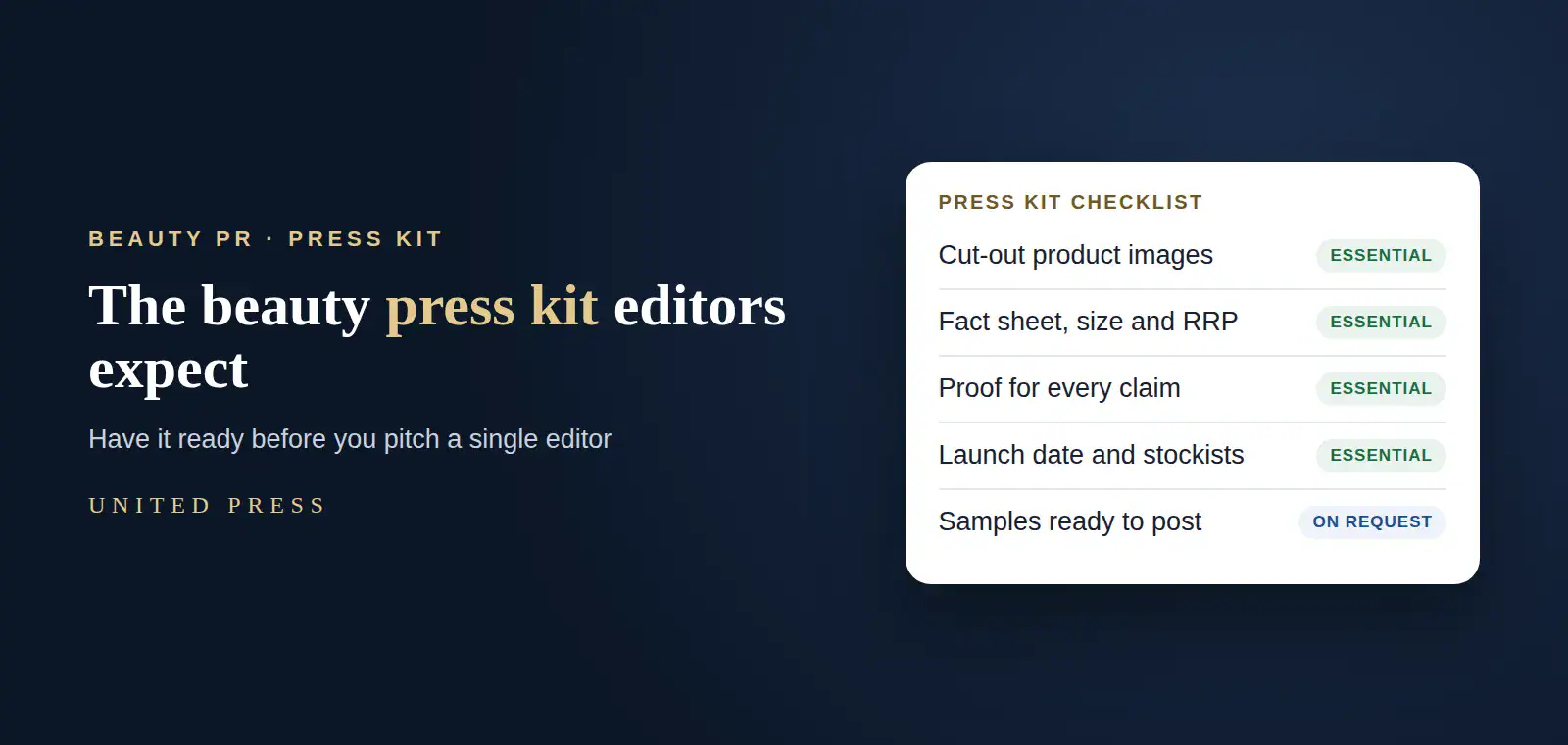
Most pitches fail on basics, not on the product. Before contacting anyone, build a simple press kit you can send in seconds.
- High-resolution cut-out images on a white background
- Two or three lifestyle or texture shots
- A one-page fact sheet: name, size, key ingredients, RRP and stockists
- The launch date, and where readers can buy it on that day
- Evidence for every claim you make, in plain English
- A short founder bio and a high-quality headshot
- Samples ready to post the same day an editor asks
- A named press contact who replies within hours, not days
If you do not have stockists yet, say where the product will be available. Beauty editors rarely feature something readers cannot buy.
Beauty PR story angles that get products into magazines
Beauty editors feature stories, not products. Give them a reason to write about yours now. These angles work across glossy magazines, newspaper beauty pages and beauty websites.
| Angle | Example hook | Works best for |
|---|---|---|
| A genuinely new ingredient or technology | “The first UK serum to use fermented rice water at 15%” | Skincare, haircare |
| A problem readers already have | “A primer made for oily skin in humid summers” | Make-up, SPF, body care |
| The founder’s story | “A pharmacist who formulated a balm for her son’s eczema” | Indie and founder-led brands |
| Proof of results | “Independent 8-week trial on 60 volunteers” (with the study ready to share) | Skincare, supplements |
| A trend with a fresh twist | “Skin cycling, simplified into one product” | Any category |
| A seasonal need | “Five-minute festive nails that survive a party” | Gift guides, seasonal pages |
| Inclusivity you can show | “40 foundation shades, tested on every Fitzpatrick type” | Complexion, haircare |
| Sustainability with evidence | “Refill pouches that use 70% less plastic, independently verified” | Packaging-led brands |
Every number in a pitch must be true and provable. If an editor asks to see the trial and you cannot share it, the feature is gone, and so is your credibility with that editor.
Plan around magazine lead times
Monthly print beauty magazines plan their issues several months before they reach the shelves, often three to six months ahead. Weekly magazines and newspaper supplements work a few weeks ahead. Websites and social channels can move in days. So the same launch needs three different timelines.
Print monthlies
Pitch summer SPF stories in early spring and Christmas gifts in the summer. If your launch is in October, the monthly editors needed to hear about it in May or June.
Online and newspapers
Pitch two to four weeks before launch, then again on launch day with live links. Online editors also update evergreen “best of” pages, so keep in touch after launch.

Christmas in July: why gift guides are planned in summer
Christmas gift guides are the biggest single chance for many beauty brands to appear in print. Because monthly titles work so far ahead, editors choose Christmas products in the summer. PR agencies and trade shows often hold “Christmas in July” press days and showcases where editors see the season’s gifts in one place. Have your gift sets, images and stock dates ready by early summer.
A typical UK beauty editorial calendar
| Issue month | Common beauty themes |
|---|---|
| January | New year skincare resets, dry winter skin, wellness |
| February to March | Spring launches, Mother’s Day gifting, Valentine’s fragrance |
| April to June | SPF and summer skin, festival hair and make-up, holiday minis |
| July to August | Back to routine, autumn launches, Christmas gift guide planning starts |
| September to November | Party make-up, gifting, Black Friday shopping round-ups |
| December | Advent and last-minute gifts, January “new you” features planned now |
Each title sets its own calendar, and some publish themes in their media packs. Treat the table as a starting point and check each magazine.
Find the right beauty editor, not just any editor
A pitch sent to the wrong person is a pitch nobody reads. Most magazines list their team on the masthead in print and on the website.
- Beauty directorSets the beauty pages and big features. Best for major launches and brand stories.
- Beauty editor or writerWrites product pages, trend stories and round-ups. Your main contact.
- Shopping or commerce editorRuns “best of” buying guides online, often with affiliate links.
- Freelance beauty journalistsWrite for several titles at once. A good freelancer can place your story in more than one place.
Follow beauty editors on social media for a few weeks before you pitch. You will learn what they like, what they are working on and how they prefer to be contacted.
How to pitch a beauty editor (with a template)
Keep it short enough to read on a phone between meetings. One product, one angle, one clear offer.
Write a specific subject line
Name the product type and the news: “New: the first fragrance-free retinal for sensitive skin, launching 3 March”.
Lead with the reader benefit
Open with why their readers will care, not with your company history.
Give the key facts in three lines
What it is, what makes it different, when and where it is available.
Offer something useful
A sample, an interview with the formulator, before-and-after images with consent, or the trial data.
Follow up once
If you hear nothing, send one polite follow-up about a week later with a new detail. Then move on.
Subject: [New / Launching DATE]: [product] that [specific benefit]
Hi [first name],
I loved your piece on [their recent article]. I thought this might suit your readers: [product name] is [what it is] that [what makes it different], launching on [date] at [stockist].
[One line of proof: trial result, award, ingredient fact.]
Would you like a sample, or a quick chat with our founder [name], who [relevant expertise]?
Images and the fact sheet are here: [link]. Thank you, [name, phone]
Sending samples to beauty editors: the etiquette
Unsolicited parcels often go straight to a giveaway pile. A quick “may I send you one?” gets your product noticed.
Editors need to use a product for weeks to judge it, especially skincare.
A card with your name, launch date, RRP, stockists and how to get images.
A sample is not a deal. Pressing for a guaranteed mention damages the relationship.
Editorial picks, advertorials and guaranteed placements explained
Not every magazine mention is the same. Understanding the options helps you plan, and keeps you on the right side of UK advertising rules.
| Type | What it is | Commercial link | What to know |
|---|---|---|---|
| Independent editorial pick | An editor chooses your product on merit | No commercial deal | Highest trust with readers and other journalists |
| Shopping or affiliate round-up | A commerce writer lists products readers can buy | Usually affiliate links | Good for sales, check how the title selects products |
| Advertorial or sponsored feature | You agree the content with the publisher | Commercial agreement | Must be clearly labelled, for example “advertisement feature” |
| Guaranteed placement | A feature on a named title agreed in advance | Commercial agreement | Reliable visibility, follows the title’s labelling rules |
| Influencer gifting | Creators receive products and may post | Gift or partnership | Posts must be disclosed when there is a commercial link |
Under the UK Advertising Codes (CAP Code), marketing must be obviously identifiable, and advertorials must be clearly marked, for example with the heading “advertisement feature”. Readers and regulators expect honesty about what is editorial and what is commercial.
Beauty awards: a route into magazines that many brands miss
Many magazines and trade titles run annual beauty awards, and the winners are often featured in print, online and in shopping pages. Marie Claire UK’s Prix d’Excellence is one long-running consumer example, and the Pure Beauty Awards are a well-known trade awards programme. A win or shortlist gives editors independent proof that your product performs.
- Check each programme’s categories, entry rules and deadlines early, often months before the results
- Enter the product that best fits a category, not every product you make
- Have samples, ingredient lists and evidence ready for the judges
- Only describe a result accurately: “shortlisted” is not “winner”
- Use award logos only as each organiser allows
Why beauty magazine features now help in AI search too
When shoppers ask ChatGPT, Google’s AI Overviews or Perplexity for “the best vitamin C serum” or “a good SPF for oily skin”, the answers often draw on trusted magazine round-ups and reviews. Getting your beauty brand featured in magazines therefore helps twice: readers see you in the magazine, and AI tools are more likely to find you when they build an answer.
- Keep your product names, ingredients and claims the same everywhere
- Make sure your own product pages explain clearly what each product does
- Link your press page to every feature so the coverage is easy to find
Mistakes that keep beauty brands out of beauty magazines
Beauty editors can spot a copy-and-paste pitch instantly.
“Miracle”, “cures” or unsupported percentages get pitches deleted, and can breach the rules.
A Christmas gift pitch in November is too late for print.
If readers cannot buy it, editors will not risk recommending it.
One follow-up is polite. Five is a reason to stop reading your emails.
Regional, trade and specialist beauty titles often lead to bigger features later.
Make every feature work harder
- Share the feature on your website’s press page
- Tell stockists, who may promote it too
- Use the logo in an “as featured in” strip, with permission
- Thank the editor, briefly
- Track sales and searches in the week after
- Pitch the next story to the same editor in a few months
Get your beauty brand into the titles your customers read
United Press has helped brands get featured in the media since 2001. Independent editor picks can never be bought or promised by anyone. What we do is combine smart pitching with guaranteed placements on named titles, agreed with you in writing before you commit.
Beauty and skincare PR
Story angles, press kits and editor outreach for launches. See PR for beauty brands.
Guaranteed features
Placements on named fashion, beauty and lifestyle titles, live by the date agreed in writing or a 100% refund.
Launch campaigns
A planned run of coverage around launch day. See our beauty and skincare launch PR.
Glossy titles
Routes into the big names, explained in how to get into Vogue.
Beauty magazine features: frequently asked questions
How do I get my beauty brand featured in magazines?
Find the right beauty editor at each title, then send a short, personal pitch with one clear story angle, proof that the product works and a sample offer. Pitch print months ahead and online weeks ahead. Many brands also add guaranteed placements on named titles so they are not relying on pitches alone.
How do I get my business featured in a magazine?
Choose the magazines your customers read, find the editor or writer who covers your area, and send a short, personal pitch with one clear news angle, a few facts and good images. Pitch print titles months ahead and websites weeks ahead. If you need certainty, guaranteed placements on named titles go live by the date agreed in writing or a 100% refund.
How do I ask to be featured in a magazine?
Email the right editor or writer directly, not a general inbox. For beauty products, that usually means one of the beauty editors or beauty writers at the title. Use a specific subject line, explain in two or three sentences why their readers will care, offer a sample, an interview or images, and follow up once about a week later. The pitch template in this guide shows exactly what to write.
How to get yourself featured in a magazine?
Offer something only you can give: expert comment on a trend, a strong personal or founder story, or useful advice for readers. Keep a short bio, a good headshot and your areas of expertise ready, reply to journalists quickly, and build a visible profile on LinkedIn and your own website so editors can check who you are.
Are Gen Z buying magazines?
Some are. Many Gen Z readers enjoy print, especially special editions and collectable issues, but most of their reading of beauty magazines and other titles happens online, through magazine websites and social media. UK market research from Mintel notes that younger readers are driving the shift to digital magazine content. For a beauty brand featured in magazines, that makes online features, shopping pages and each title’s social channels just as important as print.
How far in advance should I pitch beauty magazines?
Monthly print magazines usually plan three to six months ahead, so pitch Christmas gifts in the summer and SPF in the spring. Weekly magazines and newspaper supplements need a few weeks. Websites can move in days, but still prefer two to four weeks before launch.
Should I send beauty editors free samples?
Yes, but ask first. Editors need to try products, especially skincare, which they may test for weeks. Send full sizes when asked, include a card with the launch date, RRP and stockists, and never ask for coverage in return.
What do beauty editors want in a press release?
A clear headline, what the product is, what makes it different, the key ingredients, evidence for claims, launch date, stockists, RRP, high-resolution images and a contact who replies quickly. Keep it to one page and link to images rather than attaching large files.
Can small or indie beauty brands get into glossy magazines?
Yes. Editors love a strong founder story or a genuinely new product. Start with online beauty pages, newspapers and specialist titles to build credibility, then pitch the glossies with that coverage behind you.
Can you buy a feature in a beauty magazine?
Commercial features are allowed, but in the UK they must be clearly identifiable as marketing. Advertorials need a label such as “advertisement feature” under the CAP Code. Independent editorial picks cannot be bought, and offering an editor anything for a review damages trust.
Do magazine features help beauty sales?
They can. A trusted editor’s recommendation gives shoppers confidence, and online features with buy links can send traffic directly. Results vary by title and product, so track sales, website visits and searches in the days after each feature.
Which UK magazines are best for beauty brands?
It depends on your customer. Vogue UK and Harper’s Bazaar UK suit luxury and premium skincare, ELLE UK and Glamour UK suit trend-led and younger readers, Cosmopolitan UK suits accessible and viral products, and Women’s Health UK suits wellness-led beauty. Newspaper beauty pages and the beauty trade press are also valuable.
When should I pitch Christmas gift guides?
For monthly print magazines, usually in the summer, often from June to August. Many PR agencies and trade shows hold “Christmas in July” press days for this reason. Weekly titles and websites decide later, from September to November.
Do beauty awards help a brand get featured in magazines?
They can. Winners and shortlisted products are often featured by the title that runs the awards, and a result gives other editors independent proof that the product works. Check entry rules and deadlines early and describe any result accurately.
How long does it take to get a beauty brand featured in magazines?
Earned features in monthly print titles can take three to six months from pitch to publication. Online features can happen in weeks. Guaranteed placements on named titles are faster: United Press placements go live by the date agreed in writing or a 100% refund.
Do I need a beauty PR agency?
Not always, but an agency saves time, already knows editors and can plan guaranteed placements around your pitches. United Press builds bespoke beauty PR plans, with guaranteed placements live by the date agreed in writing or a 100% refund.
Great products deserve to be seen.
You have worked for years to get the formula right. With the right story, at the right time, sent to the right editor, your brand can sit on the pages your customers already trust.
How social media and creators help beauty brands get into magazines
Beauty editors watch social media closely, and so do the commerce writers behind the shopping pages of beauty magazines. A product that is genuinely talked about on TikTok or Instagram, or that sells out, becomes a story in itself. Social buzz alone will not earn a feature, but it gives editors a reason to look.
What helps
Real customer reviews, honest creator videos, before-and-after content shared with consent, and clear stock information when a product trends.
What to get right
When a creator has been gifted a product or has a commercial deal, the post must make that clear, for example with “#ad”. UK advertising rules apply to influencer marketing as well as magazines.