
Looking for the best PR for UK agtech startups in 2026? UK agtech startup PR — for farming technology, alt-protein producers, precision agriculture startups, and farm software. Dual audience: farmers and investors.
For guaranteed coverage across farming, agritech and rural business titles, see our agriculture PR agency UK services.
UK agtech publications in 2026
- Farmers Weekly.
- Farmers Guardian.
- AgFunder.
- Sifted climate & food.
Why PR for UK agtech startups must win farmers first
Agtech founders often speak two languages at once. To investors they talk about markets, data and scale; to farmers they need to talk about yields, soil, labour and whether a new tool will actually work in a wet field in March. PR for UK agtech startups has to bridge both. Coverage that excites investors but leaves farmers unconvinced will not turn into adoption, and adoption is what investors want to see next.
Farmers are practical, cautious buyers with good reason. Margins are tight, the weather is unpredictable and a failed trial can ruin a season. They trust other farmers, independent advisers and the farming press far more than marketing. That is why PR for UK agtech startups starts with evidence from real farms and real growers, told in plain language by people who understand agriculture.
Done well, the same stories serve both audiences. A trial on a working farm, explained by the farmer who ran it, reassures other growers and shows investors that your product has traction in the real world. PR for UK agtech startups is about finding and telling those stories consistently.
Agtech startups we work with
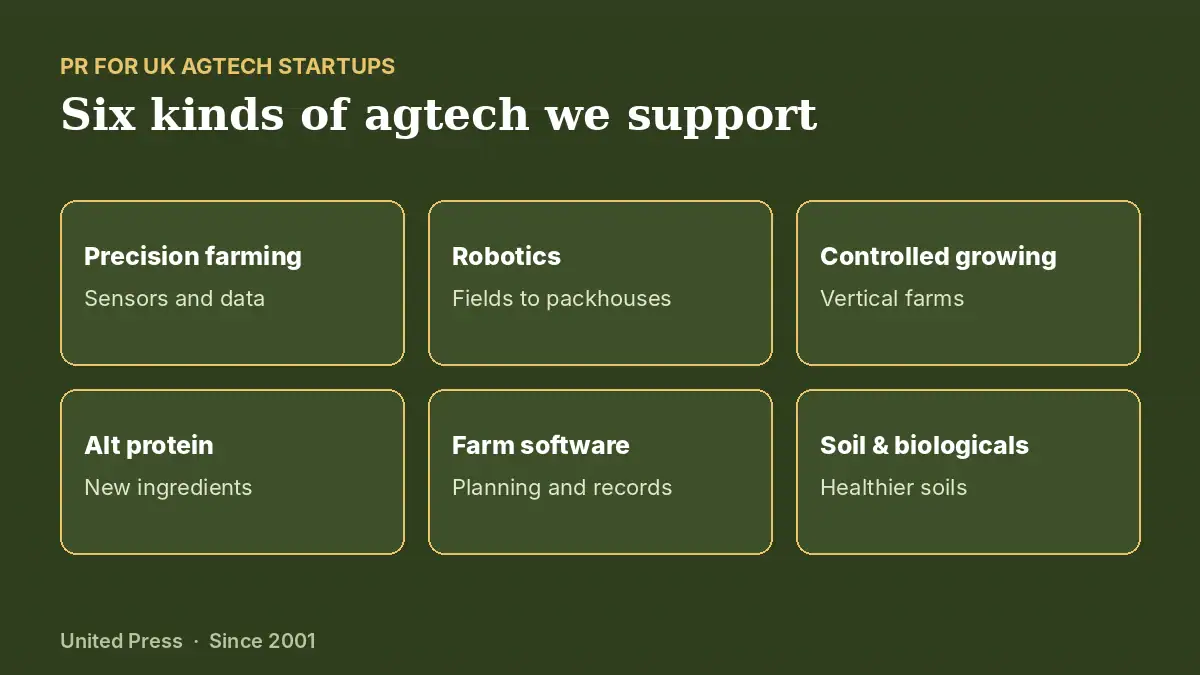
Agriculture technology covers everything from soil science to software. PR for UK agtech startups begins with understanding your corner of the market and the people who buy from you. We regularly support:
- Precision farming companies using sensors, satellite data and variable-rate tools.
- Farm robotics and automation businesses tackling labour shortages in fields, glasshouses and packhouses.
- Controlled environment growers building vertical farms and high-tech glasshouses.
- Alternative protein producers developing new ingredients from plants, fermentation and insects.
- Farm software and data platforms for planning, compliance and supply chain records.
- Soil health and biologicals start-ups offering alternatives to traditional inputs.
The proof farmers need before they switch
Farmers rarely adopt a new technology because of a launch announcement. They want to see it working on a farm like theirs, hear from someone they trust and understand what happens if it goes wrong. PR for UK agtech startups builds that proof step by step, so that by the time a farmer meets your sales team, they already know your name and have read about results from their region.
We focus on four kinds of evidence: on-farm trials with clear methods, independent results from research partners, honest comparisons with existing practice and practical details such as installation, training and support. Every claim is checked with your agronomists or scientists before it reaches a journalist, because the farming press asks hard questions and remembers the answers.

Funding, innovation programmes and PR for UK agtech startups
Public innovation funding plays a large part in UK agriculture. Defra’s Farming Innovation Programme, delivered with Innovate UK, has backed many projects that bring farmers, researchers and businesses together, and the Defra Farming blog regularly reports on the programme and the projects it supports. Winning a place on a programme like this is a strong signal of credibility.
In PR for UK agtech startups, we turn grants, research partnerships and investment rounds into stories that matter to farmers as well as investors. Rather than just announcing the award, we explain what the project will test, which farms are involved and when results are expected. That approach makes PR for UK agtech startups useful to readers and gives you a natural reason to return to the media when the results come in.
Agtech stories editors want
Farming titles, food and business media, technology press and regional outlets all look for different things. These angles work well in PR for UK agtech startups, and most campaigns blend several:
- Trial results: clear findings from working farms, with the farmer’s own view.
- Funding news: investment and grants explained in terms of what they will deliver.
- Expert commentary: reaction to farming policy, weather, labour and food security stories.
- Farmer profiles: growers and livestock farmers who adopted your technology early.
- Research partnerships: work with universities and research institutes.
- Founder journeys: why you left a lab, a farm or a tech job to solve this problem.

Planning around the farming calendar
Farming runs on seasons, and so does the farming press. Drilling, lambing, harvest and winter planning all shape what farmers read and when they have time to think about new tools. Summer field events and winter conferences are when many buying conversations begin. PR for UK agtech startups times announcements, case studies and interviews to match those moments, rather than launching into a busy harvest week when no one is reading.
We also plan for the news you cannot schedule. Extreme weather, disease outbreaks and policy changes put agriculture in the headlines quickly. Having approved spokespeople and short briefing notes ready means PR for UK agtech startups can offer useful expert comment while the story is still running.
Rural, regional and trade media
National coverage brings attention, but farmers often trust their regional farming titles, local papers and rural radio most. These outlets cover practical stories from nearby farms and are read closely. PR for UK agtech startups gives them a high priority, especially for trial results and farmer profiles, because a story about a farm down the road can be more persuasive than any national headline.
Trade titles for agronomists, machinery dealers and food supply chains matter too. Advisers and dealers influence many farm decisions, and coverage that helps them understand your product makes their recommendations easier. Balanced across farming, trade, business and technology media, PR for UK agtech startups reaches everyone who shapes a farmer’s choice.
Explaining complex science in plain words
Many agtech products rest on difficult science: microbiology, machine vision, genetics or data modelling. Journalists and farmers do not need every detail, but they do need to understand what the technology does, why it works and what it changes on the farm. We help your scientists and engineers find simple comparisons, clear numbers and everyday examples, so PR for UK agtech startups makes complex ideas easy to follow without dumbing them down.
Media training helps here too. Founders who can explain their product in two sentences, answer sceptical questions calmly and admit what is still being tested come across as credible. That honesty is one of the strongest assets in PR for UK agtech startups, because farmers have heard too many grand promises before.
Reaching food businesses and supply chains
Retailers, processors and food brands increasingly want to know how their produce is grown. Technology that improves traceability, cuts waste or reduces emissions on farm can help them meet their own goals. PR for UK agtech startups can reach these buyers through food industry and supply chain titles, showing how your technology supports the whole chain from field to shelf.
These stories often involve partners, so we coordinate approvals with every business named and keep claims precise. A clear, agreed story about a supply chain project builds credibility with farmers, food companies and investors at the same time.
Questions farmers often ask about new technology
Will it work on my farm?
Coverage that names soil types, regions, crops and livestock systems helps farmers judge whether results apply to them. We always include that detail where the farmer agrees to share it.
Who supports me if something goes wrong?
Service, training and local support matter as much as the technology itself. Stories that show your support team in action reassure cautious buyers.
What happens to my data?
Farmers want to know who owns farm data and how it is used. Clear answers in your PR for UK agtech startups build the trust needed for adoption.
Taking UK agtech to international markets
UK agtech is respected abroad, and many startups find early customers or investors overseas. We help you introduce your technology to international farming and food media, explain how it adapts to different climates and farming systems, and build relationships with overseas partners. We also help international agtech companies enter the UK market. Wherever you start, PR for UK agtech startups works best when it is grounded in real farm results that any grower can relate to.
A 90-day plan for PR for UK agtech startups
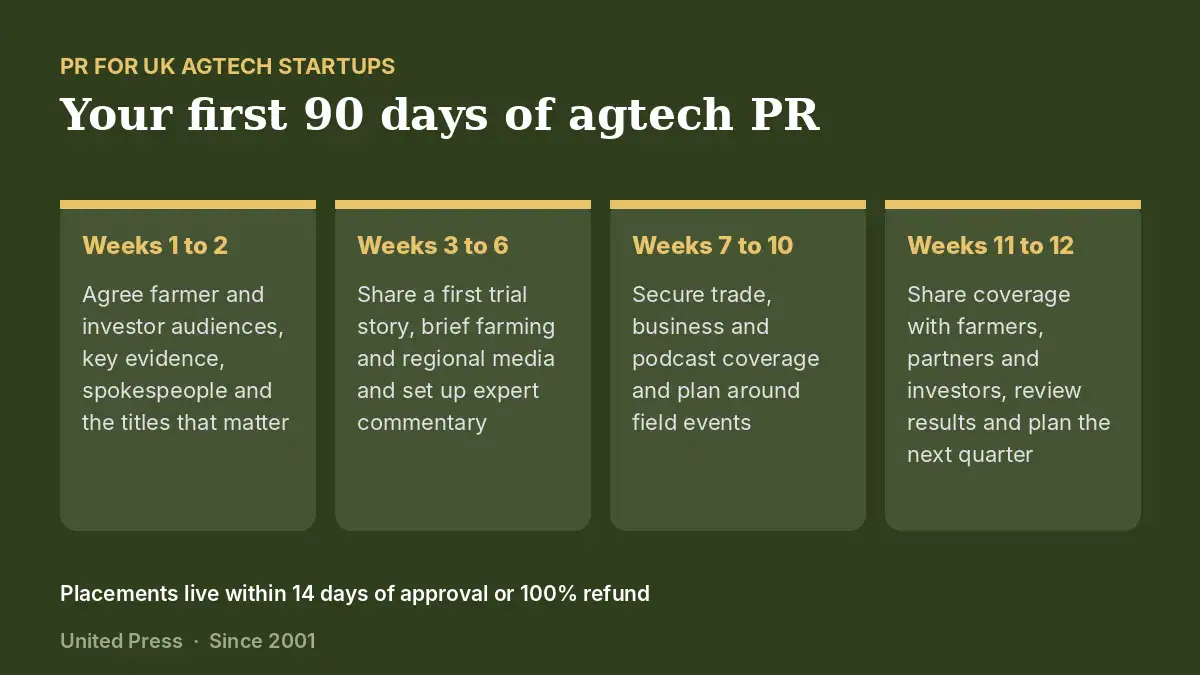
- Weeks 1 to 2: agree farmer and investor audiences, key evidence, spokespeople and the titles that matter.
- Weeks 3 to 6: share a first trial story, brief farming and regional media and set up expert commentary.
- Weeks 7 to 10: secure trade, business and podcast coverage and plan around field events.
- Weeks 11 to 12: share coverage with farmers, partners and investors, review results and plan the next quarter.
Placements go live within 14 days of approval, or you receive a 100% refund. Related reading: our guides to agriculture PR, PR for food brands, PR for green tech and PR for robotics companies.
PR for UK agtech startups in Google and AI search
Farmers, agronomists and investors now ask ChatGPT, Gemini and Google AI questions such as “best soil sensors for UK arable farms” or “which UK startups make farm robots”. Those tools draw on trusted publications, so consistent PR for UK agtech startups improves the chance that your company is mentioned. No one can guarantee an AI mention, but independent coverage in respected farming and business titles is one of the strongest signals an agtech company can build.
AgTech PR pricing
Every engagement is quoted individually after a short call, based on your goals and the publications you want. Tell us what you need on the form and we reply within 24 hours with a free plan.
What farming and food desks run on agtech
Farmers Weekly and Farmers Guardian are read by farmers, and farmers judge technology on yield, cost and whether it survives a wet season. Coverage follows on-farm evidence: trial results, a named grower, a season of data. A funding announcement means little to that readership on its own. AgFunder and Sifted cover the investment and climate-food side, where the round and the founders are the story, though both check claimed adoption.
The strongest agtech stories carry a farm name and a number from the field. The weakest are laboratory claims with no grower attached.
Placement difficulty for agtech startups
- Hardest — Farmers Weekly. Trusted by growers and cautious about unproven technology.
- Hard — Farmers Guardian. Wants on-farm evidence and a named grower.
- Moderate — Sifted. Covers climate and food ventures, verifies traction.
- Most achievable — AgFunder. Follows funding and sector movement closely.