

Looking for the best PR for green tech in the UK for 2027? United Press is a UK green-tech and cleantech PR agency that helps climate-focused companies earn credible coverage without greenwashing. Investors, policymakers and customers are more interested in climate solutions than ever — and more alert to inflated claims. Getting the story right matters as much as getting it seen.
Why earned media is a growth lever for cleantech in 2027
Climate technology sits at the intersection of capital, policy and public interest. A credible feature can attract the investors funding the transition, influence the policymakers shaping your market, and win the customers choosing between providers. Because the sector moves fast and scrutiny of green claims is intense, third-party validation from respected journalists carries real weight.
The publications that matter for UK green tech
Sector titles like BusinessGreen and Edie reach the sustainability and energy decision-makers in your market. Startup and investor media such as Sifted and UKTN reach the capital behind the transition. The Guardian’s environment desk and national business pages reach the wider public and policy audience. We help you target the mix that fits your stage and your goal.
How we approach green-tech PR
We build stories on substance: verifiable impact data, funding, deployments, and policy relevance — never vague sustainability claims that invite a backlash. We prepare your spokespeople to talk credibly about both the technology and its real-world effect, handle journalist outreach, and report honestly on results. Coverage is earned, not guaranteed.
Why PR for green tech needs proof, not promises
Climate technology has never had more attention, and it has never faced more scrutiny. Investors want evidence that a solution works at scale, procurement teams want to know it will cut emissions without disrupting operations, and journalists have learned to question every percentage and every “net zero” headline. PR for green tech succeeds when it gives all of them something solid: real deployments, measured results and founders who can explain the science in plain English.
That is why we treat every campaign as an evidence exercise first and a media exercise second. Before a single pitch goes out, we gather the data behind your claims, agree the language with your technical team and identify the stories that only your company can tell. PR for green tech built this way earns coverage that lasts, because it can stand up to the follow-up questions that sceptical editors now ask.
It also protects you from the biggest reputational risk in the sector. A single accusation of greenwashing can undo years of progress, put off investors and damage partnerships. Careful, honest PR for green tech turns accuracy into a competitive advantage, so your company becomes known as the one that tells the truth about its impact.
Green tech companies we work with
Each part of the climate economy has a different buyer, a different news cycle and a different set of trade titles. PR for green tech starts by understanding where you sit and who needs to hear from you. We regularly support:
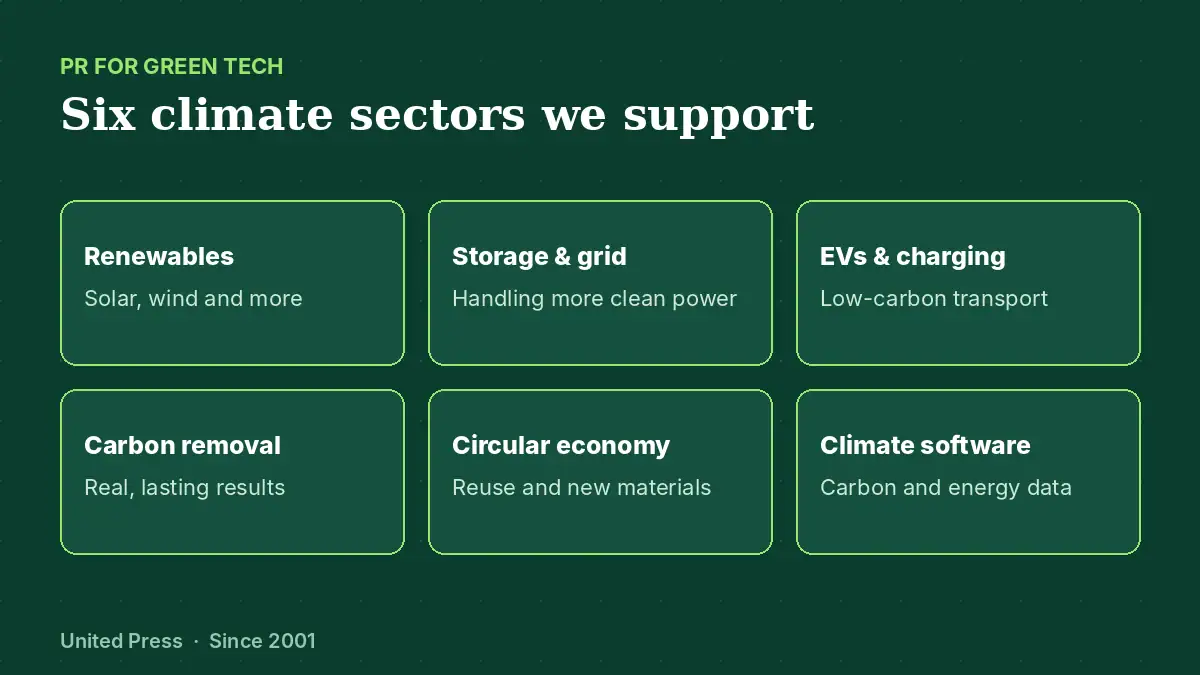
- Renewable energy developers building solar, wind and community energy projects.
- Energy storage and grid technology companies helping the network handle more clean power.
- Electric vehicle and charging businesses making low-carbon transport practical.
- Carbon capture and removal ventures that need to show their results are real and permanent.
- Circular economy and materials start-ups reducing waste through reuse, recycling and new materials.
- Climate software platforms for carbon accounting, energy management and reporting.
Green claims, the law and PR for green tech
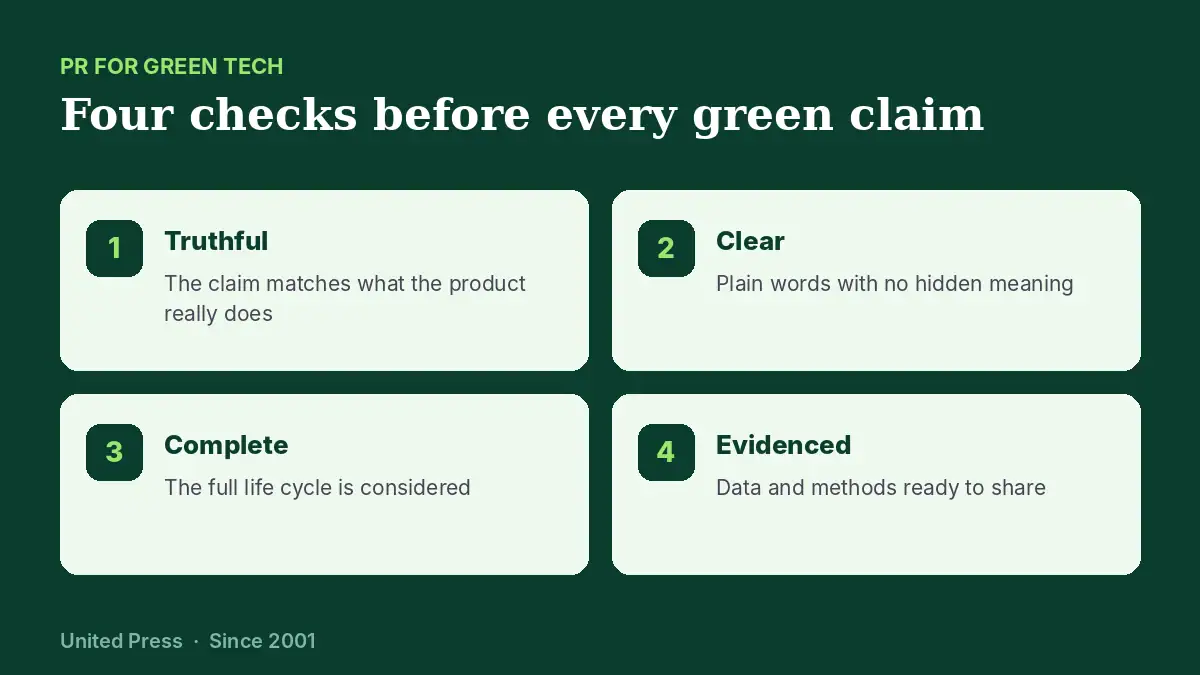
Environmental claims in the UK are judged against consumer protection law, and the Competition and Markets Authority has made clear that misleading green claims will be challenged. Its Green Claims Code checklist sets out the principles every business should follow: claims must be truthful, clear, complete, fair in any comparison and backed by evidence. Those principles apply to press releases and interviews as much as to adverts.
In PR for green tech, we build the checklist into our process. Every number is traced to its source, every comparison is checked for fairness and every claim about the full life cycle of a product is reviewed with your technical team. Words such as “carbon neutral”, “zero emissions” and “sustainable” are only used where they can be explained and proven. That discipline means PR for green tech never puts your reputation at risk for the sake of a bigger headline.
Green tech stories editors want
Energy, business, technology and environment desks all look for different things. These are the angles that work best in PR for green tech, and the strongest campaigns combine several of them:
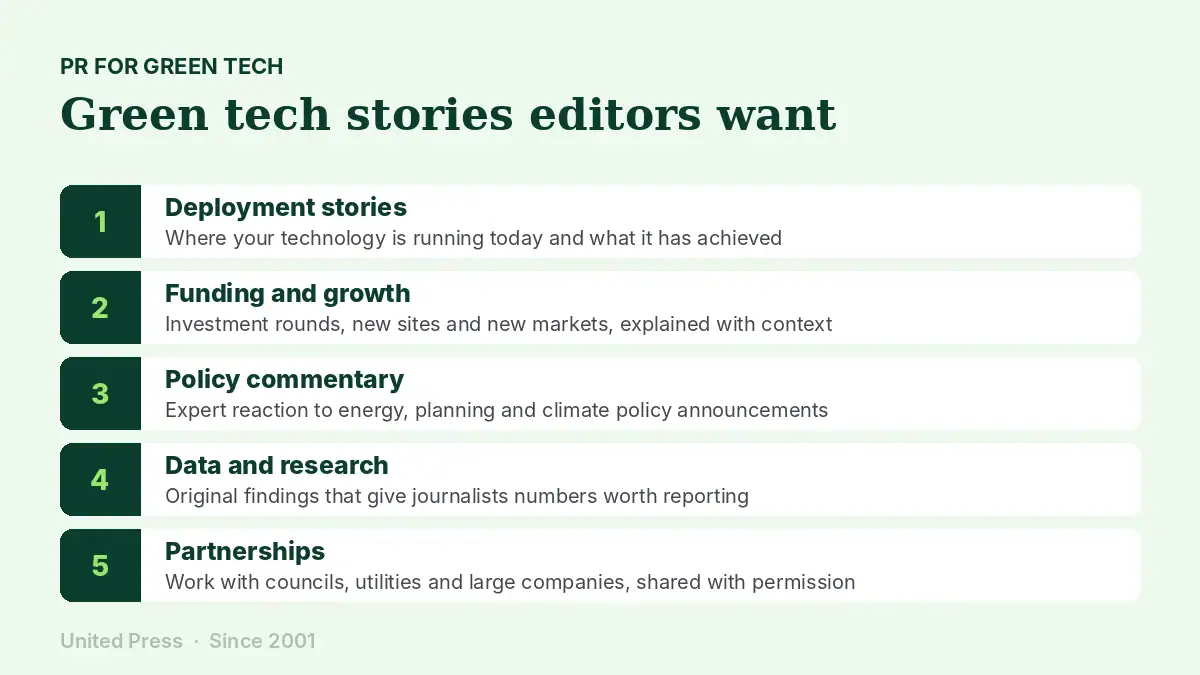
- Deployment stories: where your technology is running today and what it has achieved.
- Funding and growth: investment rounds, new sites and new markets, explained with context.
- Policy commentary: expert reaction to energy, planning and climate policy announcements.
- Data and research: original findings that give journalists numbers worth reporting.
- Partnerships: work with councils, utilities and large companies, shared with permission.
- People and skills: the engineers, installers and scientists building the green economy.
Reaching investors, policymakers and customers
Investors
Climate investors read sector news closely and notice which companies keep appearing. Consistent coverage of milestones, partnerships and leadership views makes your next funding conversation easier, because the investor already knows your story. PR for green tech that is planned around your funding timeline can build that familiarity months before a round opens.
Policymakers and public bodies
Many green tech markets are shaped by regulation, subsidies and public procurement. Thoughtful commentary in policy and trade titles shows officials and councils that your company understands the bigger picture. PR for green tech aimed at this audience focuses on practical evidence: what works, what it delivers and what would help it scale.
Customers and partners
Businesses and households want to know that a new technology is reliable before they switch. Case studies, independent results and clear explanations reduce that risk. PR for green tech for customer audiences avoids jargon and answers the questions buyers actually ask: does it work, is it proven and who else is using it?
Turning data and deployments into news
Green tech companies often sit on stories they never tell. Monitoring data from a pilot, a milestone in megawatt hours, a fall in waste sent to landfill or a new installation in an unusual location can all become strong news when framed well. We work with your engineers to find those moments and explain them in a way readers understand, so PR for green tech keeps a steady flow of genuine news rather than relying on one big announcement each year.
We also help you prepare for the moments you cannot plan. Policy announcements, energy market changes and extreme weather put climate solutions in the news overnight. A short list of approved facts and spokespeople lets PR for green tech respond quickly while the story is still live, which is often when the best coverage is won.
Common mistakes that hold green tech PR back
Most problems we see are avoidable. They come from enthusiasm rather than bad intent, but journalists and buyers notice them quickly. Avoiding these mistakes makes PR for green tech far more effective:
- Vague impact language. Phrases such as “eco-friendly” or “planet positive” mean little without numbers and a clear method behind them.
- Announcing too early. Pilots described as finished products create awkward questions later. It is better to explain honestly what stage you are at.
- Hiding the trade-offs. Every technology has limits. Explaining them openly builds more trust than pretending they do not exist.
- Forgetting the human story. Readers connect with the people who solve problems, not only with the machinery.
- Going quiet between announcements. Coverage builds familiarity over time, so long silences let competitors fill the space.
We check every campaign against these points before it goes out, so PR for green tech builds credibility step by step instead of creating risk.
Choosing the right titles for your climate audience
A national newspaper feature is valuable, but it is not always the most useful placement. An energy storage company selling to utilities may gain more from a respected energy trade title than from a general news site, while a consumer heat pump brand may need lifestyle, home and regional outlets. PR for green tech works best when the outlet list matches the people who make buying and investment decisions in your market.
We map those titles at the start of every campaign and balance them across trade, business, technology and regional media. Regional coverage is often underrated: councils, local businesses and community groups read their local press, and many green projects depend on local support. That balance keeps PR for green tech focused on real outcomes rather than vanity mentions.
PR for green tech companies outside the UK
The UK is one of the most active markets for climate technology, and many overseas companies want to build a presence here. We help international green tech businesses introduce themselves to UK editors, explain how their technology fits UK policy and grid conditions, and find British partners and customers. We also help UK companies take their stories abroad. Wherever you are based, PR for green tech follows the same rule: lead with evidence, explain it clearly and choose the audience that matters most.
A 90-day plan for PR for green tech
- Weeks 1 to 2: gather evidence, agree claims with your technical team and choose the audiences and titles that matter most.
- Weeks 3 to 6: launch a deployment or data story, brief spokespeople and set up rapid policy commentary.
- Weeks 7 to 10: secure trade, business and regional coverage, plus podcast and event opportunities.
- Weeks 11 to 12: share coverage with investors and customers, review results and plan the next quarter.
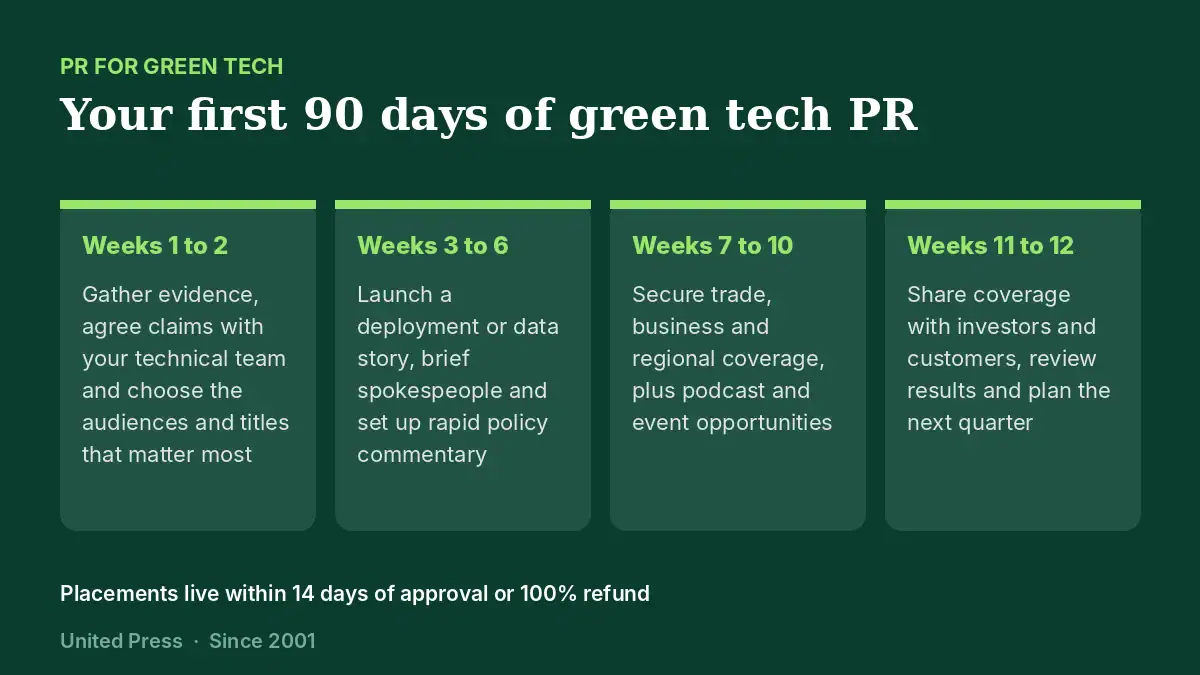
Placements go live by the date agreed in writing, or you receive a 100% refund. Related reading: our guides to PR for cleantech, PR for community energy, PR for scaleups and press release distribution.
PR for green tech in Google and AI search
Procurement managers, investors and journalists now ask ChatGPT, Gemini and Google AI questions such as “which UK companies make grid-scale batteries” or “best carbon accounting software for small businesses”. Those tools draw on trusted publications, so consistent PR for green tech improves the chance that your company is mentioned. No one can guarantee an AI mention, but independent editorial coverage is one of the strongest signals a climate company can build.
The same coverage supports your own search visibility. Articles in respected titles link back to your website, describe your technology in the words buyers use and show search engines that your company is a credible source on its subject. PR for green tech that continues month after month keeps that signal strong long after the first launch.
FAQ
How do you avoid greenwashing accusations? By leading with evidence and being precise about what your technology does and doesn’t do. Credible specificity is your best protection.
Do you work with hardware and deep-tech climate startups? Yes, including companies with long development timelines where investor and policy visibility is critical.
Tell us what you’re building and we’ll map a realistic route to coverage that supports funding and growth.