
Best PR for Elearning Platforms UK (2026): Proving That People Really Learn
PR for online course platforms, corporate learning providers and learning apps for adults. We help you show learners, employers and partners that your platform changes skills and careers, with evidence journalists can trust.
Who you sell to shapes your PR
Selling to schools? See our EdTech PR page and our education PR page.
Adult learners
People learning for a new job, a promotion or a passion.
Media: careers, money and lifestyle pressEmployers
Companies buying training for staff.
Media: HR, learning and business pressPartners
Universities, professional bodies and content creators.
Media: trade and higher education pressClaims journalists will question
| Weak claim | Stronger evidence |
|---|---|
| “Millions of learners” | Active learners and completion rates, with dates. |
| “Career-changing” | Survey of graduates on new jobs or pay, with sample size. |
| “Industry-recognised” | The named body that accredits or recognises the course. |
| “AI-powered learning” | What the AI actually does for the learner, in one sentence. |
When e-learning is in the news
The details that build trust
Clear pricing and cancellation. Subscription complaints quickly become consumer stories. Make terms easy to find.
Accessibility. Courses that work for disabled learners and on mobile reach more people and attract positive coverage.
Data and young users. If teenagers use your app, UK rules on children’s data apply, including the ICO’s Children’s Code.
Real learner stories. People who agree to share how a course changed their work are your strongest asset.
PR for Elearning Platforms by business model
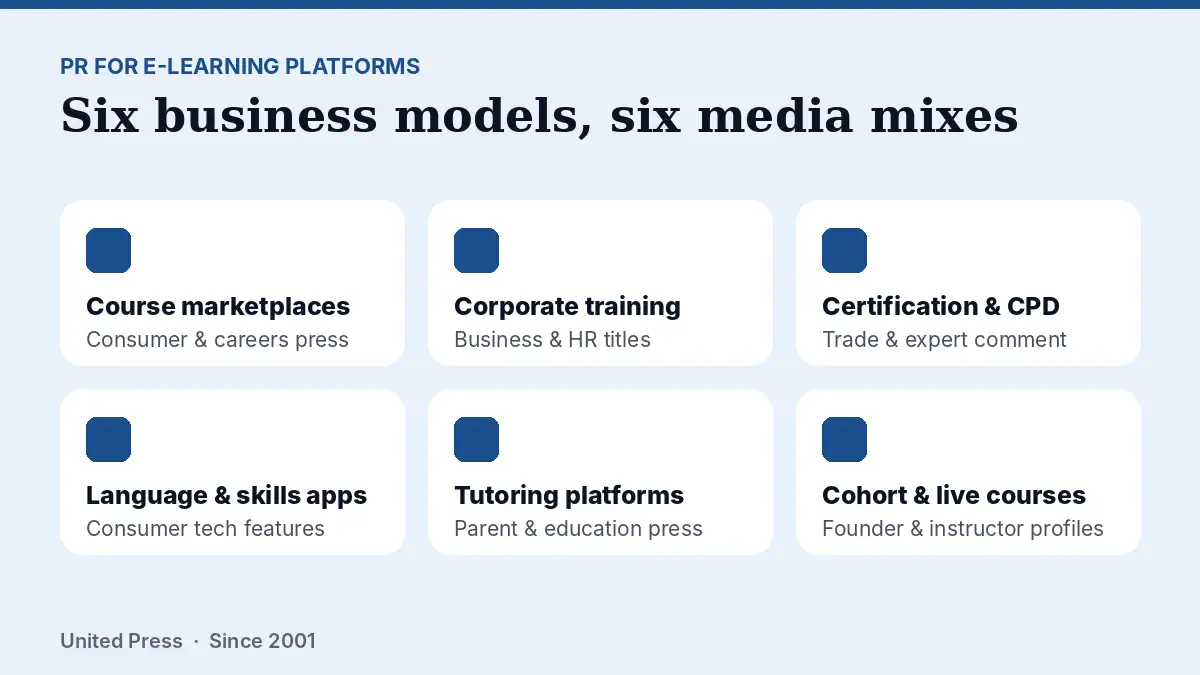
Two platforms can both teach online and still need completely different media. The right PR for elearning platforms depends on who buys, who learns and who you need to convince.
Course marketplaces
Consumer, lifestyle and careers coverage that brings individual learners to your catalogue, the most visible form of PR for elearning platforms.
Corporate training and LMS
Business and HR press that speaks to learning and development leaders choosing a supplier. B2B PR for elearning platforms is all about trust.
Professional certification and CPD
Trade titles and expert commentary that position your courses as the credible route to a qualification through PR for elearning platforms.
Language and skills apps
Consumer tech and lifestyle features built around habits, progress and everyday use, where app-focused PR for elearning platforms shines.
Tutoring platforms
Parent-focused and education coverage, with careful safeguarding and accuracy on every claim.
Cohort and live courses
Founder and instructor profiles that show the expertise and community behind each cohort, a natural fit for PR for elearning platforms.
Your instructors are your best story
Journalists rarely write about a platform. They write about people who know something useful. That is why strong PR for elearning platforms puts instructors, course designers and founders in front of editors as experts.
- Expert commentary: instructors reacting to news in their field, from AI skills to finance, coding or wellbeing.
- How-to features: practical advice drawn from a course, with the platform credited as the source.
- Career stories: how an instructor built their expertise and why they chose to teach online.
- Founder interviews: why the platform exists, what problem it solves and where learning is heading.
- Learner journeys: honest, consented stories from learners, which add a human face to PR for elearning platforms.
Each placement builds the instructor’s profile and the platform’s authority at the same time, which is one of the most efficient forms of PR for elearning platforms.
The e-learning PR calendar
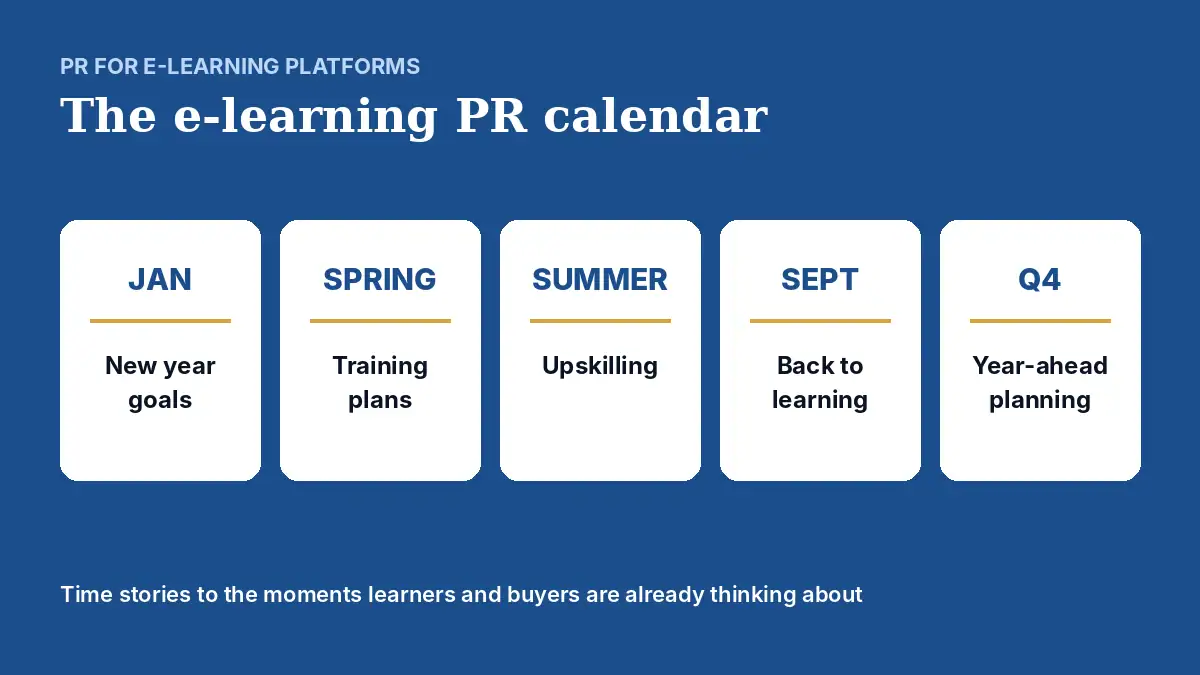
Learning has clear seasons, and editors plan around them, so your PR for elearning platforms should follow the same calendar. Timing your stories is a simple way to make PR for elearning platforms work harder.
| When | What learners and buyers are thinking | Story to pitch |
|---|---|---|
| January | New year goals and career changes | Skills to learn this year, career-switch stories |
| Spring | Training plans for the new financial year | Workplace skills gaps, L&D trends |
| Summer | Upskilling before autumn | Short courses, holiday learning for families |
| September | Back to learning | New courses, study tips, learner journeys |
| Q4 | Planning next year’s training | Year-ahead predictions, data from your platform |
PR for elearning platforms and schools
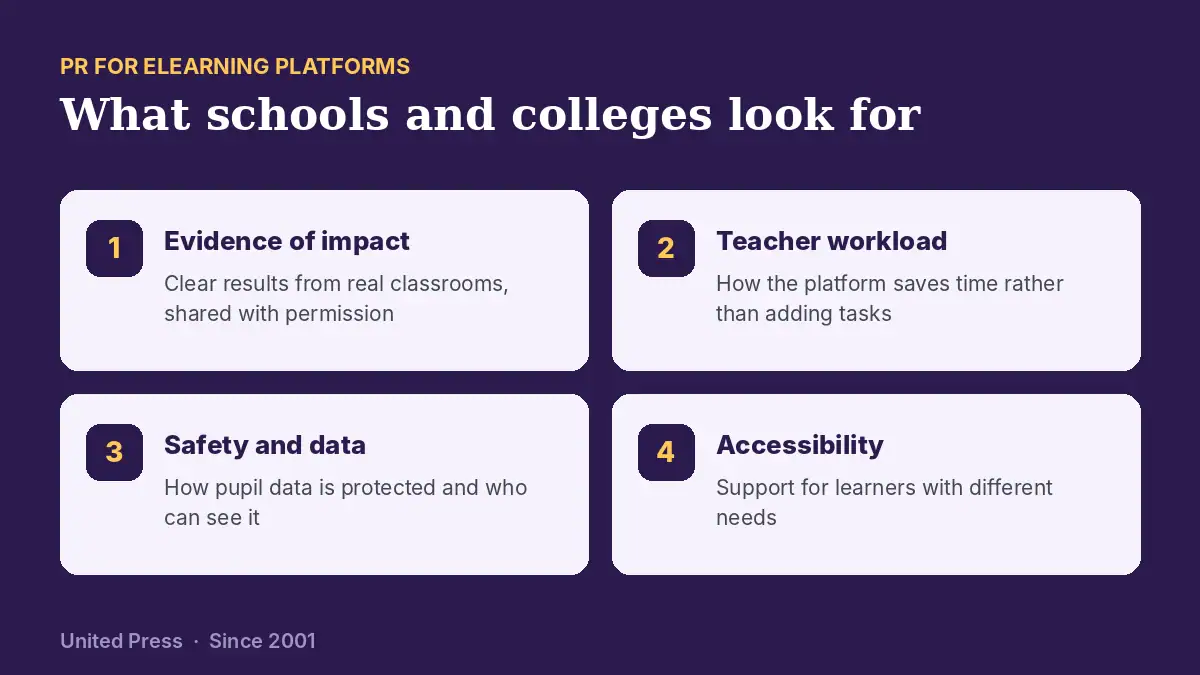
Platforms that sell into schools and colleges need to show they understand how education technology is chosen and used. The Department for Education’s guidance on using technology in education brings together its advice for schools on digital standards, safety and planning, and it is a useful reference for any education-focused story.
- Evidence of impact: clear results from real classrooms, shared with permission
- Teacher workload: how the platform saves time rather than adding tasks
- Safety and data: how pupil data is protected and who can see it
- Accessibility: support for learners with different needs
In PR for elearning platforms, we connect your product news to the questions school leaders are already asking, such as workload, safeguarding and value for teaching time. PR for elearning platforms framed this way reads as helpful rather than promotional, which is exactly what education editors and headteachers want to see.
E-learning platforms in Google and AI search
Learners and training buyers now ask ChatGPT, Gemini, Perplexity and Google AI questions such as “best online course to learn data analysis” or “compliance training platforms for UK companies”. These tools lean heavily on trusted publications when they decide which platforms to recommend, so PR for elearning platforms now shapes AI visibility too.
Editorial coverage gives them credible sources that mention your platform, your courses and your instructors. No one can guarantee an AI mention, but consistent PR for elearning platforms gives you a much better chance of appearing in those answers, while high-authority links help your course pages rank in Google.
Reviews matter too. If fake or unfair reviews are hurting sign-ups, our Google review removal service can help. For wider education coverage, see our guides to education PR and PR for universities, or pair your features with press release distribution.
Business and tech titles in our network
Most e-learning coverage is earned. Next to that, you can book features in titles from our publication network, such as Entrepreneur UK, TechRound and Technology.org. Booked features go live within 14 days of approval or you get a 100% refund.
Listed in our network, October 2026. Terms, including link treatment, are confirmed in writing before you book. Google asks that paid links are marked as sponsored or nofollow.
Three example e-learning campaigns
A coding course platform
“Survey of graduates: how long it took to land a first tech job”
- Route: careers and money press.
- Timing: January.
- Outcome sought: sign-ups.
A compliance training provider
“What staff actually remember from mandatory training”
- Route: HR and learning trade press.
- Timing: budget planning season.
- Outcome sought: employer demos.
A platform partnering with a professional body
“New online route into accountancy for career changers”
- Route: trade press and an Entrepreneur UK feature.
- Timing: launch week.
- Outcome sought: enrolments.
Illustrative plans with example headlines. They are not client results.
What clients say about United Press
★★★★★“United Press built our brand from launch to nationwide recognition. Real media coverage gave new customers the trust they needed — our ROI has been over 100:1, which blows my mind.”
Annabelle SparksGlobal Head of Marketing
★★★★★“United Press helped us turn our company story into something journalists could genuinely engage with. The coverage gave our brand a level of credibility that was difficult to achieve through our own marketing channels.”
James WhitmoreFounder & CEO
★★★★★“The team understood our industry and, more importantly, understood the story we needed to tell. Seeing our company featured across relevant publications gave us a much stronger presence when potential customers researched us.”
Olivia BennettMarketing Director
United Press is a London PR agency at Brook’s Mews, working since 2001 with clients worldwide, and a winner or shortlisted at PRWeek, CIPR Excellence, UK Agency, PRCA DARE, The Drum and UK Social Media Communications Awards.
E-learning PR questions
What does PR for an e-learning platform do?
It builds trust with learners, employers and partners through careers, HR, tech and business media, backed by evidence that people learn.
What data makes a good e-learning story?
Completion rates, career outcomes from graduate surveys, and trends in what people want to learn, with clear sources.
How is this different from EdTech PR?
This page focuses on adult and workplace learning. Products for schools have their own audiences and rules.
Do you work with platforms outside the UK?
Yes, including international platforms growing in the UK.
How quickly can a booked feature go live?
Within 14 days of your approval, or you get a 100% refund.
How much does e-learning PR cost?
There is no fixed price. Every campaign is planned around your goal and the titles you need. Share your goal and budget in the form below for a personalised plan.
How do e-learning platforms get press coverage?
Put your instructors and founders forward as experts, time stories around learning seasons such as January and September, and back every claim with data you can share. In PR for elearning platforms, we shape those stories, pitch the right editors and confirm each live link.
Who should be the spokesperson for an e-learning platform?
Usually an instructor or course designer with real expertise, supported by the founder for business and growth stories. Journalists prefer people who can explain a subject clearly over company announcements.
Can PR help an e-learning platform appear in AI search?
It can improve your chances. AI tools such as ChatGPT and Gemini rely on trusted publications when they recommend courses and platforms. No one can guarantee an AI mention, but press coverage is one of the strongest signals you can build.
Ready to show what your learners achieve?
Tell us about your platform, your learners and the results you can show. We will send a free plan with the angle, titles and timing that fit.