
UK Global Talent Visa Success Tips and Top Strategies for 2026

The UK Global Talent Visa offers an excellent opportunity for professionals in digital technology, arts and culture, academia, and research to live and work in the UK with greater flexibility and independence. However, having strong professional achievements is only one part of the process. A clear and well-prepared strategy can make a significant difference when preparing for Global Talent Visa endorsement.
This guide provides practical UK Global Talent Visa success tips and top strategies to help applicants strengthen their evidence, demonstrate professional recognition, present their achievements clearly, and build a more compelling endorsement profile.
If you are looking to strengthen your professional visibility through genuine editorial media recognition, United Press can support your wider media and personal branding strategy. Through targeted editorial PR, you can showcase your achievements, expertise, leadership, innovation, and industry impact across relevant publications.
Explore United Press to learn more about building genuine media recognition for your UK Global Talent Visa profile.
🌐 www.unitedpress.uk
💬 WhatsApp: +44 7447 882377
Build the UK Global Talent Visa Application Triangle
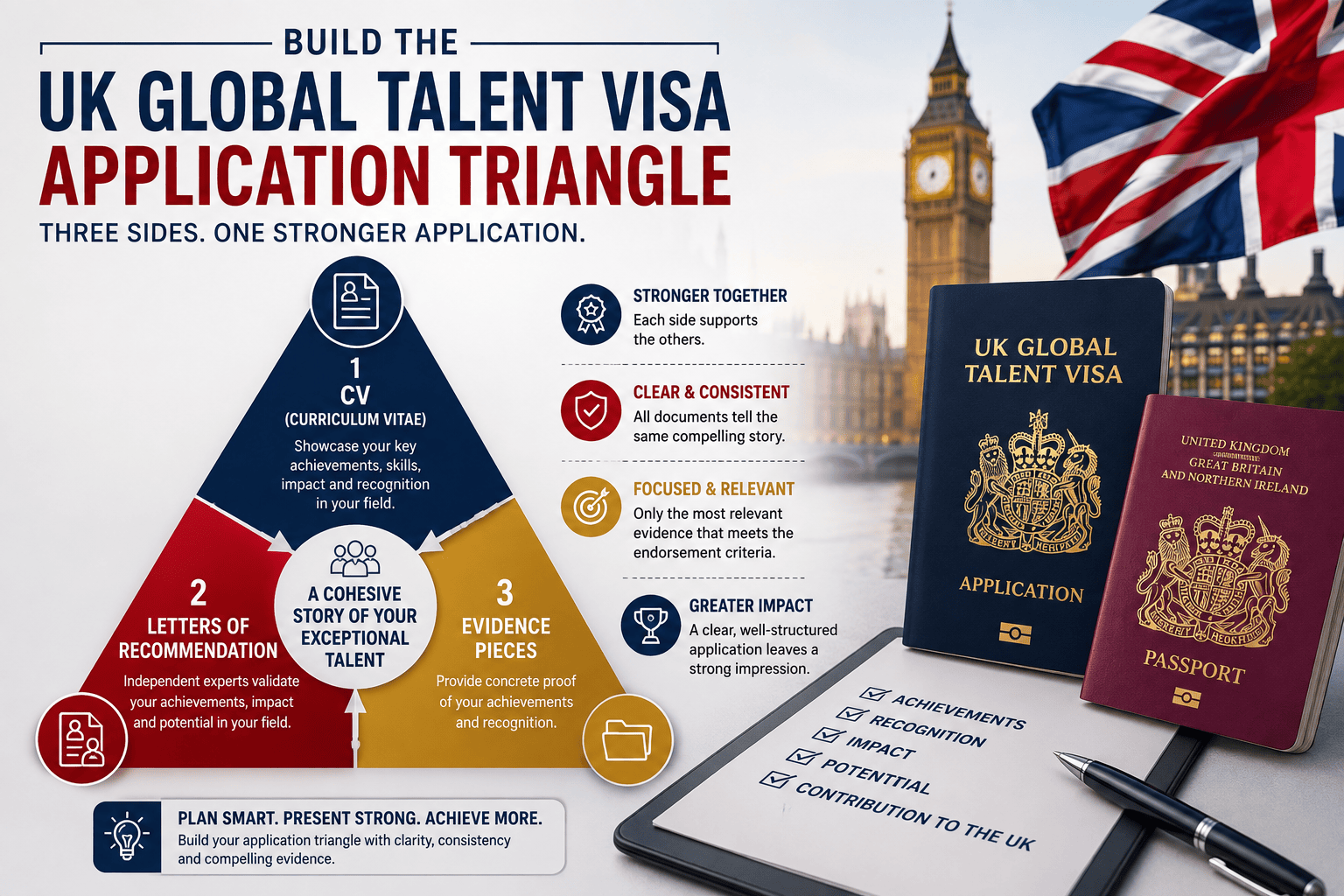
A strong UK Global Talent Visa application should present a clear and consistent picture of an applicant’s professional achievements, recognition, expertise, and future potential.
One useful way to approach the application is to think of the supporting documents as an “Application Triangle”, where each side supports the others and contributes to a cohesive evidence portfolio.
The three key elements are:
1. CV (Curriculum Vitae)
A well-structured CV provides the foundation of the application. It should clearly present the applicant’s most significant professional achievements, expertise, career progression, and recognition.
Depending on the applicant’s field, relevant information may include Google Scholar or ResearchGate profiles for academics and researchers, GitHub profiles and technical projects for digital technology professionals, as well as awards, publications, speaking engagements, mentorship, leadership positions, patents, research projects, and other notable accomplishments.
The objective is not simply to create a long CV. Instead, the CV should make it easy to understand the applicant’s professional journey and identify the achievements that demonstrate leadership or strong potential within their field.
2. Letters of Recommendation
Recommendation letters should reinforce the achievements presented in the CV while providing an independent perspective on the applicant’s professional standing.
Applicants should select referees who are established and respected within their field and who can provide specific examples of their expertise, achievements, influence, and potential.
A strong recommendation letter should go beyond general statements such as “highly talented” or “excellent professional.” It should explain what the applicant achieved, why those achievements matter, and how they demonstrate recognition or potential within the relevant field.
The referee’s professional background should also be clearly established so that the reader understands why their opinion is relevant and credible.
3. Supporting Evidence
Supporting evidence provides tangible proof of the achievements and recognition described in the CV and recommendation letters.
Depending on the applicant’s profession, this could include:
- Published research and citations
- Industry awards
- Media coverage
- Speaking engagements
- Patents and original innovations
- Evidence of commercial or industry impact
- Professional memberships
- Research projects
- Technical contributions
- Leadership achievements
- Recognition from established organisations
Every document should have a clear purpose. Instead of submitting evidence simply to increase the volume of an application, applicants should select documentation that directly supports the relevant Global Talent criteria.
Where Does Media Recognition Fit Into the Triangle?
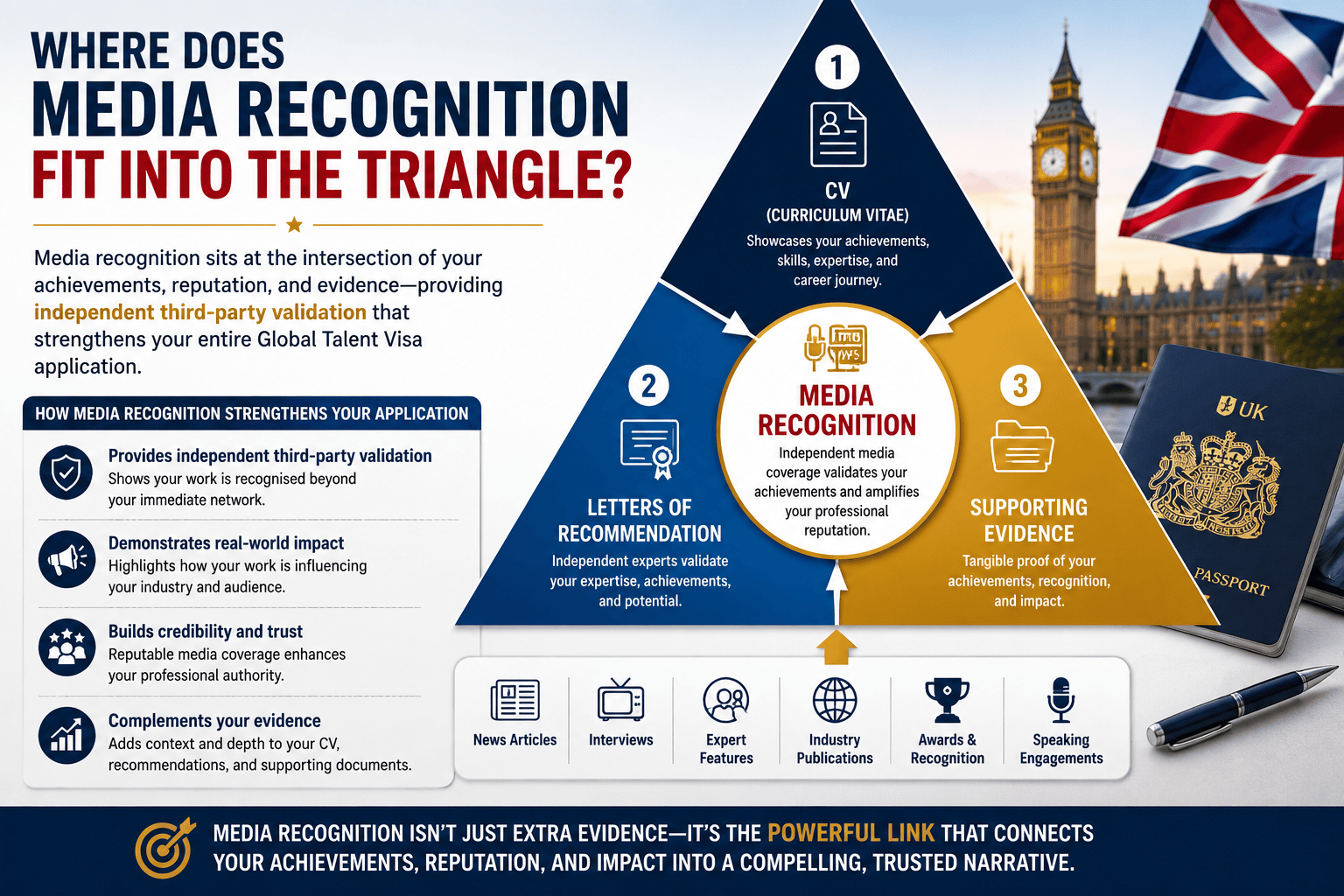
For many professionals, independent media recognition can provide useful third-party context around their achievements.
A journalist-written feature, expert interview, or relevant industry article can help demonstrate that an individual’s work has received attention beyond their immediate organisation or professional network, where such recognition is relevant to the applicable endorsement criteria.
This is where an editorial PR strategy can complement the wider application.
For example, United Press helps founders, entrepreneurs, researchers, scientists, academics, engineers, executives, innovators, and other professionals build genuine editorial media recognition around their real achievements.
Rather than treating media coverage as a standalone solution, the objective is to ensure that the coverage supports the applicant’s broader professional narrative. Articles can highlight genuine achievements, research, innovation, leadership, industry contributions, or other areas of recognised expertise.
United Press can therefore form part of a wider professional visibility strategy, helping applicants document their achievements through credible editorial coverage while building long-term professional reputation.
Make All Three Sides Work Together
The strongest approach is to make the CV, recommendation letters, and supporting evidence tell the same story.
An important achievement mentioned in the CV should, where appropriate, be supported by documentation. Recommendation letters should provide additional context and independent perspectives rather than simply repeating information from the CV.
This creates a logical evidence chain:
CV → Recommendation Letters → Supporting Evidence
When these elements are consistent and complementary, it becomes easier to understand the applicant’s professional journey, achievements, recognition, and potential contribution.
The goal is not to overwhelm the application with documents. The goal is to create a clear, evidence-based professional narrative in which every important piece of information has a reason for being included.
Applicants should always check the latest Global Talent Visa requirements for their specific field and endorsing body, as evidence requirements and document limits can vary between routes.
Build Recognition Before You Need It
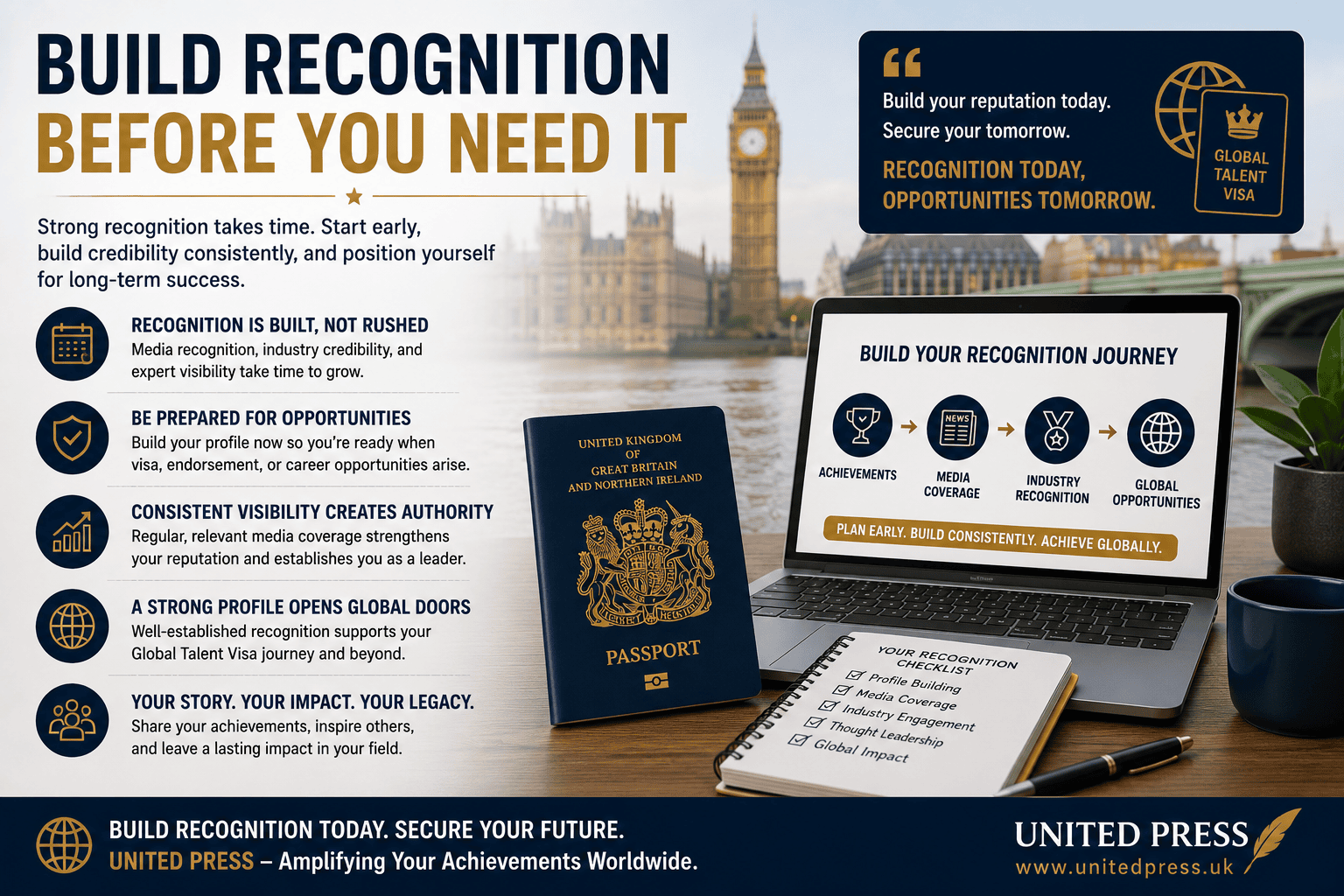
A strong Global Talent profile is rarely built immediately before an application.
Professional recognition develops over time through achievements, research, innovation, industry participation, awards, recommendations, speaking opportunities, and genuine media coverage.
For professionals who want to strengthen the media-recognition element of their profile, United Press provides editorial PR focused on authentic achievements and professional credibility.
Strengthen Your Evidence for a UK Global Talent Visa Application
While your CV and Letters of Recommendation are important parts of a UK Global Talent Visa application, the supporting evidence can be equally important. These documents provide the practical proof behind the achievements, recognition, and contributions described elsewhere in the application.
A strong evidence strategy is not simply about collecting as many documents as possible. Each piece should have a clear purpose and should help demonstrate why the applicant meets the relevant Global Talent endorsement criteria.
1. Give Every Evidence Document a Clear Title and Purpose
Each evidence document should be clearly labelled and connected to the specific criterion it supports.
Instead of uploading a collection of unrelated documents, provide a short introduction explaining:
- What the evidence demonstrates
- Why it is relevant
- Which achievement it supports
- How it connects to the applicable endorsement criterion
This allows the reviewer to understand the importance of the document without having to interpret the evidence themselves.
2. Add Context to Your Evidence
One of the most common problems with supporting evidence is providing documents without enough explanation.
For example, a screenshot of an email, research result, award, company report, or project document may be meaningful to the applicant but difficult for someone unfamiliar with the work to understand.
A short explanation can clarify:
What is this document? Who produced it? What does it demonstrate? Why is it significant?
The explanation should remain factual and concise. Its purpose is to make the evidence easier to evaluate, not to make unsupported claims.
3. Make Each Evidence Piece Different
Avoid using the same achievement repeatedly across the CV, recommendation letters, and supporting documents without adding anything new.
Each evidence piece should contribute something useful to the overall story.
For example:
- One document could demonstrate an industry award
- Another could demonstrate measurable business impact
- Another could demonstrate research recognition
- Another could demonstrate media coverage
- Another could demonstrate leadership or innovation
This creates a broader picture of professional recognition rather than repeating the same achievement several times.
4. Prioritise Independent and Verifiable Evidence
Independent evidence can make professional achievements easier to verify.
Where relevant, applicants can consider evidence such as:
- Reputable media coverage
- Published research
- Independent awards
- Conference programmes
- Official company or institutional records
- Research citations
- Publicly available industry information
- Letters or documentation from recognised organisations
- Evidence of adoption or implementation
This is also where genuine editorial media recognition can complement a wider Global Talent evidence strategy.
For professionals who want to document their achievements through credible media, United Press helps founders, entrepreneurs, researchers, scientists, academics, engineers, executives, innovators, and other professionals develop genuine editorial coverage focused on their real achievements and industry contributions.
The objective is not simply to obtain publicity. It is to create accurate, relevant media recognition that can contribute to a professional’s wider public profile.
5. Focus on Quality, Clarity and Relevance
Evidence should be easy to understand.
Applicants should avoid filling documents with unnecessary technical information, lengthy explanations, or irrelevant material. Even when the work is highly specialised, the evidence should clearly communicate the achievement, impact and significance.
A useful test is:
Can someone unfamiliar with the applicant’s work understand what this document proves within a few minutes?
If the answer is no, the document may need better organisation or explanation.
6. Connect Evidence to the Overall Application Story
The strongest applications are cohesive.
The CV introduces the professional journey. Recommendation letters provide independent perspectives. Supporting evidence then provides tangible documentation of the achievements being discussed.
Think of the structure as:
Achievement → Recognition → Independent Evidence → Professional Impact
For example, if an applicant claims to have developed an influential technology, the supporting evidence should help demonstrate what was developed, why it was significant, who recognised it, and what measurable impact it created.
This approach makes the evidence more meaningful than simply listing achievements.
7. Avoid Unsupported Claims
Applicants should be careful with statements such as:
- “Industry-leading”
- “World-renowned”
- “One of the best”
- “Internationally recognised”
Such descriptions are most persuasive when supported by objective evidence.
Instead of relying on self-description, applicants should demonstrate recognition through verifiable achievements, independent publications, awards, research impact, industry adoption, reputable media coverage, or other relevant documentation.
Supporting evidence should not be treated as an afterthought in a UK Global Talent Visa application.
Every document should answer an important question:
What does this evidence prove about the applicant’s talent, recognition, achievements, or potential?
A carefully selected and clearly explained evidence portfolio can make the overall application easier to understand and can help create a consistent professional narrative.
For professionals looking to strengthen their media recognition, United Press provides genuine editorial PR focused on authentic achievements, professional expertise, leadership, innovation, and industry impact.
What Not to Include in Your UK Global Talent Visa Application
A strong UK Global Talent Visa application is not necessarily the one with the largest number of documents. Including irrelevant, repetitive, or poorly explained evidence can make it harder for an assessor to identify the achievements that genuinely demonstrate an applicant’s talent, recognition, or potential.
Before submitting an application, applicants should carefully review their evidence and remove anything that does not directly contribute to their case.
Repetitive Information
Each supporting document should add something meaningful to the application.
Avoid submitting multiple documents that demonstrate exactly the same achievement without providing additional context or independent verification. If an award, project, publication, or professional achievement is already clearly established, additional documents should ideally demonstrate a different aspect of its significance or impact.
A well-structured application should develop a clear story rather than repeat the same claims throughout the evidence.
Documents Without Clear Relevance
Every piece of evidence should have a clear connection to the applicable Global Talent endorsement criteria.
Applicants should be cautious about including:
- Unrelated certifications
- Generic training certificates
- Old documents with no relevance to the application
- Routine employment records
- Evidence that does not demonstrate recognition or impact
- Documents whose purpose is unclear
Before including a document, applicants should ask:
What does this document prove, and why is it relevant to the endorsement criteria?
If that question cannot be answered clearly, the document may not deserve a place in the evidence portfolio.
Over-Reliance on Self-Certified Information
Claims supported only by the applicant’s own statements can be less persuasive than claims supported by independent evidence.
Where possible, important achievements should be supported through objective and verifiable sources such as:
- Independent media coverage
- Official awards
- Public records
- Research publications
- Conference programmes
- Institutional documentation
- Third-party recognition
- Evidence from established organisations
For professionals building their public profile, genuine editorial media recognition can also provide independent context around significant achievements and professional contributions.
United Press helps founders, entrepreneurs, researchers, scientists, academics, engineers, executives, innovators, and other professionals develop authentic editorial media coverage that focuses on their real achievements and expertise.
Avoid Promotional Evidence Presented as Recognition
Applicants should distinguish between genuine recognition and marketing material.
A company advertisement, promotional webpage, paid placement, or self-published article should not automatically be presented as evidence of independent professional recognition.
Where media coverage is included, it is important that the content accurately identifies the applicant, discusses their achievements or contributions, and comes from a credible editorial source relevant to their field.
Don’t Submit Evidence Just to Fill Space
More evidence does not automatically create a stronger application.
The better approach is to select documents that collectively demonstrate a clear pattern of achievement, recognition, impact, and professional potential.
A concise, relevant and well-organised evidence portfolio is easier to understand than a collection of unrelated documents.
Final Check Before Submission
Before finalising a UK Global Talent Visa application, applicants should review each document and ask:
Is it verifiable?
Does it add something new?
Does it support the applicable criterion?
Does it contribute to the overall professional narrative?
If the answer is yes, the evidence is more likely to have a clear purpose within the application.
🌐 www.unitedpress.uk
💬 WhatsApp: +44 7447 882377
Build credibility. Earn genuine media recognition. Showcase your professional impact with United Press.
How United Press Helps Build Genuine Global Talent Media Recognition
Building a strong UK Global Talent Visa profile is not only about having impressive achievements. Professionals also need to communicate those achievements clearly and establish credible recognition within their field.
This is where a strategic editorial PR approach can help.
United Press helps professionals turn genuine achievements into meaningful media stories that showcase their expertise, leadership, innovation, research, and industry impact.
1. We Start With Your Professional Profile
Every professional has a different story.
United Press first looks at the applicant’s:
- Career achievements
- Industry expertise
- Awards and recognition
- Research and innovation
- Business accomplishments
- Leadership experience
- Products or projects
- Speaking engagements
- Professional milestones
This helps identify the strongest stories that can be presented to relevant media.
2. We Identify Your Strongest Media Angles
Not every achievement makes a strong news story.
The focus is on identifying genuine, newsworthy angles that can demonstrate why the professional’s work is relevant to their industry.
For example, a technology professional may have a story around innovation or AI. A researcher may have significant research findings. An entrepreneur may have built a successful company or introduced an innovative solution.
The objective is to make the individual’s real achievements the centre of the story.
3. We Develop Editorial-Focused Content
Strong media coverage should feel like journalism—not advertising.
United Press focuses on creating professional editorial content that clearly communicates:
- Who the professional is
- What they have achieved
- Why their work matters
- What makes their contribution distinctive
- How their expertise is influencing their field
This approach helps create a more credible professional profile than simply publishing promotional advertisements.
4. We Focus on Relevant Media Recognition
The goal is not to collect random articles.
The focus is on finding relevant publications and editorial opportunities that align with the professional’s industry, expertise, and achievements.
Relevant coverage can help professionals build a searchable digital footprint around their name and expertise while strengthening their long-term professional visibility.
5. We Help Create Consistent Professional Recognition
One article should not be viewed as the entire media strategy.
A stronger approach is to develop a consistent professional narrative across multiple forms of recognition.
For example:
Expertise → Achievement → Media Recognition → Industry Impact → Professional Authority
When media coverage consistently reflects the same genuine areas of expertise, it can help create a stronger and more recognisable professional identity.
6. We Help Document Your Media Recognition
Once coverage is published, professionals should maintain organised records of their media recognition.
This can include:
- Published article links
- Publication names
- Publication dates
- Screenshots
- Article PDFs
- Author information
- Relevant audience or publication information
Keeping these records organised makes it easier to reference media recognition as part of a wider professional evidence portfolio where appropriate.
7. We Support Different Types of Professionals
United Press works with professionals across a range of industries, including:
- Technology founders
- Entrepreneurs
- Researchers
- Scientists
- Academics
- Engineers
- Physicians
- Executives
- Consultants
- Artists
- Innovators
Each profile requires a different editorial strategy because the achievements that matter in technology may be very different from those that matter in research, business, medicine, arts, or academia.
Build Recognition Around Real Achievements
The purpose of editorial PR should never be to manufacture achievements.
It should be to document and communicate achievements that already exist.
For professionals preparing for the UK Global Talent Visa, genuine media recognition can complement other evidence such as awards, research, publications, recommendation letters, leadership, innovation, and industry contributions where relevant to their specific endorsement route.
United Press focuses on helping professionals turn those genuine accomplishments into credible editorial stories that support a stronger long-term public profile.
Frequently Asked Questions About the UK Global Talent Visa
How difficult is it to get a Global Talent Visa?
The UK Global Talent Visa can be competitive because applicants generally need to demonstrate that they are a leader or potential leader in their field. The difficulty depends on the applicant’s profession, endorsement route, achievements, recognition and quality of evidence.
A strong application should clearly connect the applicant’s achievements with the relevant endorsement criteria rather than relying on a large quantity of documents. United Press can help professionals strengthen the media-recognition side of their wider professional profile through genuine editorial coverage.
Can a Global Talent Visa be rejected?
Yes. An application can be refused if the applicant does not meet the relevant eligibility or suitability requirements. For most applicants, endorsement is a separate stage, and receiving an endorsement does not automatically guarantee that the subsequent visa application will be granted.
If an endorsement application is refused, applicants may have the option to request an endorsement review, depending on the circumstances. GOV.UK states that an endorsement review generally needs to be requested within 28 days.
What is the success rate of the UK Global Talent Visa?
There is no single official percentage that accurately represents the Global Talent Visa success rate across all fields, endorsement routes and application stages.
The process includes different decisions, including endorsement and the visa application itself. Outcomes can therefore vary depending on the applicant’s circumstances and the evidence submitted.
Rather than relying on an advertised success percentage, applicants should focus on meeting the current requirements and presenting strong, relevant and verifiable evidence.
What are the rules for a Global Talent Visa?
The current Global Talent route is for adults who can demonstrate exceptional talent or exceptional promise in eligible fields including science, engineering, humanities, social sciences, medicine, digital technology, and arts and culture. Most applicants go through an endorsement stage followed by the visa application, while eligible prestigious-prize winners can apply without endorsement.
The specific evidence requirements depend on the applicant’s field and relevant endorsing body.
What is the rejection rate for the Global Talent Visa?
There is no single official rejection-rate figure that should be applied to every Global Talent Visa application.
Home Office immigration statistics contain data about different visa categories and outcomes, but Global Talent applications involve different stages and routes. Therefore, quoting a single percentage as the overall Global Talent Visa rejection rate can be misleading.
Applicants should evaluate their own eligibility and evidence rather than relying on a general rejection statistic.
What is the hardest visa to get in the UK?
There is no official ranking that identifies one UK visa as the “hardest” to obtain.
Different visa categories have different eligibility requirements. The Global Talent Visa can be demanding because applicants need to demonstrate exceptional talent or exceptional promise through the relevant endorsement criteria. However, whether it is more difficult than another visa depends on the applicant’s individual circumstances and the requirements of the route.
Which UK visa has the highest rejection rate?
There is no universal answer because refusal rates vary by visa category, nationality, application type, eligibility requirements and time period.
Home Office statistics publish outcomes across different parts of the immigration system, but comparing categories without considering these differences can produce misleading conclusions.
Can I do two jobs on a Global Talent Visa?
Generally, the Global Talent route provides considerably more flexibility than an employer-sponsored route. Under the current Immigration Rules, work—including employment, self-employment and voluntary work—is permitted, except employment as a professional sportsperson or sports coach.
This means Global Talent holders can generally work for more than one organisation, undertake self-employment, or pursue different professional activities, provided they continue to comply with the conditions of their immigration permission.
Is a Global Talent Visa better than a Skilled Worker Visa?
Neither visa is automatically better. The right option depends on the individual’s circumstances and career plans.
The Global Talent Visa can offer greater professional flexibility because it does not tie the holder to a specific sponsored employer in the same way as the Skilled Worker route. The current Global Talent rules permit employment, self-employment and voluntary work, subject to the route’s conditions.
The Skilled Worker route, by contrast, is based on sponsored employment and has specific rules governing additional work.
For professionals who already have strong industry recognition, research achievements, innovation, awards or leadership experience, Global Talent may offer an attractive alternative.
How long does it take to process a Global Talent Visa in the UK?
The visa application stage usually takes:
- 3 weeks when applying from outside the UK
- 8 weeks when applying from inside the UK
These times apply after the applicant has submitted the visa application, proved their identity and provided the required documents.
The endorsement stage is separate. For example, current digital technology guidance states that endorsement decisions usually take 5 to 8 weeks, while some academic or research routes may have different processing times or fast-track options.
Therefore, applicants should consider the full timeline, rather than looking only at the final visa decision period.
How many Global Talent Visas have been issued?
The Home Office publishes immigration statistics covering visa grants and different work routes, but the overall statistics should be interpreted carefully because Global Talent figures can be presented across different datasets, periods and stages.
The latest Home Office immigration statistics cover the year ending March 2026 and provide detailed data tables for immigration applications and outcomes.
Applicants should use the latest official Home Office datasets when quoting a specific number rather than relying on older figures published by third-party websites.
How many UK visas get rejected?
There is no single rejection number that applies to all UK visas. The UK immigration system includes many different visa categories, and refusal rates vary considerably depending on the route and period.
The Home Office’s latest immigration statistics provide data on applications and outcomes across the UK immigration system, including work, study, family and other routes.
For this reason, applicants should look at statistics for the specific visa category they are considering rather than using the overall UK visa refusal figure.
Can media coverage help a Global Talent Visa profile?
Relevant editorial media recognition can complement a professional profile where it is relevant to the applicable endorsement criteria. However, media coverage should not be treated as a guarantee of endorsement or visa approval.
The strongest approach is to ensure that coverage accurately reflects genuine achievements, expertise, innovation, research, leadership or professional impact.
United Press helps professionals develop genuine editorial media recognition around their real achievements, providing a way to build long-term professional visibility alongside their broader Global Talent evidence strategy.
What can I do if I am preparing my Global Talent application?
Start by identifying the correct endorsement route and reviewing its current requirements. Then organise your strongest achievements, recommendation evidence and supporting documents around the applicable criteria.
Professionals should also consider building their public professional profile well before applying. United Press can help with the editorial media side by developing genuine coverage that highlights authentic professional achievements and industry contributions.
Final Thoughts
A successful UK Global Talent Visa application is not simply about having an impressive career. It is about presenting clear, credible and relevant evidence that demonstrates your expertise, achievements, recognition, leadership and potential contribution to the UK.
The strongest approach is strategic. Start by understanding the requirements for your specific field, identify your strongest achievements, select evidence that directly supports those achievements, and make sure your CV, recommendation letters and supporting documents tell a consistent story.
For professionals building their profile, genuine editorial media recognition can also play an important role where it is relevant to the applicable endorsement criteria. Meaningful coverage can help document professional achievements, showcase expertise and establish visibility beyond an individual’s own website or organisation.
The objective should never be to create publicity simply for the sake of publicity. It should be to accurately showcase achievements that already exist and build a credible professional reputation over time.
Ready to Build Your Global Talent Media Profile?
Your achievements deserve to be seen, understood and recognised.
United Press helps founders, entrepreneurs, researchers, scientists, academics, engineers, executives, innovators and other professionals develop genuine editorial media coverage focused on their real achievements, expertise, leadership and industry impact.
Whether you are preparing for a UK Global Talent Visa, strengthening your professional profile, or building long-term international visibility, a strategic editorial PR approach can help turn your achievements into compelling professional stories.
With United Press, you can:
- ✓ Develop a media strategy around your genuine achievements
- ✓ Identify strong editorial angles based on your expertise
- ✓ Build relevant media recognition around your professional profile
- ✓ Showcase your research, innovation, leadership or business impact
- ✓ Create a stronger and more consistent online professional presence
Start building genuine media recognition for your Global Talent profile today.
🌐 Visit: www.unitedpress.uk
💬 WhatsApp: +44 7447 882377
Build credibility. Earn genuine media recognition. Showcase your professional impact with United Press.