
Looking for the best PR for UK consumer tech brands in 2026? UK consumer tech brand PR — review-driven PR for consumer electronics, smart home tech, wearables, audio, and connected devices. UK consumer tech PR depends on sample-based product review programmes — journalists need hands-on time before they will recommend.
UK consumer tech publications in 2026
- TechRadar.
- Stuff.
- Wired UK.
- Trusted Reviews.
- Pocket-lint.
- What Hi-Fi.
- T3.
Why PR for UK consumer tech brands depends on hands-on reviews
Shoppers rarely buy headphones, a smartwatch or a robot vacuum on the strength of a press release. They read reviews, compare scores and look for a trusted writer who has lived with the product for a few weeks. PR for UK consumer tech brands is built around that reality: getting the right products into the right hands at the right time, so independent reviewers can tell readers what it is really like to use.
That makes consumer tech one of the most practical areas of PR. Success depends on careful planning of samples, embargoes and launch dates, as much as on clever angles. A well-run review programme can turn a new brand into a recommended choice within a single season, while a chaotic one can leave a strong product with no coverage at all. Good PR for UK consumer tech brands removes that risk.
It also protects you when reviews are mixed. No product is perfect, and reviewers will say so. We help you prepare honest answers to likely criticisms, share software updates and fixes promptly and keep relationships strong, so PR for UK consumer tech brands builds long-term trust rather than chasing a single perfect score.
Consumer tech brands we work with
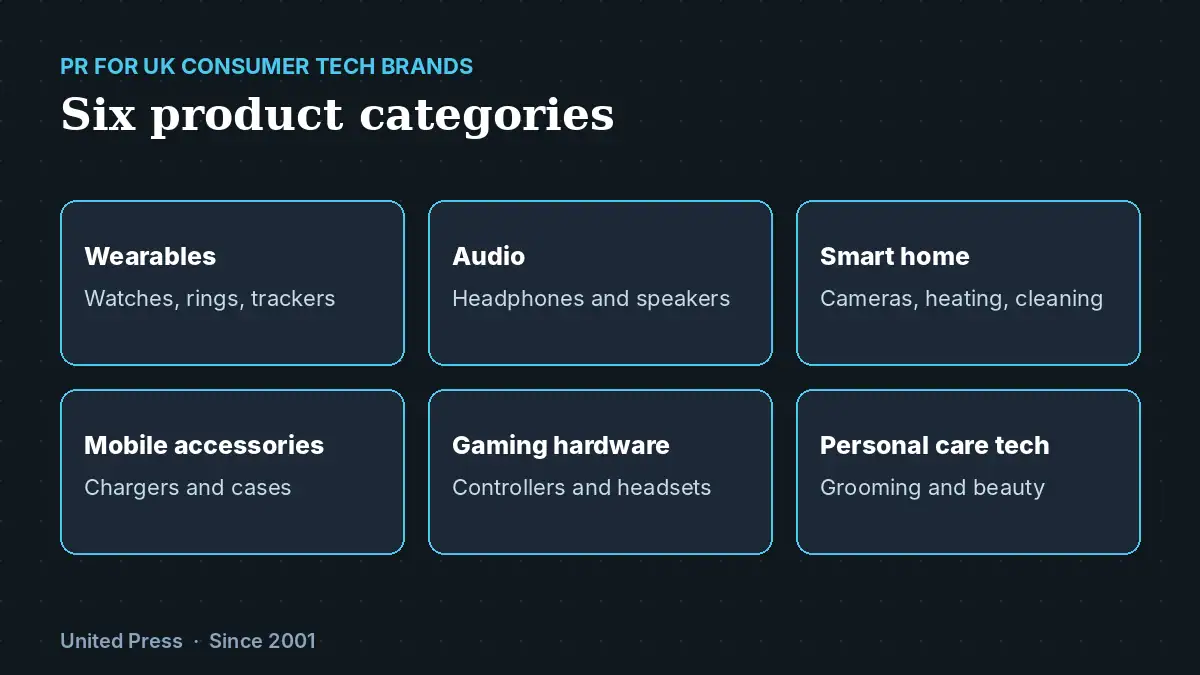
Each product category has its own specialist writers, testing habits and buying seasons. PR for UK consumer tech brands starts by understanding where you fit. We regularly support:
- Wearables and fitness tech such as smartwatches, rings and trackers.
- Audio brands making headphones, earbuds and speakers.
- Smart home devices including cameras, lighting, heating controls and robot cleaners.
- Mobile accessories such as chargers, cases and power banks.
- Gaming hardware including controllers, headsets and streaming kit.
- Personal care tech such as electric toothbrushes, grooming tools and beauty devices.
Running a review programme that works
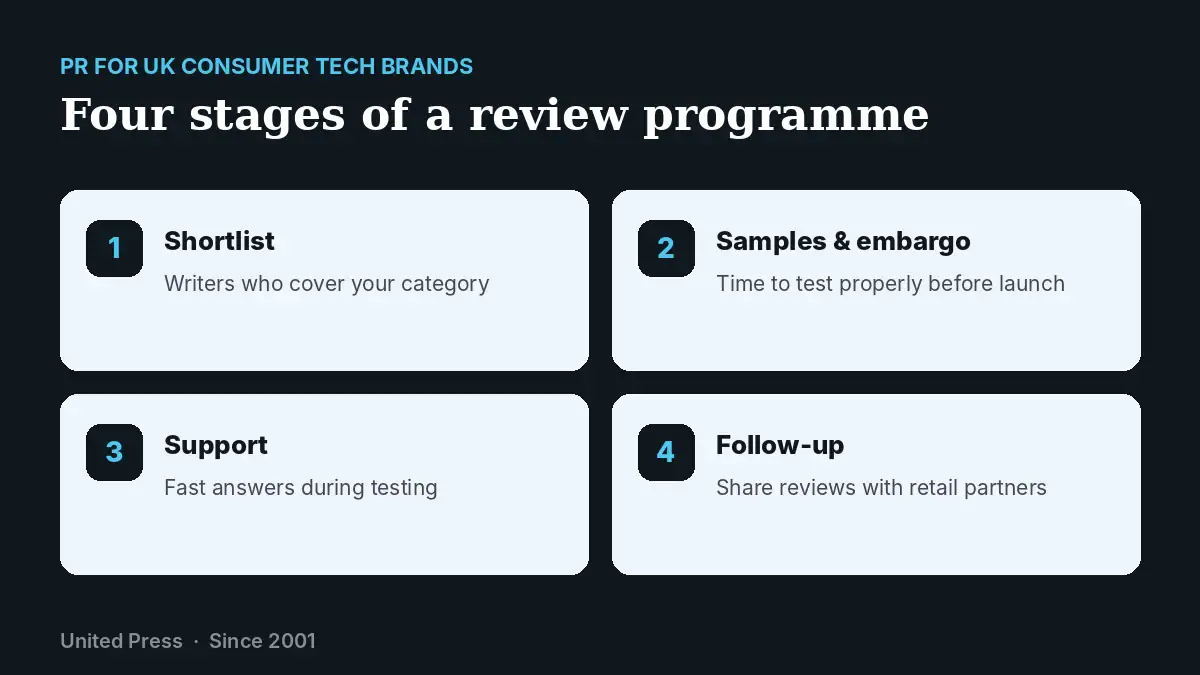
1. Choosing the right reviewers
We build a shortlist of writers, YouTubers and editors who genuinely cover your category and whose readers match your customers. Quality matters more than numbers: ten thoughtful reviews from trusted names beat fifty brief mentions.
2. Planning samples and embargoes
Reviewers need time to test properly. We plan sample delivery weeks before launch, agree embargo dates clearly and make sure every reviewer has the same information, firmware and support contacts.
3. Supporting reviewers during testing
Questions come up during testing, and quick, accurate answers make a difference. We act as the single point of contact, connecting reviewers with your product team when they need technical detail.
4. Following up after launch
We track coverage, share standout reviews with your retail partners and collect samples back or arrange long-term loans. That steady follow-up is what turns PR for UK consumer tech brands into a repeatable process for every new product.
Backing up every specification
Battery life, water resistance, noise cancelling and charging speed are exactly the claims reviewers test. If a figure does not match their experience, it becomes the headline. The Advertising Standards Authority’s advice on substantiation explains that marketers need evidence for objective claims before they make them, and the same discipline makes press materials far stronger.
In PR for UK consumer tech brands, we check every specification against your test data, explain the conditions behind each figure and avoid wording such as “best” or “fastest” unless it can be proved. That care saves awkward corrections and shows reviewers that your brand can be trusted, which makes them more likely to cover your next launch.
Consumer tech stories beyond the review
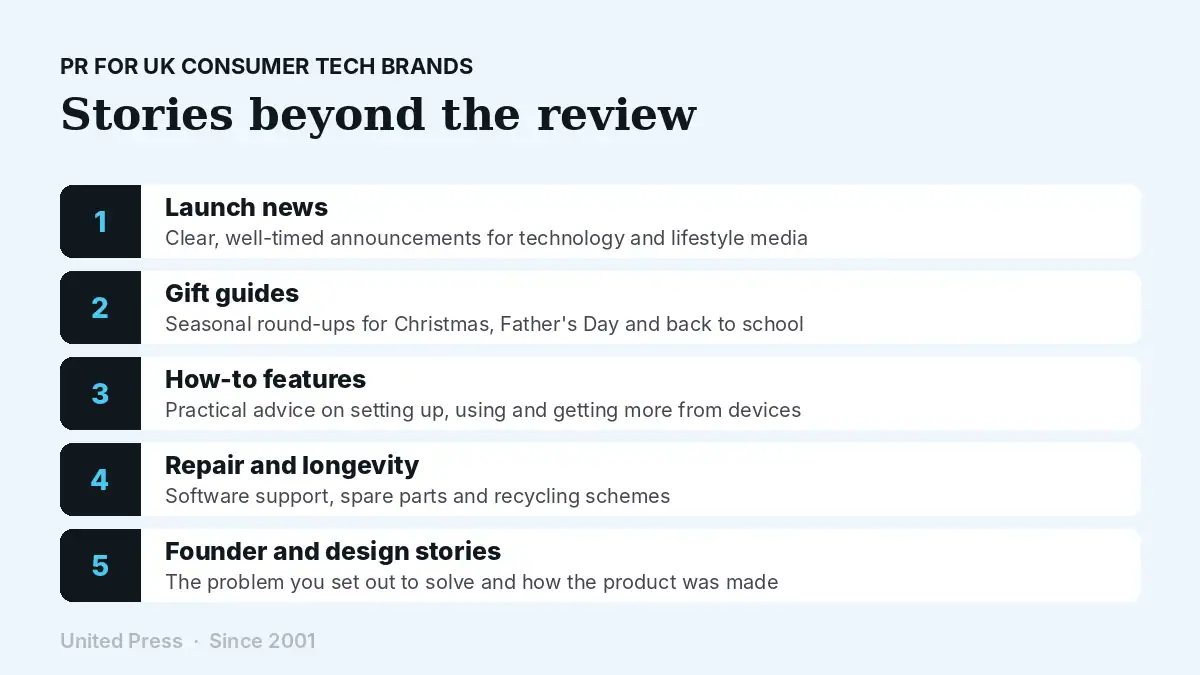
Reviews are the core of consumer tech coverage, but they are not the only way in. These angles help PR for UK consumer tech brands reach readers all year round:
- Launch news: clear, well-timed announcements for technology and lifestyle media.
- Gift guides: seasonal round-ups for Christmas, Father’s Day and back to school.
- How-to features: practical advice on setting up, using and getting more from devices.
- Repair and longevity: software support, spare parts and recycling schemes.
- Founder and design stories: the problem you set out to solve and how the product was made.
- Consumer research: surveys on habits such as screen time, sleep or home energy use.
Planning around the consumer tech calendar
Consumer tech coverage follows a busy calendar, and PR for UK consumer tech brands has to plan around it. Major trade shows set the tone in January and late summer, gift guides are planned months before Christmas, and big sales events dominate November. PR for UK consumer tech brands works back from those dates, so samples arrive while editors are still building their lists rather than after pages have closed.
We also look for quieter moments when there is less competition. A spring or early summer launch can earn more attention than a crowded autumn slot, especially for a newer brand. Choosing the right window is one of the simplest ways to make PR for UK consumer tech brands more effective.
Supporting retail and marketplace partners
Retailers want to stock products that customers are already talking about, and PR for UK consumer tech brands creates that conversation. Strong reviews and features give buyers confidence, and quotes from respected titles can support product listings and in-store displays. PR for UK consumer tech brands that is shared with retail partners helps secure range listings, better placement and promotions.
For brands selling through online marketplaces, PR for UK consumer tech brands also helps shoppers choose between similar products. A link to a trusted review answers the question every buyer asks: is this actually any good?
Building lasting relationships with tech writers
Consumer tech journalism is a small world. The same writers test products for several titles, move between publications and remember which brands were helpful. PR for UK consumer tech brands treats them as long-term partners: honest about release dates, quick with answers and respectful of their independence. We never ask for a positive review, and we never pressure a writer to change a verdict.
Over time that approach brings practical rewards. Reviewers ask to test your next product, include you in comparisons and contact you first for comment on industry stories. Strong relationships make PR for UK consumer tech brands easier with every launch.
Handling faults, updates and product issues
Even well-tested products can have problems after launch: a software bug, a connectivity issue or a batch fault. How a brand responds often matters more than the fault itself. We help you prepare clear statements, share fixes and firmware updates with reviewers who flagged the issue and explain what customers should do. Calm, open communication keeps trust intact and shows that PR for UK consumer tech brands is about long-term reputation, not just launch-day headlines.
Where a safety concern is involved, we work closely with your product and legal teams so every message is accurate and timely. Customers remember brands that put their safety first.
International brands entering the UK
Many consumer tech brands launch in the UK after success in other markets, and PR for UK consumer tech brands helps them arrive well prepared. UK reviewers expect UK plugs, a UK website, local support and stock available at launch. We help international brands prepare for that, introduce them to UK writers and plan a launch that feels local. We also help UK brands take their story abroad. Either way, PR for UK consumer tech brands works best when the product is ready, the facts are checked and reviewers are treated as partners.
A 90-day plan for PR for UK consumer tech brands
- Weeks 1 to 2: agree launch dates, key specifications, reviewer shortlist and sample logistics.
- Weeks 3 to 6: brief reviewers, send samples under embargo and prepare launch materials.
- Weeks 7 to 10: launch, support reviewers, pitch gift guides and how-to features.
- Weeks 11 to 12: share coverage with retailers, review results and plan the next product cycle.

Placements go live within 14 days of approval, or you receive a 100% refund. Related reading: our guides to PR for smart home brands, PR for mobile apps, PR for D2C brands and PR for gaming companies.
PR for UK consumer tech brands in Google and AI search
Shoppers now ask ChatGPT, Gemini and Google AI questions such as “best wireless earbuds for running” or “which smart thermostat works with my boiler”. Those tools draw heavily on trusted reviews, so consistent PR for UK consumer tech brands improves the chance that your product is recommended. No one can guarantee an AI mention, but independent reviews in respected titles are one of the strongest signals a consumer tech brand can build.
Consumer tech PR pricing
Every engagement is quoted individually after a short call, based on your goals and the publications you want. Tell us what you need on the form and we reply within 24 hours with a free plan.
What UK consumer tech desks actually run
Consumer technology coverage in the UK is decided by review programmes, not press releases. Reviewers need working hardware in hand several weeks before an embargo lifts, and a launch announcement on its own almost never runs. Seasonal buying guides carry most of the purchase-intent traffic, and inclusion in them is agreed months ahead of the season, not in the week of a launch.
Feature desks work differently again. Wired UK is looking for an argument a product happens to illustrate, so a pitch built around specifications will not land there. What Hi-Fi tests in its own listening rooms and will not publish supplied measurements. TechRadar, Stuff and T3 are sample-led and will consider a product on its merits, provided the unit arrives early enough to be used properly.
Placement difficulty for consumer tech brands
- Hardest — Wired UK. Needs an idea with the product as evidence. No sample will substitute for a story.
- Hard — What Hi-Fi. Independent in-house testing, long queues, and a genuine risk of a poor verdict.
- Moderate — TechRadar, Stuff, T3. Achievable with early samples and a realistic review window.
- Most achievable — Trusted Reviews, Pocket-lint. Buying-guide inclusion, where most comparison traffic sits.
The practical constraint is lead time. A brand that approaches these desks four weeks before launch has already missed the seasonal guides and most review slots.