

Best PR for Social Enterprises UK (2026): Telling a Story of Profit and Purpose
PR for social enterprises, community interest companies, B Corps and purpose-led businesses. We help you show customers, buyers and investors both sides of what you do: a business that works, and the good it creates.
Say what you are
Journalists notice when labels are used loosely. Use the one that fits.
| Label | What it means |
|---|---|
| Social enterprise | A business with a social or environmental mission that reinvests most of its profit in that mission. |
| Community interest company | A UK company type with an asset lock and a duty to benefit the community. |
| B Corp | A certification that a company meets set standards on social and environmental performance. |
| Purpose-led business | A wider term for companies built around a mission. It has no legal meaning. |
Proving your impact
Impact claims face the same scrutiny as any other claim. Clear evidence makes your story stronger and protects you from accusations of “impact washing”.
PR for social enterprises by sector
Social enterprises work in almost every part of the economy, and each sector has its own media. Effective PR for social enterprises matches the impact story to the readers who care about it most.
Food and hospitality
Cafés, restaurants and caterers that train or employ people, featured in food, lifestyle and local press through PR for social enterprises.
Retail and fashion
Ethical products and fair supply chains, told through the makers and the materials, a strong angle in PR for social enterprises.
Energy and environment
Community energy, recycling and repair projects with clear local benefit and measurable results.
Health and care
Services that improve wellbeing, explained with care, accuracy and respect for the people involved.
Employment and skills
Training and job programmes, with progress stories told by the people who took part, the most moving form of PR for social enterprises.
Housing and community
Local regeneration, community spaces and housing projects that regional and national press follow closely.

Telling beneficiary stories with dignity
The most powerful stories in PR for social enterprises come from the people your work supports. They also carry the most responsibility. Good PR for social enterprises protects the people at the centre of the story as carefully as it promotes the business.
- Informed consent: people understand where their story will appear and can change their mind before publication.
- Their words, not ours: quotes are approved by the person, and they review how they are described.
- Strength, not pity: stories focus on progress, skills and choices rather than hardship alone.
- Privacy first: names, faces and locations are only shared when the person is comfortable.
- Founder voice for the big picture: your leaders speak about the wider issue so beneficiaries are never asked to carry it.

Turning your impact report into news
An annual impact report is often read by a handful of stakeholders. With the right angle, it can reach thousands. We pull out one headline finding, one human story and one practical insight, then pitch each to the outlet where it fits best. Impact reports are an underused asset in PR for social enterprises.
Other reliable news moments include anniversaries, new sites, certification, partnerships and responses to national news in your field. Planned across the year, they give PR for social enterprises a steady rhythm instead of one burst of coverage. Organisations with charitable status can also read our guide to PR for charities.
PR for social enterprises starts with clarity
Journalists often ask what makes a business a social enterprise. The government’s guide to setting up a social enterprise explains the main legal structures, such as community interest companies, and that helps you describe your model accurately.
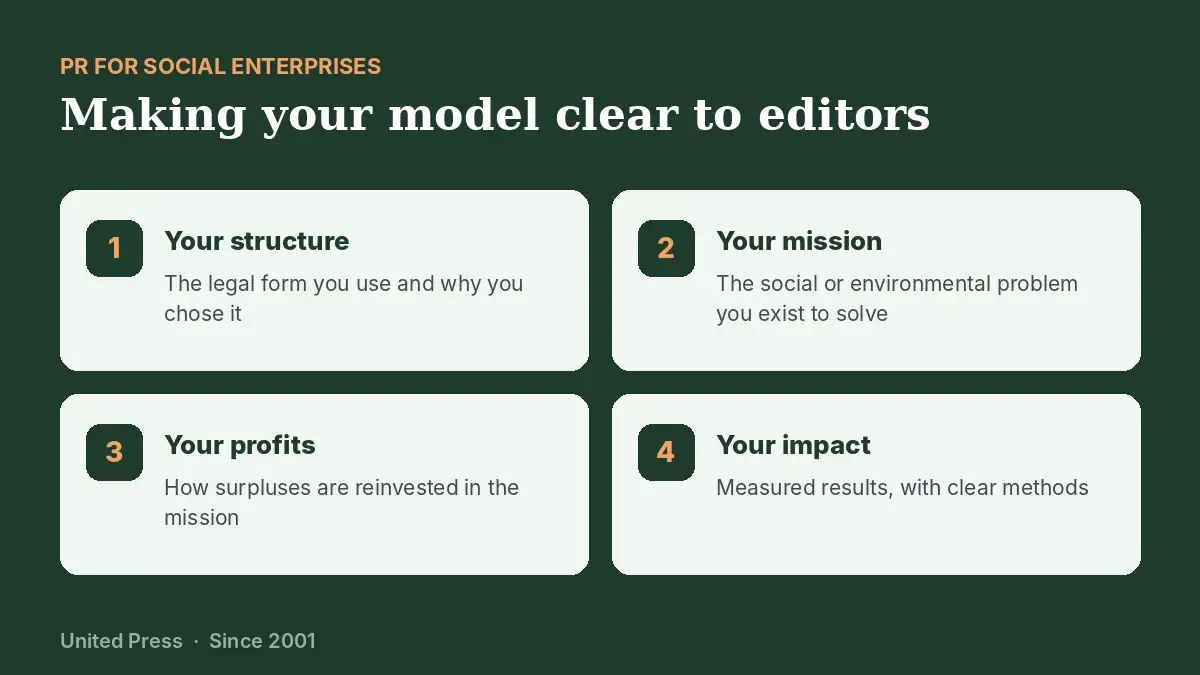
- Your structure: the legal form you use and why you chose it
- Your mission: the social or environmental problem you exist to solve
- Your profits: how surpluses are reinvested in the mission
- Your impact: measured results, with clear methods
In PR for social enterprises, we make your structure, mission and use of profits clear in a sentence or two, so editors can explain it to readers without confusion. Simple, accurate PR for social enterprises builds trust with customers, funders and partners, and it stops your purpose being lost in the story.
Titles in our network that suit purpose stories
Most social enterprise coverage is earned. Next to that, you can book features in titles from our publication network, such as Entrepreneur UK and London Loves Business for business readers, and The Good Men Project and Green Matters for purpose-minded readers. Booked features go live within 14 days of approval or you get a 100% refund.
Listed in our network, October 2026. Terms, including link treatment, are confirmed in writing before you book. Google asks that paid links are marked as sponsored or nofollow.
Social enterprise PR questions
How is PR for a social enterprise different?
You need to show a business that works and the impact it creates, with evidence for both.
Should we lead with the mission or the product?
It depends on the audience. Customers often want the product first; local and purpose media want the impact first.
How do we avoid impact washing?
Only claim what you can show, explain how you measured it and be open about what you are still working on.
Do you work with social enterprises outside the UK?
Yes, including international purpose-led businesses entering the UK.
How quickly can a booked feature go live?
Within 14 days of your approval, or you get a 100% refund.
How much does social enterprise PR cost?
There is no fixed price. Every campaign is planned around your goal and the titles you need. Share your goal and budget in the form below for a personalised plan.
How do social enterprises get media coverage?
Pair a clear business story with honest, evidenced impact, and use real news moments such as contracts, certification, new sites and impact reports. In PR for social enterprises, we shape those stories for business, sector and local editors, and confirm each live link.
How should a social enterprise share beneficiary stories?
Only with informed consent, approved quotes and a focus on progress rather than hardship. Founders should speak about the wider issue so the people you support are never asked to carry the story alone.
Can PR help a social enterprise appear in AI search?
It can improve your chances. AI tools such as ChatGPT and Gemini rely on trusted publications when they recommend ethical brands and suppliers. No one can guarantee an AI mention, but press coverage is one of the strongest signals a social enterprise can build.
Ready to share both sides of your story?
Tell us about your business, your mission and the evidence you have. We will send a free plan with the angle, titles and timing that fit.














Two stories that must work together
Run as a charity rather than a business? See our UK nonprofit PR page.
The business story
The impact story