Looking for the best PR for digital agencies in the UK for 2026? UnitedPress.uk runs guaranteed-publication PR for digital agencies brands in the UK. You don’t pitch, you don’t chase journalists, and you don’t pay a retainer hoping for coverage that never lands. We secure your placement in named UK publications — and you only pay for confirmed publication. This page explains how guaranteed PR works for digital agencies, which UK publications we deliver in, and how to start a campaign.
Why Digital agencies brands choose guaranteed publication over retainers in 2026
The UK digital agencies sector is competitive in 2026, with media coverage concentrated among national, trade and digital-native publications.. Traditional digital agencies PR is built on uncertainty: you sign a retainer for £4,000–£12,000 a month, the agency pitches journalists for 60–90 days, and only a fraction of pitches convert into editorial. Founders and marketing leads in the digital agencies category tell us the same thing — they need a predictable, finance-approved spend that produces named placements they can show to the board, investors, paid-social teams and ranking algorithms.
UnitedPress.uk inverts the model. We have direct, contracted relationships with editorial desks across UK national, business, trade and digital-native press relevant to digital agencies. When you brief us, we confirm the outlet, the publication date and the price upfront. If we cannot place, you don’t pay. That gives digital agencies marketing leads the same financial discipline they expect from paid media — but with the trust signal of editorial coverage.
Digital agencies publications we guarantee in
We secure guaranteed placements for digital agencies brands across the publications that buyers, retail partners, investors and search engines reference: The Times, Forbes, Sky News, BBC News, The Guardian, The Telegraph, City AM, Stylist, Wired UK, Campaign UK, alongside our wider 150+ outlet roster spanning Forbes, Bloomberg-syndicated outlets, City AM, the Times, Telegraph and Sky News. We map your editorial goal — whether it’s awareness with end-consumers, B2B buyer trust, retail-buyer credibility, or a fundraising halo — to the right publication for that audience.
What a guaranteed digital agencies PR campaign delivers
- Named placement: we contractually commit to the publication before you pay.
- Editorial story: our editors craft the angle to fit the publication’s house style — we don’t recycle press releases.
- Permanent indexable URL: a real URL on a real publication, ranking in Google and AI Overviews.
- Citation surface for AI search: coverage in trusted UK media is now a primary signal for AI Overviews, Perplexity, ChatGPT search and Bing Copilot.
- Right-of-use: “as featured in” assets you can use across paid social, decks and product pages.
UK digital agencies market context (2026)
The UK digital agencies sector is competitive in 2026, with media coverage concentrated among national, trade and digital-native publications.. Founders and marketing leads operating in this category face high signal-to-noise ratios in earned media. Trade press tends to cover product launches, funding and senior hires; consumer press covers founder stories, category trend pieces and lifestyle features; national business desks (FT, Times, Telegraph, City AM) cover scaling, M&A and policy.
Notable UK digital agencies brands and what their PR looks like
UK digital agencies category benchmarks include UK challengers, market leaders, category disruptors. The brands that win earned media attention typically combine a clear founder narrative, proprietary data (consumer surveys, supply-chain insights, sales benchmarks), and a willingness to comment on policy and category developments quickly. UnitedPress.uk applies the same playbook to your guaranteed placement: we build the story spine, layer in the data, and place the piece in the right publication on the right week.
How a guaranteed digital agencies PR campaign works (step-by-step)
- Brief (15 minutes): share the launch, milestone, comment opportunity or thought-leadership angle you want covered.
- Outlet match (24 hours): we propose the publication(s) we can guarantee, with editorial slot and indicative date.
- Content build (3–7 days): our editorial team writes the piece in the publication’s voice, with quotes, data and a hook that fits the masthead.
- Approval & publication: you approve, the editor approves, the piece goes live with you credited and linked.
- Reporting: live URL, screenshot pack and recommended distribution pack for paid social and sales enablement.
Why PR for digital agencies wins the pitch before it starts
Most new business for a digital agency is decided before the first meeting. A marketing director builds a shortlist from the names they have read, heard on a podcast or seen quoted in a trade title, and agencies that have never appeared anywhere rarely make that list. PR for digital agencies puts your team in front of buyers while they are still forming opinions, so the pitch starts with recognition rather than a cold introduction.
There is a simple irony here. Agencies devote their days to building visibility for clients, yet many have almost none of their own. Client work comes first, the agency blog goes quiet and the website still describes services from three years ago. Good PR for digital agencies fixes that with a steady rhythm of commentary, case studies and bylined articles that show how your team thinks, without pulling your best people away from client delivery.
It also changes the kind of enquiry you receive. A prospect who has read your founder’s view on search, social or conversion arrives already trusting your approach. That shortens sales cycles, lifts win rates and attracts the clients you actually want to work with, which is the real return on PR for digital agencies.
Digital agencies we work with
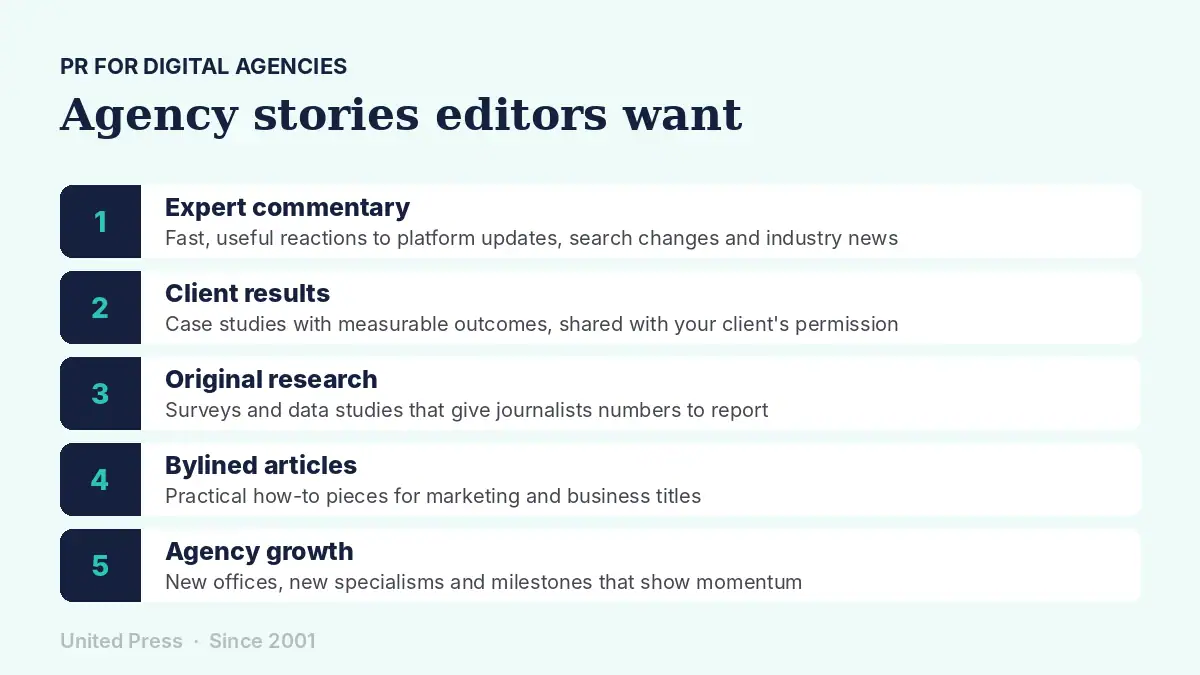
Every agency has a different specialism and a different buyer, so PR for digital agencies starts by understanding who you sell to and which titles they read. We regularly support:
- SEO and search agencies explaining algorithm changes, AI search and what they mean for brands.
- Social media agencies commenting on platform changes, creator partnerships and community building.
- Web design and development studios sharing views on accessibility, performance and user experience.
- Performance marketing agencies talking about measurement, attribution and data privacy.
- Creative and branding agencies showing the thinking behind memorable campaigns and identities.
- Ecommerce and B2B specialists helping retailers and service firms grow online.
Agency stories that earn coverage
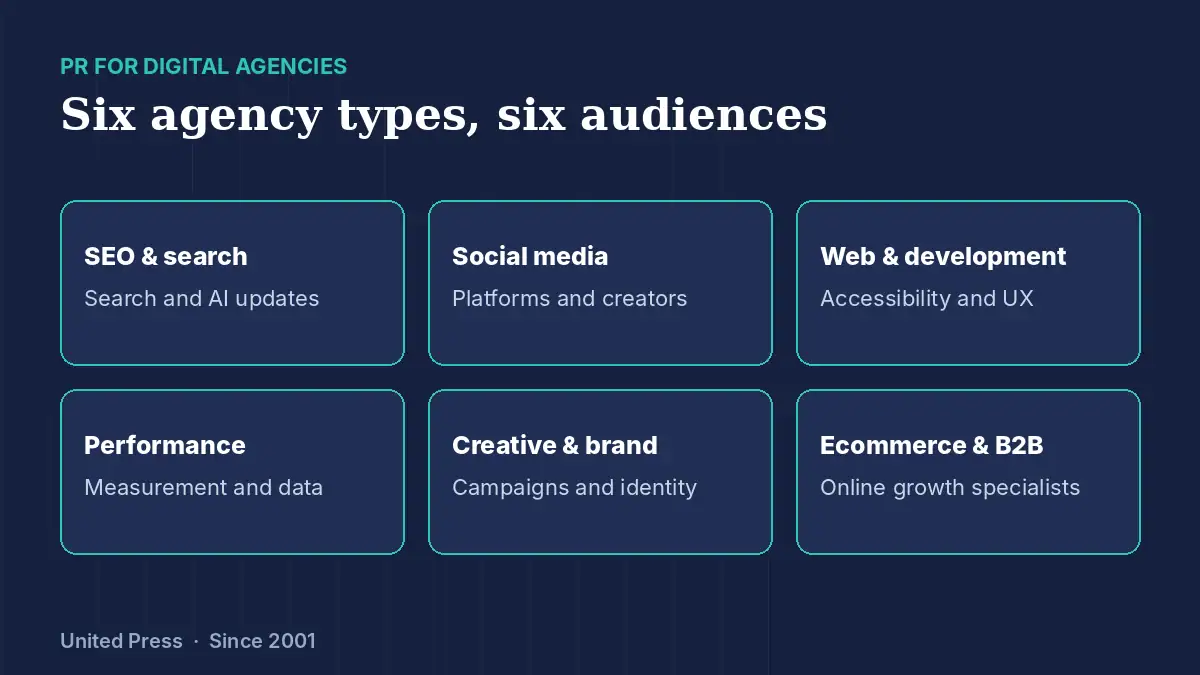
Marketing, business and trade editors all want something different, and a press release about a new hire rarely interests anyone outside your office. These are the angles that work best in PR for digital agencies:
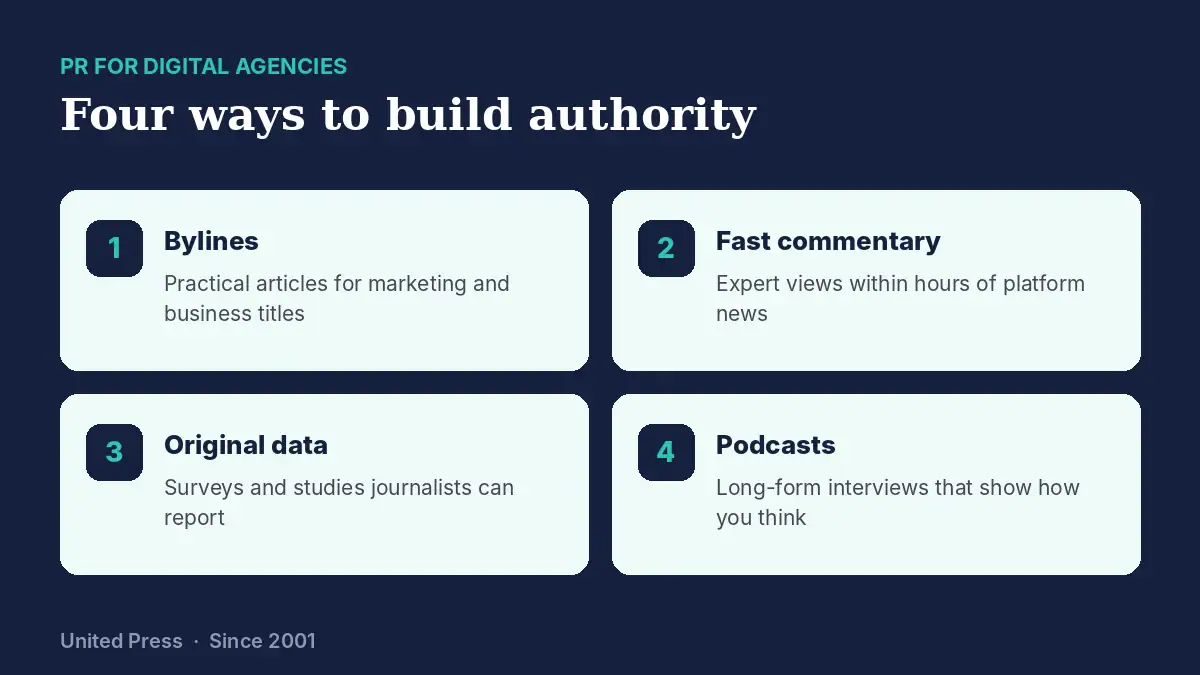
- Expert commentary: fast, useful reactions to platform updates, search changes and industry news.
- Client results: case studies with measurable outcomes, shared with your client’s permission.
- Original research: surveys and data studies that give journalists numbers to report.
- Bylined articles: practical how-to pieces for marketing and business titles.
- Agency growth: new offices, new specialisms and milestones that show momentum.
- People and culture: training, flexible working and career stories that help you hire.
Most campaigns blend three or four of these, because PR for digital agencies works best when buyers see your name in more than one context.
Choosing the right titles for your buyers
An article in a national newspaper looks impressive, but it may not reach the marketing manager at a regional retailer or the head of growth at a software company. PR for digital agencies works best when the outlet list mirrors your client list. A search agency selling to ecommerce brands needs retail and ecommerce titles, a B2B specialist needs business and sector trade press, and a creative studio may get more from design and marketing publications than from general news.
We map those titles at the start, then balance them with business and regional outlets that add credibility for wider audiences. That focus keeps PR for digital agencies efficient: fewer, better-placed stories that your future clients will actually read, rather than scattered mentions that impress nobody.
Location matters too. Many buyers still prefer an agency they can meet in person, so regional business titles in your city often bring higher-quality enquiries than national coverage. For agencies working with international clients, we add overseas trade titles and global marketing publications, so PR for digital agencies supports growth beyond the UK as well as at home.
Turning client work into credible case studies
Case studies are the most persuasive content an agency can publish, and they are also the easiest to get wrong. Clients may not want their numbers shared, results can be hard to attribute to one channel, and vague claims such as “huge growth” make editors suspicious. In PR for digital agencies, we agree the story with your client first, check every figure against the source data and describe your role accurately, including the work of other partners where it matters.
The same care applies to claims about your agency. Phrases such as “award-winning” or “the UK’s leading agency” must be backed by evidence your audience can check. The Advertising Standards Authority explains how marketers should approach claims based on awards or surveys, and following that standard keeps your reputation safe with journalists and prospects alike. Accurate, evidence-led PR for digital agencies builds far more trust than bold claims that collapse under a single question.
Building authority with bylines and commentary
Buyers choose agencies whose people sound like they know the answer before the question is asked. Regular bylined articles and timely commentary show that knowledge in public. We help your specialists choose topics, shape their arguments and meet editors’ deadlines, so PR for digital agencies becomes a habit rather than an occasional burst of activity.
Speed matters most with commentary. When a major platform changes its rules or a search update hits, journalists want a clear expert view within hours. We keep a short list of your spokespeople, their specialisms and their availability, so PR for digital agencies can respond while the story is still live.
PR for digital agencies that helps you hire
Talented strategists, developers and designers can choose where they work, and many research an agency’s reputation before they apply. Stories about training programmes, career progression, inclusive hiring and interesting client work make your agency easier to choose. PR for digital agencies that covers people as well as results supports recruitment, reduces reliance on job boards and helps you keep the team you already have. Candidates often find an agency through the same articles as clients do, so PR for digital agencies quietly strengthens hiring and sales at once, and many teams treat PR for digital agencies as part of their employer brand.
A 90-day plan for PR for digital agencies
- Weeks 1 to 2: agree your target clients, specialist topics, spokespeople and the titles your buyers read.
- Weeks 3 to 6: publish a first case study, pitch two bylined articles and set up fast commentary.
- Weeks 7 to 10: launch original research or a data story and secure podcast and trade interviews.
- Weeks 11 to 12: share coverage with prospects, add it to pitch documents and plan the next quarter.
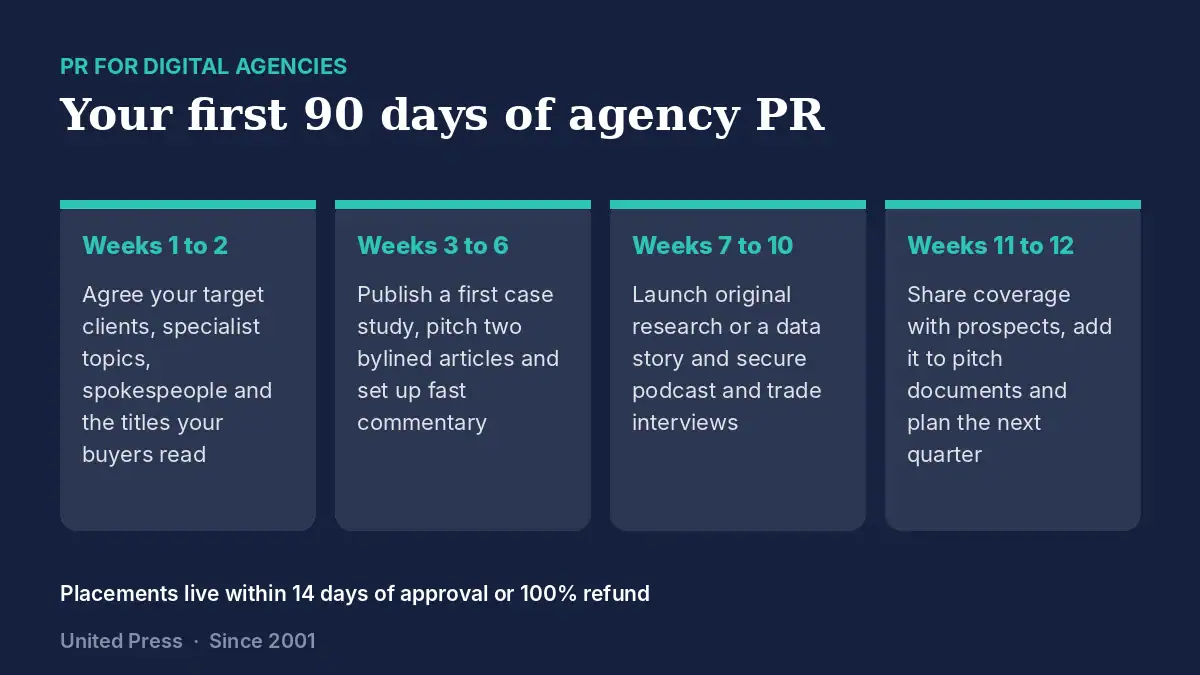
Placements go live within 14 days of approval, or you receive a 100% refund. Related reading: our guides to PR for scaleups, PR for the creator economy and press release distribution.
Using coverage in new business
Coverage keeps working long after it is published. Add press logos and links to your website, pitch documents and proposals, share articles with prospects in the middle of a buying decision and use bylines as the basis for LinkedIn posts from your leadership team. When PR for digital agencies is connected to your sales process, each article supports several conversations rather than just one.
Marketing leaders now ask ChatGPT, Gemini and Google AI questions such as “best SEO agency for ecommerce in the UK” or “which agencies understand AI search”. Those tools draw on trusted publications, so consistent PR for digital agencies improves the chance that your agency is named. No one can guarantee an AI mention, but independent editorial coverage is one of the strongest signals an agency can build, and PR for digital agencies that continues month after month keeps that signal strong.
Cost of guaranteed digital agencies PR vs. retainers
UK digital agencies retainer agencies typically charge £4,000–£12,000 per month with 6–12 month commitments. Output is variable: in any given month you may get 0, 1 or 4 placements. UnitedPress.uk priced placements range from low three-figures for trade/digital-native outlets to four-figures for tier-1 nationals. You decide which placements, when, and the budget tracks the output. For full pricing, see our PR pricing page and guaranteed publications list.
FAQ — Guaranteed PR for digital agencies
Is this paid editorial or sponsored content?
The placements we guarantee are clearly disclosed where required by ASA / IPSO / CAP Codes and the publication’s editorial policy. Some are paid editorial; some are commercial-content slots; many tier-1 publications carry editorial categories that are explicitly labelled. We are upfront about labelling on every placement so your team — and your readers — know exactly what they are seeing.
How fast can a digital agencies placement go live?
Most digital-native and trade placements go live in 5–10 working days. Tier-1 nationals (Times, Telegraph, City AM, Sky News) typically need 10–20 working days depending on editorial cycle.
Will the article rank in Google for our brand?
Branded queries almost always pick up the placement within 7–14 days of publication, because the host publications carry strong domain authority and the URLs are crawlable. For competitive non-brand keywords, ranking depends on on-page SEO, internal linking, and the strength of your own site — but the placements support your topical authority and AI-search citation surface.
Can we choose specific journalists?
For most placements we work with the contributor or editorial team who owns that vertical at the publication. If you need a specific named byline, we’ll tell you upfront whether that’s possible and at what price.
What happens if a placement is delayed?
Editorial cycles do shift. If a guaranteed placement slips, we either reschedule, swap to an equivalent publication of equal or better tier, or refund — your choice.
Start a guaranteed digital agencies PR campaign
Brief us in 15 minutes via our contact page, or browse the full list of UK publications we guarantee in. To compare options for digital agencies brands, see our UK PR pricing page, our best PR agency UK 2026 overview, and our resources hub. Want to dig deeper? Read our guides on how to get featured in The Times, how to get in Forbes, and how to get on Sky News.