
Best PR for Baby Brands UK (2026): Earning the Trust of New Parents
PR for baby and toddler brands, from feeding and sleep products to clothing, toys and nursery furniture. Parents research carefully before they buy. We help you earn reviews and coverage that give them confidence, with safety and honesty at the centre.
Reach parents at the right moment
Selling online direct to parents? See our e-commerce PR page too.
Rules that apply to baby products
| Area | What to know |
|---|---|
| Product safety | Products must meet UK safety rules and carry the right marks. Journalists and reviewers may ask for test evidence. |
| Sleep products | Any sleep claim must be consistent with safer sleep advice. Never imply a product prevents sudden infant death. |
| Infant formula | Infant formula for babies under six months cannot be advertised in the UK. Follow-on formula has strict rules too. |
| Health claims | Claims about development, colic or immunity need strong evidence or should not be made. |
General guidance, not legal advice. Check with a product safety or regulatory expert.
Two kinds of review
Editorial reviews and awards
Parenting titles and buying guides test products independently. Send samples, accept honest results and never ask for approval of the review.
Parent creators
Parents with an audience can share real use. Gifted or paid posts must be clearly labelled as ads, and children’s privacy must be respected.
Stories parents want to read
A real problem solved. The founder who could not find what they needed and made it.
Expert advice. A midwife, sleep consultant or paediatric expert adds trust, as long as their advice is independent and accurate.
Sustainability. Reusable, second-hand and longer-lasting products, with claims you can prove.
Value. What parents really need, and what they can skip. Honest guidance builds trust.
PR for baby brands by product category
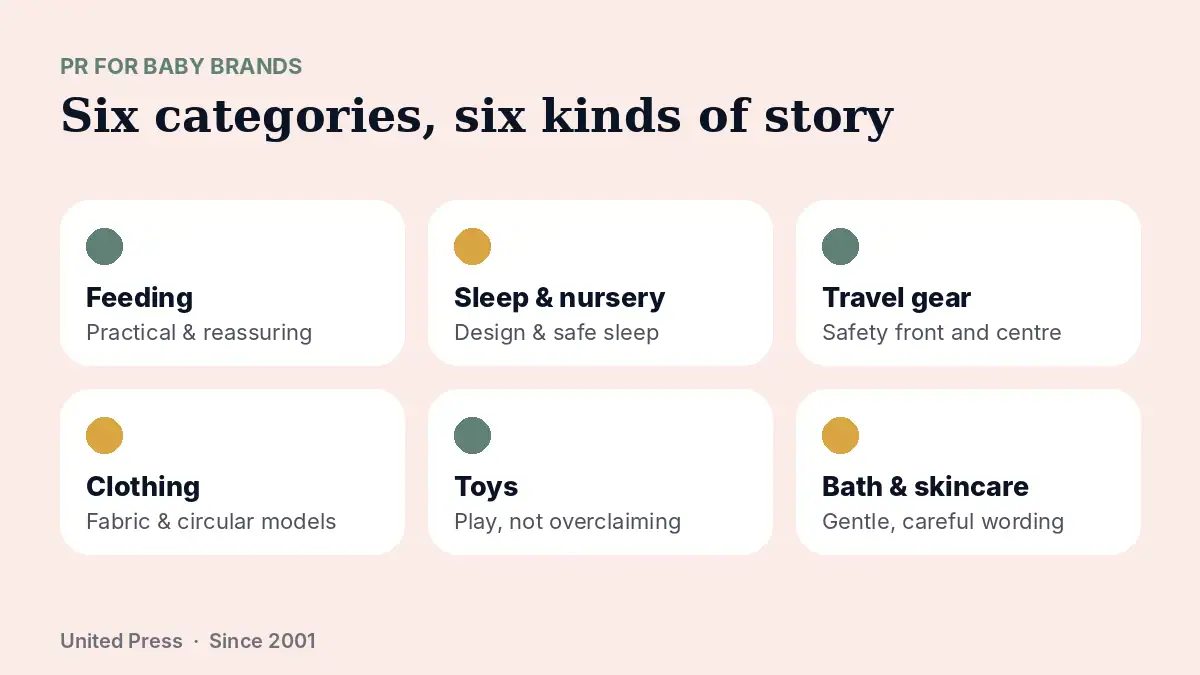
Parents research a car seat very differently from a muslin or a toy. Effective PR for baby brands matches each category with the questions parents ask and the editors who answer them.
Feeding
Practical, reassuring stories for tired parents, with every health-related claim checked and approved, a must in PR for baby brands.
Sleep and nursery
Design-led features and safe-sleep messaging that follows current UK guidance.
Travel gear
Prams, carriers and car seats tested by editors, with safety standards front and centre in all PR for baby brands.
Clothing and sustainability
Fabric, durability and circular models such as rental and resale, explained clearly, a growing theme in PR for baby brands.
Toys and development
Play ideas and age-appropriate design, told without overstated developmental claims, which keeps PR for baby brands credible.
Bath and skincare
Gentle, ingredient-led stories with careful wording on sensitive skin and safety.
Gift guides and seasonal features
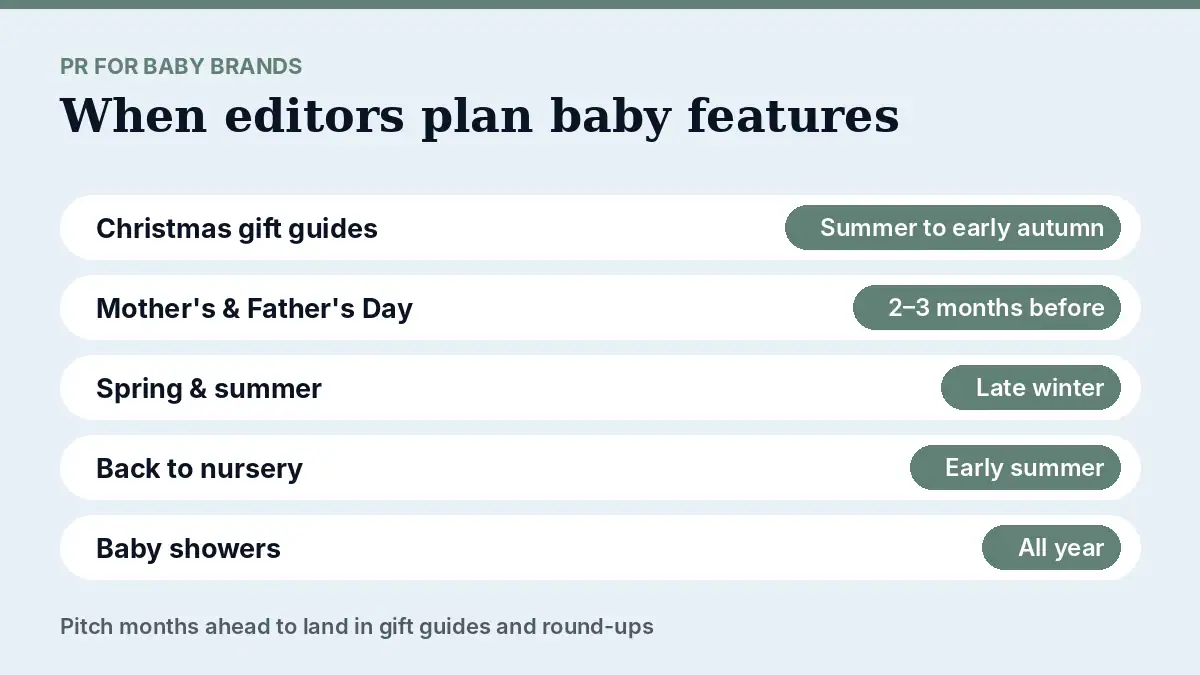
A large share of coverage won through PR for baby brands appears in gift guides and seasonal round-ups, and most are planned months ahead. Planning PR for baby brands around this calendar is one of the simplest ways to win space.
| Moment | When editors plan | What to pitch |
|---|---|---|
| Christmas gift guides | Summer to early autumn | Gifts for new parents, first Christmas ideas |
| Mother’s Day and Father’s Day | Two to three months before | Gifts and self-care for new parents |
| Spring and summer | Late winter | Travel gear, sun protection, outdoor play |
| Back to nursery | Early summer | Clothing, bags, labels and routines |
| Baby showers all year | Ongoing | Registry essentials and thoughtful gifts |
Parent founder stories that build trust
Many baby brands start because a parent could not find what they needed. That origin story is often the most powerful asset in PR for baby brands, because other parents recognise the problem straight away.
- Start with the moment: the night, the trip or the frustration that led to the idea.
- Show the work: testing, safety checks and the people involved in getting it right.
- Be honest about growth: journalists and parents trust founders who talk openly about challenges, which makes honest PR for baby brands so effective.
- Keep the child private: share family details only where you are fully comfortable.
Retail and stockist PR for baby brands
Parents need to know where to buy, and retailers need confidence that a brand will sell. Trade coverage, new stockist announcements and award news all support conversations with nursery retailers, department stores and online shops.
Coverage also strengthens your own website and marketplace listings, giving parents independent proof at the moment they decide, so PR for baby brands supports sales directly. Working with parent creators as well? See our guide to influencer PR.
PR for baby brands puts safety first
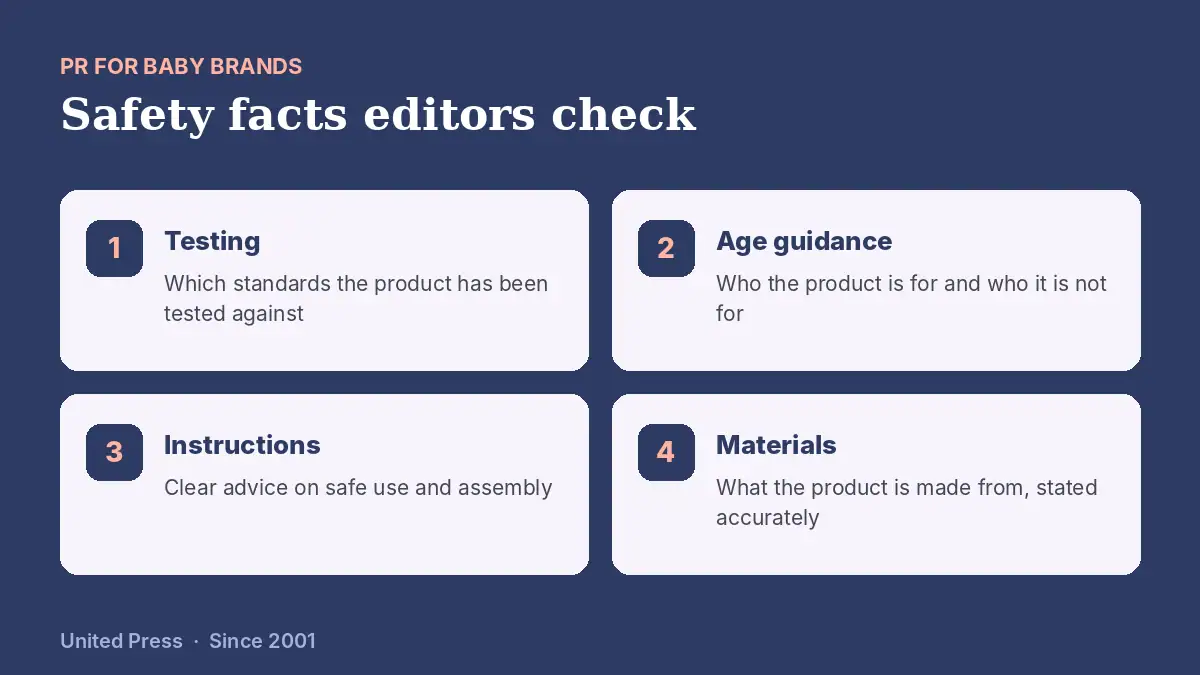
Parents and editors expect baby products to meet strict safety standards. The Office for Product Safety and Standards is the UK regulator for consumer product safety, and its work sets the context for how journalists judge new products for babies and young children.
- Testing: which standards the product has been tested against
- Age guidance: who the product is for and who it is not for
- Instructions: clear advice on safe use and assembly
- Materials: what the product is made from, stated accurately
In PR for baby brands, every safety claim is matched to real testing and certification before it is shared, and we avoid wording that could overstate protection. Careful PR for baby brands earns the trust of parenting editors, retailers and new parents, who notice when a brand takes safety seriously.
Baby brands in Google and AI search
New parents now ask ChatGPT, Gemini, Perplexity and Google AI questions like “best baby carrier for a newborn in the UK” or “sustainable baby clothing brands”. These tools lean heavily on trusted publications and buying guides when they decide which products to mention, so PR for baby brands now shapes AI visibility too.
Editorial coverage gives them credible sources that name your brand and explain why parents choose it. No one can guarantee an AI mention, but consistent PR for baby brands gives you a much better chance of appearing in those answers, while high-authority links help your product pages rank in Google. If fake reviews are hurting sales, our Google review removal service can help, and many brands pair features with press release distribution.
Parenting titles in our network
Most UK parenting coverage is earned. If you sell in North America, our publication network includes parenting titles such as Scary Mommy, Romper, Fatherly, Today’s Parent in Canada and Parent Herald. Booked features go live within 14 days of approval or you get a 100% refund.
Listed in our network, October 2026. Terms, including link treatment, are confirmed in writing before you book. Google asks that paid links are marked as sponsored or nofollow.
Three example baby brand campaigns
A new baby carrier
“The carrier designed with physiotherapists for parents with back pain”
- Route: samples to parenting reviewers and buying guides.
- Timing: three months before launch.
- Outcome sought: reviews and retail listings.
A baby clothing rental service
“Why babies outgrow seven sizes in their first year”
- Route: parenting, money and sustainability press.
- Timing: spring.
- Outcome sought: subscribers.
A UK toy brand entering the US
“The wooden toy brand made in Yorkshire arrives in America”
- Route: Fatherly and Romper features, plus gift guides.
- Timing: before the holiday season.
- Outcome sought: US sales.
Illustrative plans with example headlines. They are not client results.
What clients say about United Press
★★★★★“United Press built our brand from launch to nationwide recognition. Real media coverage gave new customers the trust they needed — our ROI has been over 100:1, which blows my mind.”
Annabelle SparksGlobal Head of Marketing
★★★★★“The team understood our industry and, more importantly, understood the story we needed to tell. Seeing our company featured across relevant publications gave us a much stronger presence when potential customers researched us.”
Olivia BennettMarketing Director
★★★★★“United Press helped us turn our company story into something journalists could genuinely engage with. The coverage gave our brand a level of credibility that was difficult to achieve through our own marketing channels.”
James WhitmoreFounder & CEO
United Press is a London PR agency at Brook’s Mews, working since 2001 with clients worldwide, and a winner or shortlisted at PRWeek, CIPR Excellence, UK Agency, PRCA DARE, The Drum and UK Social Media Communications Awards.
Baby brand PR questions
What does PR for a baby brand do?
It earns reviews, buying-guide places and stories that help parents trust your products, while keeping safety and honesty first.
Can you get our product into a buying guide?
We pitch with samples and evidence, but editors and testers decide. Guaranteed features are available only in titles from our publication network.
Can we use parent influencers?
Yes, if posts are clearly labelled as ads where gifted or paid, and children’s privacy is respected.
Do you work with baby brands outside the UK?
Yes, including overseas brands launching in the UK and UK brands entering the US.
What claims should we avoid?
Any health, sleep or development claim you cannot prove, and anything that conflicts with safer sleep or feeding guidance.
How much does baby brand PR cost?
There is no fixed price. Every campaign is planned around your goal and the titles you need. Share your goal and budget in the form below for a personalised plan.
How do baby brands get featured in gift guides?
Pitch early. Most gift guides are planned months ahead, with Christmas guides often decided in summer. In PR for baby brands, we match your product to the right guides, send samples to editors who request them and confirm each live link.
What makes a good baby brand founder story?
A clear moment that sparked the idea, honest detail about testing and safety, and openness about the journey. Parents trust founders who recognise the same problems they face, while family privacy stays protected.
Can PR help a baby brand appear in AI search?
It can improve your chances. AI tools such as ChatGPT and Gemini rely on trusted publications and buying guides when they recommend baby products. No one can guarantee an AI mention, but press coverage is one of the strongest signals a baby brand can build.
Ready to earn parents’ trust?
Tell us about your products, where you sell and your next launch. We will send a free plan with the angle, titles and timing that fit.