Best Paris Fashion Week PR UK 2026
Looking for the best Paris Fashion Week PR in the UK for 2026? Press coverage, showroom strategy and designer publicity built around the FHCM calendar — for fashion brands, designers and founders who want Paris to produce something that lasts longer than the week itself.
What is Paris Fashion Week PR?
Paris Fashion Week PR is the work of turning a collection, a show or a brand story into published media coverage around the Paris Fashion Week calendar. In practice it covers five things: building the media list and the story angles months ahead, getting samples and imagery in front of the right editors, handling press logistics for a show or presentation, managing journalist, stylist and creator relationships during the week, and converting the week into coverage that keeps working afterwards.
It is not the same as getting a slot on the official calendar, and it is not the same as buying a ticket to a show. Those are separate things, and knowing the difference is the first thing that saves a brand money.
Calendar dates above are taken from the FHCM published calendar and were correct at the time of writing. Paris operates a formal provisional-to-final process, so individual show times move — we confirm against the official calendar before any campaign is committed.
What we guarantee — and what nobody can
Fashion PR attracts more overpromising than any other sector we work in. So here is the line, stated plainly. It is the same line we will give you on a call, and it is the reason clients stay with us.
What United Press guarantees
Publication. Not a pitch, not a “best effort” — the placements we contract for are agreed with you in writing before you commit a penny, and they run.
- →The publications are named and agreed before you pay, not chosen afterwards
- →A live URL for every guaranteed placement, delivered to you
- →Copy written to editorial standard and approved by you before it goes anywhere
- →A written timeline, so you know what lands and when
- →An honest answer up front if we do not think Paris is where your budget should go
What no agency can honestly promise
If an agency tells you otherwise, that is the moment to end the conversation.
- ×A slot on the official FHCM calendar — that is decided by the Fédération’s own committees, not by any agency
- ×A guaranteed feature in a specific tier-one title such as Vogue — editorial decisions belong to editors
- ×Front-row seats or invitations to other houses’ shows — every seat is issued by that brand’s own press office
- ×A positive review — critics are not a stakeholder to be managed, and treating them as one becomes the story
- ×Named celebrity attendance — that runs through the talent’s stylist and their own commercial terms
The single most useful fact in fashion PR: accreditation is not an invitation. Both the Italian and British fashion councils say so in their own words on their own accreditation pages — press accreditation admits you to the week, but every seat at every show is issued by that brand’s press office. Any agency that blurs that line is selling you something it does not control.
Why Paris moves the needle when the other weeks do not in 2026
New York, London and Milan all matter — if you are showing at home, that is fashion show and event PR in London. Paris is structurally different, and the difference is worth understanding before you choose where to spend.
It closes fashion month
Paris runs last. By the time the international press arrive they have already sat through three cities, and the summary pieces that define the season get written from Paris. That is a disadvantage if your story is weak and a considerable advantage if it is strong.
Six moments, not two
Womenswear in March and October, menswear in January and June, haute couture in January and July. Most brands plan for one and miss five. Menswear and couture weeks are less crowded and often produce better coverage per pound spent.
You can plan a year out
The FHCM publishes a confirmed forward calendar further ahead than any other fashion body. That means a Paris campaign can be built against real dates rather than assumptions — and long-lead press can actually be worked properly.
There is a real route without a runway
Paris has a substantial commercial layer beside the official calendar — curated showrooms and trade platforms where buyers and press genuinely go. A brand can build meaningful Paris visibility without ever booking a show.
Publications relevant to fashion and Paris Fashion Week PR
A selection from our media list, chosen for fashion, luxury, celebrity and lifestyle brands. The right mix depends on whether you are building consumer desire, buyer credibility or founder authority — and we confirm the exact titles with you in writing before any campaign begins.
Fashion, style & luxury
Where a collection, a designer or a launch belongs.
Editorial opportunity
Editorial opportunity
Editorial opportunity
Editorial opportunity
Editorial opportunity
Editorial opportunity
Business & national
For the founder story, the funding round and the growth narrative.
Guaranteed slot
Guaranteed slot
Editorial opportunity
Guaranteed slot
Guaranteed slot
Guaranteed slot
Lifestyle, culture & celebrity
Where fashion meets the wider audience that actually buys.
Guaranteed slot
Guaranteed slot
Guaranteed slot
Guaranteed slot
Guaranteed slot
Matched per brief
How to read this list. Titles marked guaranteed slot are placements we contract for — agreed with you in writing, then delivered with a live URL. Titles marked editorial opportunity are pitched on merit: we can build the story, brief the desk and give you a realistic view of the odds, but the decision belongs to the editor and we will never pretend otherwise. Availability is confirmed per campaign before you commit.
Paris is won in the eight weeks before it starts
The most expensive mistake in fashion PR is starting in show week. By then the long-lead pages are closed, the editors have their schedules, and the only thing left to buy is noise. Here is the sequence that actually works, counted backwards from the first day of the calendar.
Build what the press will need before you need it
None of this is publicity. It is the raw material without which publicity has nothing to work with — and it is the stage brands skip, then wonder why the coverage never comes.
- ◆Brand positioning stated in one line a journalist could quote
- ◆Founder story written down and agreed — a story, not a bio
- ◆High-resolution look-by-look imagery with correct credits
- ◆Stockists, prices and links a market editor can actually use
Turn one collection into four different stories
A collection is not a story. Inside it there are usually four: a craft story, a business story, a founder story and a cultural story. Four angles, four desks, four chances. This is also when long-lead monthlies are deciding pages, so a glossy working three to four months ahead is on this deadline, not the one before the show.
- ◆Media list built by name, title, desk and lead time
- ◆Long-lead outreach opens
- ◆Founder prepared for interview, including the awkward questions
- ◆On-calendar or off-calendar route confirmed
Secure the placements that need lead time
Guaranteed placements are scheduled and drafted here, so they land when they carry the most weight. Announcements go out once a slot is confirmed — never before, because an announcement that has to be walked back costs more credibility than the coverage was worth.
- ◆Collection or show announcement
- ◆Press day and showroom appointments booked
- ◆Invitation list built against real capacity, with a reserve
- ◆Show-week content produced in advance
Deliver, and capture everything
The week itself is logistics and speed. A review filed at midnight needs your images by early evening — miss that and the piece runs with someone else’s picture. The archive you build in these few days is the raw material for the next six months of coverage.
- ◆Front of house, seating and press logistics
- ◆Image distribution within hours, not days
- ◆Designer available immediately after the show
- ◆Creator and VIP attendance, correctly disclosed
The part almost everyone skips
Most brands stop the day the week ends, which is why most brands get one week of value from a season of spend. The coverage only compounds if it is followed up, linked, indexed and fed into the next season’s positioning.
- ◆Coverage round-up, honestly assessed
- ◆Founder interviews with more room than show week allowed
- ◆Digital PR so the coverage keeps earning
- ◆Positioning carried into the next season
Fashion show PR — and why a presentation is not a lesser thing
Paris publishes shows and presentations as two separate formats on the same official calendar. A show has a fixed call time and runs for about ten minutes. A presentation has an open window, usually two to eight hours, with the collection displayed and the designer present.
Brands assume the runway is the ambitious choice and the presentation is the budget one — and for a designer building a name, our PR for fashion designers service starts before either. That is not how the press see it. A presentation gives an editor time to look properly, handle the fabric and talk to the designer — which is exactly what a market editor or a features writer needs, and exactly what ten minutes in a dark room does not give them.
- ◆Choose the format for the story. Spectacle needs a runway. Craft, fabric and detail are better served by a presentation.
- ◆Cost is not the same conversation. A presentation can cost a fraction of a show and produce more usable coverage for a smaller brand.
- ◆Both are on the official calendar. A presentation is not off-schedule and does not read as second tier to the press.
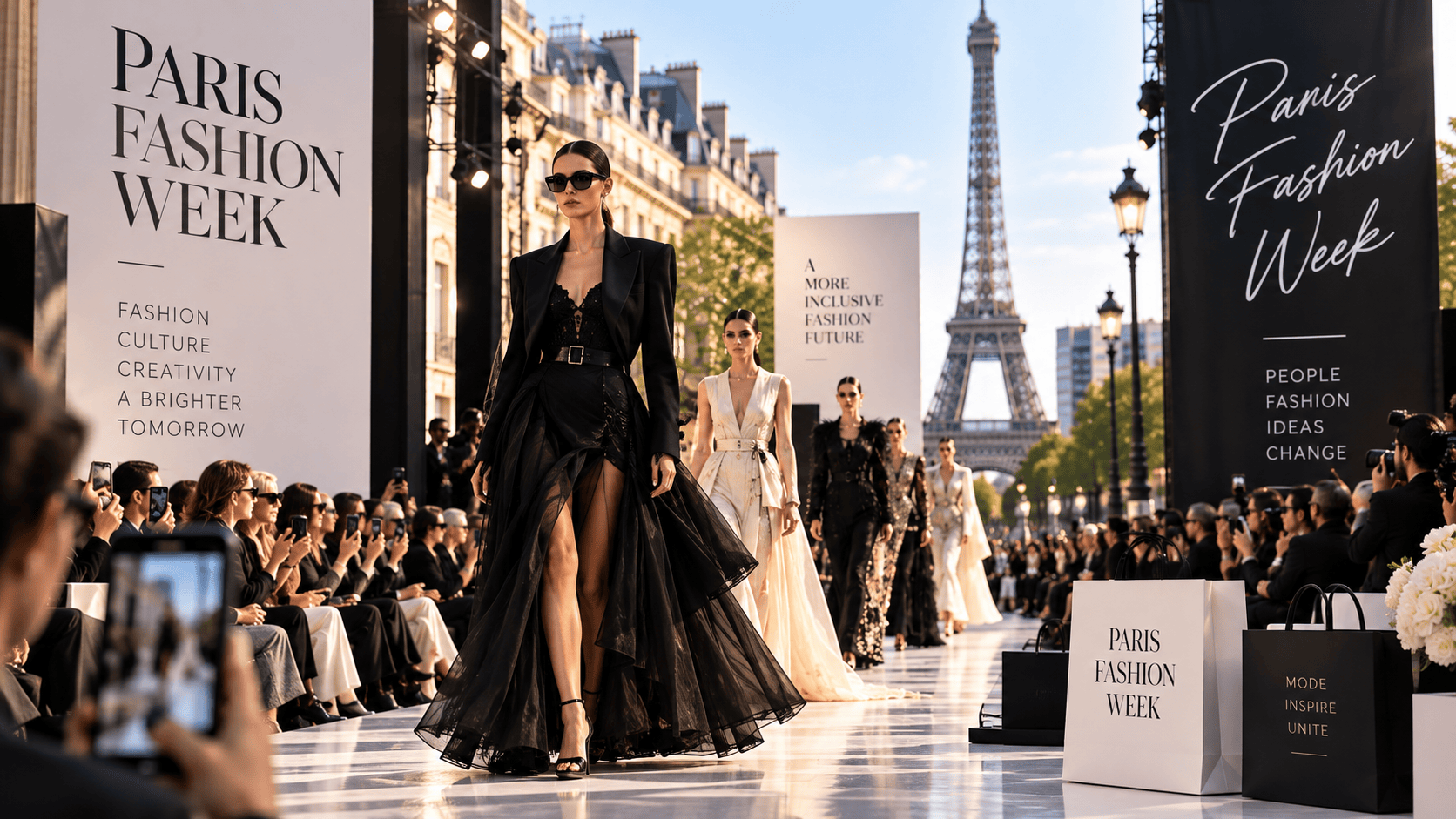 Show PR · Paris
Run of show
Seating plan, front of house, press check-in, photographer positions and the running order — handled so the room works for the people who will write about it.
Image distribution
Look-by-look imagery delivered to press the same evening, correctly credited and correctly sized, so the coverage runs with your pictures.
Guest strategy
An invitation list built for who will write, buy or amplify — not for who fills seats. A full room that produces nothing is a cost, not a result.
Off-calendar options
Curated showrooms and trade platforms run alongside the official week. For many brands this is where the buyers and the useful press actually are.
Designer PR: the label and the person behind it
At an independent label the designer is the story, and separating the two wastes the strongest asset you have. At a larger house they are different stories that need different handling. Getting this wrong is the most common reason a well-made collection gets no coverage.
Collection launch PR
The collection narrative written for press rather than for a mood board: what it is, what it is responding to, why now, and the three details a writer will actually use. Delivered with imagery, credits and availability so an editor can run it without chasing you.
Founder and designer profile
Features editors commission people, not products. We build the founder story into something a features desk can commission — the turn in the story, the evidence behind it, and a designer prepared to be interviewed properly.
Emerging designer PR
A first Paris season has different economics and different targets. We are direct about what a first season can realistically produce, and we build for credibility with buyers and trade press before consumer reach.
Luxury and heritage brands
Longer approval chains, tighter image control and a press pack that has seen every angle before. The work here is finding the story the desk has not already run three times this season.
Fashion media relations: who to approach, and with what
Most failed fashion pitches fail for one reason — they went to the wrong desk. “Fashion editor” means a stylist at a glossy and a senior writer at a newspaper. A market editor and a features editor want completely different things from the same collection. This is the map we work from.
The assistant is the contact
Stylist and editor assistants handle the actual sample pulls, returns and logistics. The senior name on the masthead is rarely the person you need on the day.
Lead times decide everything
Monthly glossies work three to four months ahead. Weeklies work in days. Digital works same-day. Pitching a monthly the week before a show is a wasted approach.
A contributing editor cannot commission
Freelance with a masthead credit is not the same as commissioning power. Pitching them as though it is loses you a week.
How celebrity dressing and creator visibility actually work
Brands routinely approach this the wrong way round — they try to reach the person. Almost nobody dresses a public figure by contacting the public figure. The route runs through the stylist, and it runs on lead time.
Identify the stylist
Every dressed public figure has one, and they are the gatekeeper. The request goes to them, not to talent or their agent.
Offer the right look
Stylists are working to a brief you cannot see. The offer has to fit the moment, the fit and the schedule — not just be your best piece.
Get the sample there
Sample logistics decide more celebrity placements than design does. Wrong size, late delivery or no return plan and the answer is no.
Earn the credit
A dressed moment is only worth what the credit and the imagery deliver afterwards. That part is PR work, not styling work.
Creators, gifting and the rule people keep getting wrong
Say creator rather than influencer — the industry has moved and the people concerned notice. More importantly: in the UK the ASA and CAP rules, and the FTC in the US, test for control or agreement, not for whether money changed hands. Gifting or seeding with any expectation attached must be disclosed. That is an enforcement risk for your brand and for your agency, not only for the creator, and we build campaigns on that basis rather than hoping nobody checks.
Event publicity, and the six months after the week ends
Event and launch publicity
Not every Paris moment is a runway. Dinners, private views, showroom openings, capsule launches and partner events all produce coverage — often better coverage per pound than a show, because there is time to talk.
The work is the same shape: a reason for the event to exist that a journalist can write about, a guest list built for outcomes rather than optics, and a plan for what happens with the imagery afterwards. An event with no story is a party with a budget attached.
- ◆A reason to attend that is not simply that the brand is having an event
- ◆The right forty people rather than the wrong four hundred
- ◆An image plan agreed before the doors open
Post-show PR — where the value actually accrues
Most brands stop the day the week ends. That is why most brands get one week of value from a season of spend. The week creates the material; the months afterwards are what turn it into a position.
Reviews and round-ups get followed up. The founder gives the interviews there was no room for during the week. The collection becomes commentary on where the category is going. The coverage gets linked, indexed and put to work so it keeps returning value long after the room has been packed away.
- ◆Coverage assessed honestly — including what did not land and why
- ◆Second-wave features using the access the week produced
- ◆Search and AI visibility so the coverage compounds
- ◆Positioning carried forward into the next season’s brief
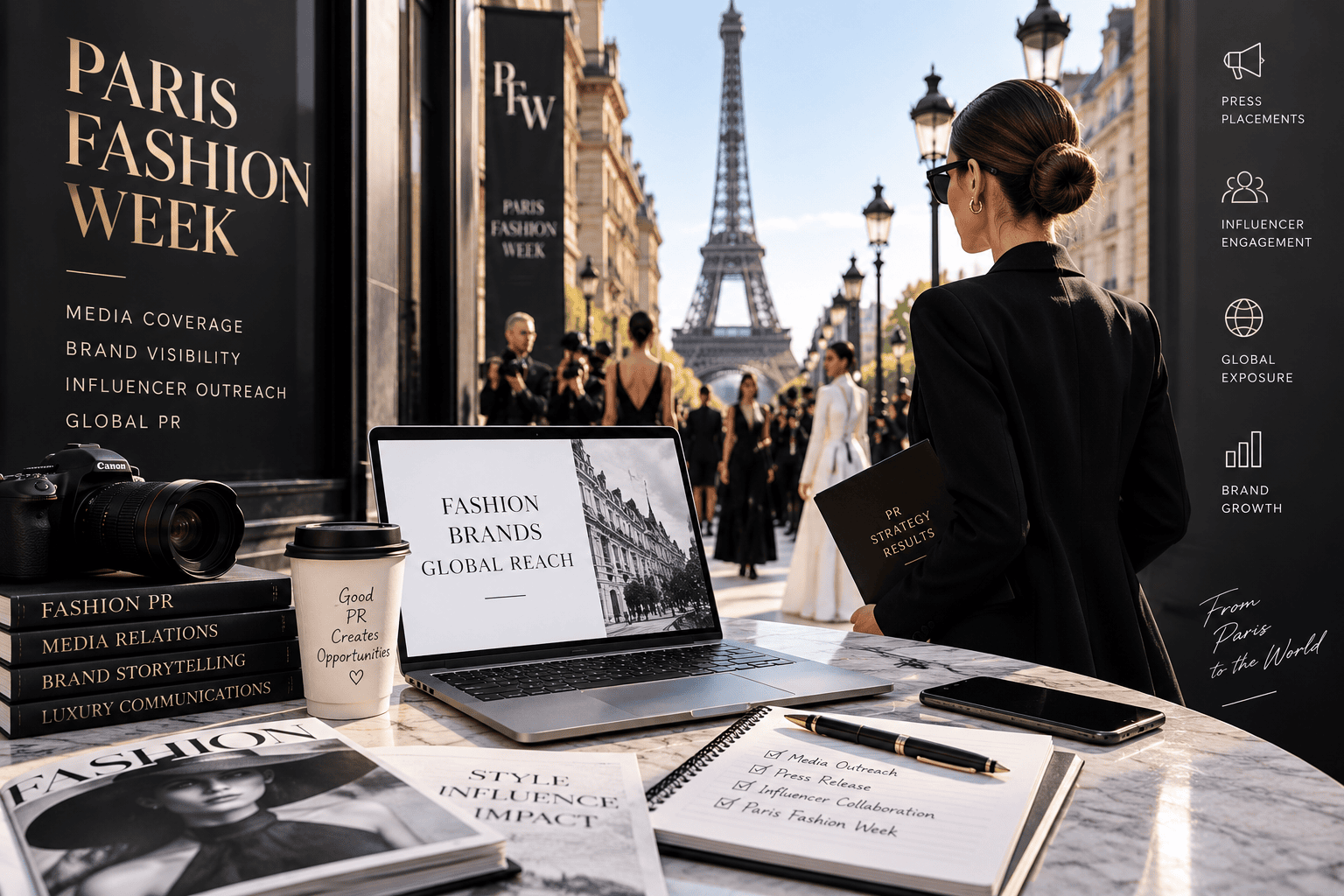 Digital PR · Global reach
From Paris to the markets you actually sell in
A Paris placement is worth more outside Paris than inside it. The reason a British brand shows in France is rarely the French market — it is the international buyers, the international press and the credibility that travels home with you.
Digital PR is what makes that travel. Coverage that is syndicated, linked and indexed keeps producing enquiries months later; coverage that sits in one print issue does not. We build the campaign so that the placements support each other and the whole thing is still working when the next season comes round.
- ◆Syndication reach — titles chosen partly for how far their coverage travels
- ◆Search visibility — so people researching your brand find the coverage, not just your own site
- ◆Market sequencing — UK, US, Gulf and Asia handled on their own timelines
- ◆A permanent record — the coverage becomes the answer when someone checks you out
Being found when the search is an AI, not a search box
A growing share of the people researching your brand never see a results page. They ask ChatGPT, Google’s AI Mode, Perplexity or Claude, and read one synthesised answer built from whatever those systems can find and trust. Fashion PR has barely caught up with this. Here is what is actually documented — and what is being sold to you that is not.
Coverage is the raw material
These systems answer by retrieving and summarising published sources. If independent publications have written about your brand, there is something to retrieve. If they have not, the model has nothing to work from but your own website.
Crawler access is a real lever
OpenAI, Anthropic and Google each publish separate crawlers for search and for training, controlled independently. Blocking the search crawlers reduces your visibility in those answers. Many brands block them by accident.
Google says it is still SEO
Google’s own guidance states there are no additional requirements and no special markup needed to appear in AI Overviews or AI Mode — no new files, no separate schema. What earns inclusion is being indexed, eligible for a snippet, and genuinely non-generic.
Attribution is unreliable
Columbia’s Tow Center tested 200 quotes across 20 publishers and found AI search returned partly or wholly incorrect attributions in around three quarters of cases. Which is precisely why the volume and consistency of what is published about you matters.
What we will not sell you. There is currently no documented way to guarantee a citation in ChatGPT, Perplexity, Claude or Google’s AI answers — OpenAI says so plainly in its own documentation. Anyone selling “guaranteed AI citations”, special AI files or entity-density scoring is selling you a theory. What genuinely helps is unglamorous and works: real coverage in real publications, said consistently, kept crawlable, and pointed at a brand that is easy to identify.
Who we work with around Paris Fashion Week
Paris PR is not one service. What a heritage house needs and what a two-season label needs share almost nothing except the dates.
Fashion brands
Contemporary and premium labels with wholesale or direct-to-consumer channels, using Paris to reach buyers and build consumer desire at the same time.
Designers & labels
Designer-led businesses where the collection and the person behind it are the same story, and both need handling properly.
Emerging designers
First or second Paris season. Different economics, different targets, and a straight answer about what one season can realistically achieve.
Luxury & heritage
Longer approvals, tighter image control, and press who have seen every angle. The work is finding what has not already run.
Fashion founders
Founders building personal authority alongside the brand — profiles, interviews, commentary and a public record that stands up to scrutiny.
Accessories & jewellery
Categories that carry the margin in luxury, and that Paris’s trade and showroom layer is unusually good for.
Fashion events & launches
Dinners, private views, capsule launches and partner activations built around the week rather than on the runway.
Stylists & creatives
Stylists, creative directors, photographers and models building a professional profile that opens the next commission.
Twenty-five years of getting people published
Fashion is the industry most likely to promise you the moon and deliver a mood board. We have been doing this since 2001, and the only reason a PR agency lasts that long is that it keeps telling clients the truth about what their money will buy.
We are a PR and media agency, not a fashion council and not a ticket broker. We do not sell access we do not control. What we sell is publication — agreed in writing, delivered with a live link, and built to keep working long after the week is over.
What clients say about working with United Press
Real client feedback from across our practice. We have kept these exactly as they were given to us.
On-calendar, off-calendar, or Paris without a show at all
There are three genuine routes into Paris and they cost very different amounts. Brands routinely choose the most expensive one because it is the only one they know exists.
On the official calendar
A show or presentation listed by the Fédération. Maximum credibility with press and buyers, and the only route that puts you in the same document as the major houses.
- ◆Admission is decided by the Fédération’s committees, on application, with hard seasonal deadlines
- ◆Highest cost by a wide margin once production is included
- ◆Right when the collection is genuinely ready and the brand can sustain it season after season
Off-calendar and showrooms
Paris runs a substantial commercial layer beside the official week — curated showrooms and trade platforms that buyers and press genuinely attend, because they are where the business gets done.
- ◆A fraction of the cost of a runway show
- ◆Buyers actually have time to look, which a ten-minute show never gives them
- ◆Often produces better trade coverage per pound than a show does
Press campaign, no physical presence
The season is a news hook whether or not you are in Paris. A collection announcement, a founder feature or category commentary can run against the calendar without a single flight booked.
- ◆Lowest cost and the fastest to start
- ◆Where guaranteed publication does the heaviest lifting
- ◆Usually the right first step before committing to a show
What shapes the investment
We do not publish a single price, because a press campaign and a runway season are not the same product and quoting one figure for both would be dishonest. What we will do is give you a written scope and a fixed cost before you commit. These are the things that move it:
Paris Fashion Week PR questions
When is Paris Fashion Week?
Paris runs six fashion-week moments a year, not two. Womenswear falls in late September to early October and again in late February to early March; menswear in January and June; haute couture in January and July. The Fédération de la Haute Couture et de la Mode publishes the official calendar and confirms dates further ahead than any other fashion body — the confirmed dates we are currently working to are listed earlier on this page.
Do you guarantee publication?
Yes — for the placements we contract for. Those publications are named and agreed with you in writing before you commit, and each one is delivered with a live URL. What we do not guarantee, and what nobody honestly can, is a feature in a specific tier-one title chosen by an editor, a slot on the official Paris calendar, or an invitation to another brand’s show. We separate the two clearly on every proposal so you know exactly what you are buying.
Can you get us on the official Paris Fashion Week calendar?
No agency can promise that. Admission to the official calendar is decided by the Fédération’s own committees through a seasonal application process with fixed deadlines, and there are two routes — member houses, who are scheduled automatically, and guest houses, admitted by committee decision. What we can do is tell you honestly whether an application is realistic for your brand this season, help you prepare it, and build the press campaign around whichever route you end up taking.
Do I need a runway show to get press coverage at Paris Fashion Week?
No, and for most brands a show is not the right first move. Paris has a substantial off-calendar layer of curated showrooms and trade platforms that buyers and press genuinely attend, and a press campaign can run against the season without any physical presence at all. A show is the most expensive route, and it only pays back when the collection and the business are ready to sustain it season after season.
What is the difference between a show and a presentation?
Both appear on the official Paris calendar, listed separately. A show has a fixed call time and lasts around ten minutes. A presentation has an open window — often several hours — with the collection displayed and the designer present. A presentation is not a lesser format: it gives editors time to look properly, handle the fabric and talk to the designer, which is exactly what market editors and features writers need and exactly what a ten-minute runway does not provide.
How far in advance should Paris Fashion Week PR start?
Eight to sixteen weeks is the realistic minimum, and six months is better. Monthly magazines work three to four months ahead, so by show week their pages are already closed. If you contact us less than eight weeks before a season, we will usually recommend targeting the next one rather than rushing this one — a rushed season costs more and delivers less.
Is accreditation the same as an invitation?
No, and this is the single most useful thing to understand about fashion week access. Press accreditation admits you to the week as working press. It does not admit you to any individual show — every seat is issued by that brand’s own press office, entirely at their discretion. The Italian and British fashion councils both state this explicitly on their own accreditation pages. Any agency that blurs the line is selling access it does not control.
How much does Paris Fashion Week PR cost?
It depends on the route, and we will not quote a single figure for products that are not comparable. A press campaign built around the season, a showroom presence and a full runway production sit at very different levels. What shapes the number is the route you take, how many guaranteed placements you want and in which tier of publication, whether it is one season or a rolling press office, whether your imagery and press materials already exist, how many markets you want to reach, and how much lead time we have. You get a written scope and a fixed cost before you commit to anything.
What is the difference between fashion PR and influencer marketing?
Fashion PR earns editorial coverage — a journalist or editor decides your story is worth publishing, and that third-party judgement is what makes it credible. Influencer or creator marketing is a paid or gifted partnership where you have some control over the message, and where disclosure is legally required. Both have a place. The important distinction is that earned editorial cannot be bought outright, which is precisely why it carries weight when a customer or a buyer researches you.
Can a new or emerging label work with a fashion PR agency?
Yes, and it is often the better time to start. What changes is the target: a first season should build credibility with buyers and trade press before chasing consumer reach, and the honest measure of success is a foundation you can build on rather than a viral moment. We will tell you plainly what one season can and cannot achieve for a brand at your stage.
Do you work with individuals as well as brands?
Yes. Designers, founders, stylists, creative directors, photographers and models all have a professional profile that opens or closes doors, and it is built the same way a brand’s is — a clear story, real published coverage and a public record that stands up when someone checks. For many fashion professionals the personal profile is the commercial asset.
How does media coverage affect AI search results?
AI assistants answer by retrieving and summarising published sources, so what independent publications have written about you is the raw material those systems work from. If there is nothing, they have only your own website. Google’s own guidance states there is no special markup or separate file needed to appear in AI Overviews or AI Mode — being indexed, crawlable and genuinely non-generic is what matters. Be cautious of anyone selling guaranteed AI citations: none of the AI providers documents a way to promise that, and OpenAI says so directly.
Which publications will we actually appear in?
You will know before you commit. We build the list against your brand, your channel and your market, then confirm it with you in writing. Titles we contract for are guaranteed and delivered with a live link. Titles we pitch on merit are labelled as opportunities, with a realistic view of the odds — we would rather tell you a Vogue feature is a long shot than take your money pretending otherwise.
What happens after Paris Fashion Week ends?
This is where most of the value is, and where most brands stop. The week produces the material; the months afterwards turn it into a position. That means following up reviews and round-ups, placing the founder interviews there was no room for during the week, turning the collection into commentary on where the category is going, and making sure the coverage is linked and indexed so it keeps returning value. A season of spend should produce more than a week of attention.
Tell us about your brand and your season
Most brands are not overlooked in Paris because the work was not good enough. They are overlooked because nobody told the right people it existed. You have already done the hard part — the collection, the years, the nerve it took to put your name on it. Tell us about it, and we will tell you honestly what Paris can do for your brand this season.