
United Press · Media List · UK
The Titles
Britain Actually Reads.
National coverage gets the applause. Regional coverage gets the customers. Our UK list runs from The Sun, The Independent, the Evening Standard and The Times down through the local daily in almost every county — and for most businesses, the second half of that sentence is the one that sells.
- ★Named titles, agreed firstYou approve the list before anything is sent
- ◆Editorial and syndication, separatedReported apart, never blended into one figure
- ●Billed on publicationYou pay once the placement is live
- ↻A senior practitioner, not an account layerYou deal with the person pitching your story
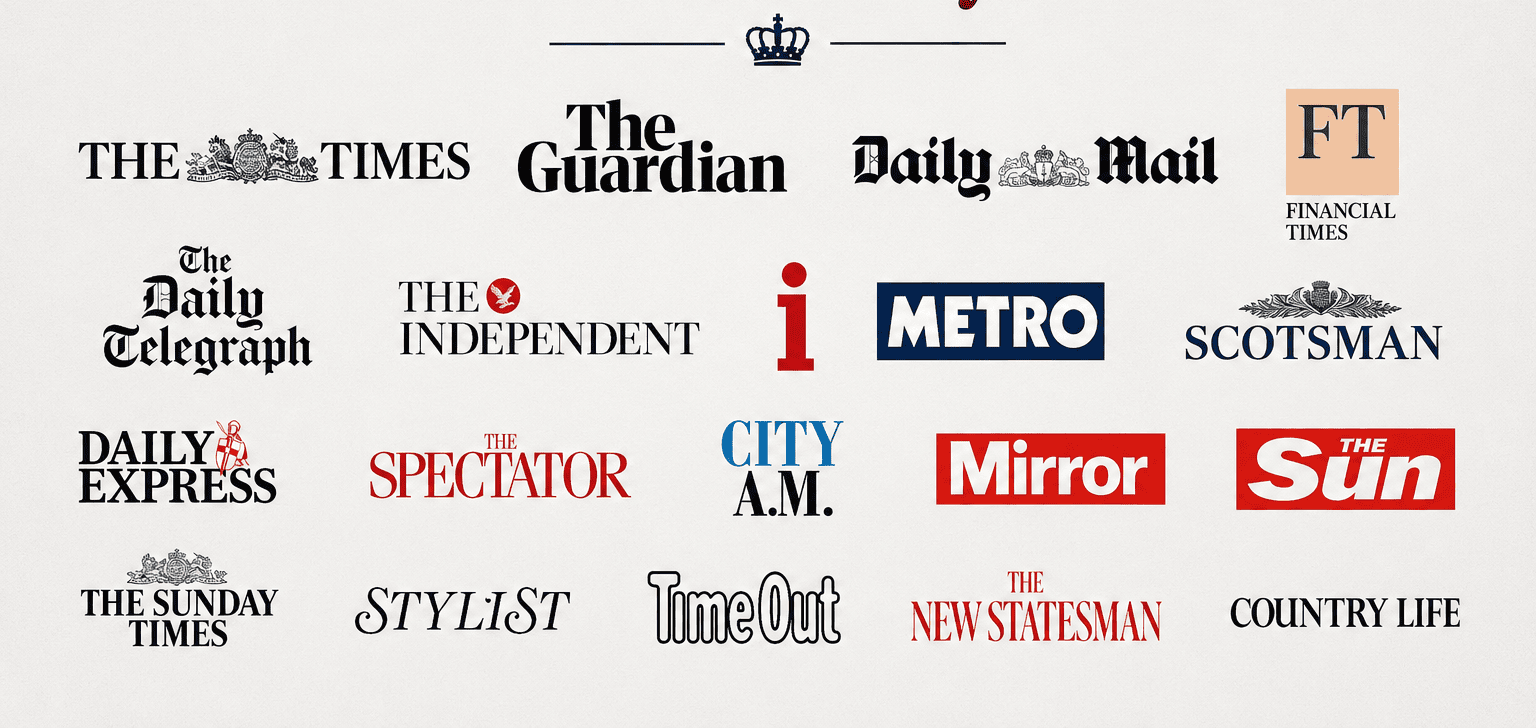
UK titles across the list
The Choice
National or Regional? It Is Not the Question You Think
Founders almost always ask for a national. The better question is where your buyer lives, because the answer changes which title is worth more to you — often by a wide margin.
UK media PR is the practice of earning coverage in British national, regional and trade publications. The national press builds credibility that travels everywhere. The regional press builds trust with people who can actually walk into your shop, book your service or sign your contract.
A mention in a national is a badge. A feature in the paper your customers read over breakfast is a conversation they have with their neighbour. Most businesses need one of each, in that order of budget — and the ones who only chase the national usually get neither.
When a national is worth it
You are raising money, entering a new market, or you need a name that means something to somebody who has never heard of your sector. Nationals also feed AI assistants and search results long after the day they run.
When a regional beats it
Your customers are local, your service has a catchment area, or your buyer trusts their own paper more than a London masthead. Regional editors are also far more reachable, and far more interested in a genuine local story.
When you need both
A national gives you the credential; the regionals give you the reach into the places you actually trade. Run them together and the regional pickup is easier — local editors take a story more seriously once it has run elsewhere.
The Titles
Every UK Publication on the List
Grouped by nation and region so you can find the papers your customers actually read. Availability and fit are confirmed against your brief — being listed is not a promise that a given editor will run your story.
National
Titles that carry weight anywhere in the country.London
The capital and its borough weeklies.South & South West
The South Coast, Thames Valley, Wessex and the West Country.East of England
Norfolk, Suffolk, Essex, Cambridgeshire and the Fens.Midlands
The West and East Midlands, Oxfordshire and the Home Counties.North West
Lancashire, Greater Manchester, Merseyside, Cheshire and Cumbria.Yorkshire
West, South, North and East Yorkshire.North East
Tyne and Wear, Durham, Teesside and Northumberland.Scotland
Scottish nationals and the city and county press beneath them.Wales
North and South Wales, in English and bilingual titles.Northern Ireland
Belfast, Derry and the county press.More local & regional titles
The long tail — district weeklies and county papers across the UK.Where a title has its own guide, the name links to it. AI-visible marks outlets that assistants such as ChatGPT and Perplexity draw on when answering questions about UK companies.
What Works
What UK Editors Actually Run
British newsdesks are stretched and sceptical. The stories that get through tend to share the same handful of qualities.
A genuine local hook
Regional editors want the place in the first line. A national expansion is not a story to the Yorkshire Post; opening in Leeds and hiring forty people there is.
Data nobody else has published
Your own bookings, prices, waiting times or regional demand figures make a story a paper can build a headline around. This is the single most reliable route into UK coverage without a budget.
A named human who will talk
British papers want a person, not a company. A founder willing to be quoted, photographed and rung at short notice is worth more than any press release.
Timing against the news agenda
A story that connects to something already being covered — a rate change, a seasonal trend, a policy shift — gets picked up far more easily than one that arrives cold.
Something genuinely first or biggest
Editors are rightly allergic to the word “first”, so it has to be true and narrow enough to defend. First in your county is a story; first in the world usually is not.
What does not work
A new website, a rebrand, an award nobody has heard of, or a milestone that matters only internally. We will say so rather than send it and waste the relationship.
AI Search
UK Titles Are Heavily Cited by AI Assistants
Ask ChatGPT or Perplexity about a British company, sector or town and the answer is largely assembled from UK news sources. Many of the titles on this list carry that AI-visible flag.
Why UK press matters for AI answers
British publishers are well structured, consistently formatted and widely indexed, which makes them a reliable source for models answering UK-specific questions. A regional daily can be cited as readily as a national.
Local questions have local answers
“Best plumber in Leeds” or “who supplies X in Manchester” are resolved from local sources. If your only coverage is national, you can still be invisible in exactly the queries that matter to you.
Consistency is what makes you quotable
Where your company name, location and description match across several UK titles, a model can answer confidently. Where they conflict, it hedges — or names a competitor.
More on this: how to rank in AI search · browse the full media list
By City
Can a Regional Agency Get You National Coverage?
It is one of the most common questions we are asked, and the honest answer is that the agency’s postcode is irrelevant. What matters is whether they have the relationships and whether your story stands up.
Yes — a PR agency based anywhere in the UK can secure national and international press coverage. National newsdesks do not care where the pitch comes from; they care whether the story is right for their readers, arrives from someone they trust, and lands at a moment they can use it. A London office is not a requirement.
What a regional presence does change is the reverse direction: local knowledge makes it far easier to place a story in the paper that covers your town, and those placements often convert better than a national mention for businesses with a defined catchment area.
Manchester & the North West
Manchester World, Liverpool World, The Bolton News, Lancashire Telegraph, Warrington Guardian and the Cheshire and Cumbria weeklies — alongside national desks that cover the Northern Powerhouse economy closely.
Birmingham & the Midlands
Birmingham World, Dudley News, Worcester News, Hereford Times and the Warwickshire, Derbyshire and Nottinghamshire titles.
Leeds, Sheffield & Yorkshire
Yorkshire Post, Yorkshire Evening Post, The Star, Telegraph and Argus, Halifax Courier and the county weeklies.
Glasgow & Edinburgh
The Scotsman, Edinburgh News, Herald Scotland, Glasgow Times and The National — Scottish coverage behaves differently from England and is worth planning on its own.
Newcastle & the North East
The Northern Echo, Sunderland Echo, Shields Gazette, Hartlepool Mail and the Northumberland and Teesside press.
London & the South East
The Evening Standard plus the borough weeklies — News Shopper, Your Local Guardian, Islington Gazette, Hackney Gazette and the rest of the London network.
We work with businesses across the UK. If your customers are concentrated in one region, we build the list around that region first and treat national coverage as a credential rather than the goal.
The Process
How a UK Placement Happens
Four steps, and you approve the list before anything is sent.
Where are your customers?
Not which paper you like — where the people who buy from you live and work. That decides whether this is a national play, a regional one, or a national credential followed by a regional rollout.
We build the named list
Specific UK titles, shown with turnaround, format and AI visibility. You approve it before outreach starts. Nothing goes out against a list you have not seen.
We shape the story for each desk
A national business desk and a regional newsdesk want different versions of the same facts. We write for the desk rather than sending one release everywhere.
Report and repeat
What ran, where, and how your description in search and AI answers has shifted. Regional relationships compound — the second story is always easier than the first.
The Comparison
Earned UK Coverage vs. Blanket Distribution
Both put your name on a British website. Only one of them is read.
| Blanket distribution | UnitedPress UK placement | |
|---|---|---|
| The titles | Whatever the network carries | Named UK papers, agreed with you first |
| The story | One release, sent everywhere | Written for the desk it is going to |
| Local relevance | None | The place named in the first line |
| Who reads it | Largely crawlers | Readers in the towns you trade in |
| Editorial vs syndication | Blended | Separated and reported separately |
| Duplicate content risk | High — identical copy across sites | Avoided by writing per outlet |
| What you can show a customer | A list of links | A local paper they recognise |
If a regional title has no relevance to your buyer, we will say so. Coverage in a town you do not trade in is not worth paying for.
FAQ
UK Media: Your Questions Answered
The questions people actually ask about getting into the British press.
Can a PR agency outside London get national coverage?
Yes. National newsdesks judge the story, not the sender’s postcode. A pitch from Manchester, Glasgow or Cardiff lands the same way a London one does, provided it reaches the right journalist with something they can use. Where location genuinely helps is the other way round — knowing a region makes it far easier to place a story in the papers that cover it.
How do I get featured in a UK newspaper?
Start with what has actually changed in your business, not what you want to sell. Identify the specific journalist who covers your sector or your area, read what they have written recently, and approach them with a story shaped for their readers. Keep it short, make a named person available, and be ready to respond quickly. Most attempts fail on relevance and timing rather than on the idea itself.
How do I get featured in The Sun, The Independent or The Times?
Those titles are on our list, and each has its own way in. We have detailed guides for The Independent, The Times and the Evening Standard. No agency can promise a national will run your piece — editors decide — but a story that is genuinely newsworthy and reaches the right desk has a real chance.
How do I get on BBC or Sky News?
Broadcast works on a shorter clock than print and wants a spokesperson who can talk. Our guides cover getting featured on the BBC and Sky News. Regional BBC radio is considerably more reachable than network television and is usually the better first target.
Is local newspaper coverage worth it?
For any business with a catchment area, it is often the best value in PR. Local readers trust their own paper, local editors are reachable, and the coverage stays indexed and citable long afterwards. It also answers the location-specific questions people now put to AI assistants, which national coverage alone does not.
Which UK newspapers have the highest authority?
The national mastheads carry the most domain authority, but authority is not the same as usefulness. A county weekly read by your customers will usually outperform a national mention that nobody in your market sees. We sort by relevance first and authority second when building a shortlist.
Do you cover Scotland, Wales and Northern Ireland?
Yes. The Scotsman, Herald Scotland, The National, Glasgow Times and Edinburgh News in Scotland; South Wales Argus, Leader Live, Western Telegraph and the Welsh network; the News Letter, Derry Journal and Newry Reporter in Northern Ireland. The devolved nations have their own news agendas and are worth planning separately from England.
What makes a story newsworthy to a UK editor?
Something that has changed, something you know that others do not, or something a reader can use. A first premises, a significant hire, an expansion, an award shortlisting, data from your own trading, or an informed view on something already in the news. What is not newsworthy: a new website, a rebrand, or a milestone that only matters internally.
How long does UK press coverage take?
It varies by title and story. News-led routes move fastest; features and the larger regional titles take longer; anything tied to a print edition works to that edition’s schedule. Turnaround is confirmed per publication when we build your shortlist, so you can plan against a real date.
Do you guarantee coverage in UK newspapers?
No, and no honest agency does. Editors decide what runs. What we commit to is the named shortlist agreed with you before outreach, the work behind it, and clear reporting on which placements were editorial and which were clearly-labelled syndication.
Will UK press coverage help me appear in ChatGPT and AI search?
Considerably. British publishers are well indexed and heavily drawn on by assistants answering UK questions, and many titles on this list carry that flag. Local coverage matters here too — location-specific questions are answered from location-specific sources, so a regional feature can do work a national never will.
Can you get coverage in a specific town or county?
Usually, yes. The list runs from the nationals down to district weeklies across England, Scotland, Wales and Northern Ireland. Tell us the town and we will tell you honestly which titles reach it and whether the story is strong enough for them.
Do you write the story or do I?
We write it, shaped for the specific desk — a national business desk and a regional newsdesk want different versions of the same facts. Where you already have material or a strong founder view, we work with that rather than rewriting for the sake of it. You approve everything before it goes out.
What does it involve from my side?
A conversation about what has changed in the business, who your customers are and where they are, plus a named person available to be quoted. Most of the raw material for good coverage is already in your head; the work is recognising which part a journalist would want.
How do we start?
Tell us where your customers are, what has changed recently and any date you are working to. We will come back with a named list of UK titles — national, regional or both — for you to approve before anything is sent.
Related
Where to Go Next
Other parts of the list, and the practices that use it.
Media List
Every category we place into, published in the open.
Small Business PR
For founder-led businesses and startups working to a real budget.
B2B Public Relations
For companies selling to other businesses rather than consumers.
PR for Investors
The credibility investors check before a raise or an exit.
iGaming PR Agency UK
Platforms, studios and suppliers in online gaming.
Guest Post Agency
Authored placements, clearly labelled and honestly reported.
Let’s Talk
Get a Named List of UK Titles
Tell us where your customers are and what has changed in your business. We will come back with specific UK publications — national, regional or both — for you to approve before anything is sent. No obligation.