

Best PR for Biotech Companies UK (2026): Making Hard Science Easy to Cover
PR for biotech and life science companies, from university spin-outs to funded scale-ups. We turn science, data and funding news into stories for investors, partners, talent and science media, with accuracy you and your scientists can stand behind.
PR that grows with your company
A commercial-stage medicines company? See our pharma PR page.
Embargoes, journals and disclosure
From the lab to the headline
Accuracy and clarity go together. These are illustrative rewrites, not client claims.
| Lab version | Press version |
|---|---|
| Novel small-molecule inhibitor with high target selectivity | A new drug candidate designed to block one faulty protein while leaving healthy cells alone |
| Statistically significant reduction in the primary endpoint | The main measure improved in an early trial; larger trials are needed |
| Platform technology with broad applicability | One method that could be used to develop several different treatments |
Who PR for biotech needs to reach
A biotech company speaks to more audiences than almost any other kind of business. Good PR for biotech tells one accurate science story, then shapes it for each group that matters to your next milestone.
- Investors who need confidence in the science, the team and the route to market.
- Pharma and industry partners looking for platforms, assets and collaborators.
- Clinicians and researchers who judge the quality of your data.
- Patients and the public, reached with care and without promotional claims.
- Talent: scientists, engineers and leaders deciding where to build their careers.
- Policymakers and funders shaping the UK life sciences landscape.

Planning PR for biotech around these audiences means one clinical update can become an investor story, a trade feature for partners and a recruitment message, all from the same approved facts. That joined-up approach is what separates strategic PR for biotech from one-off announcements.
PR for biotech and the medicines rules
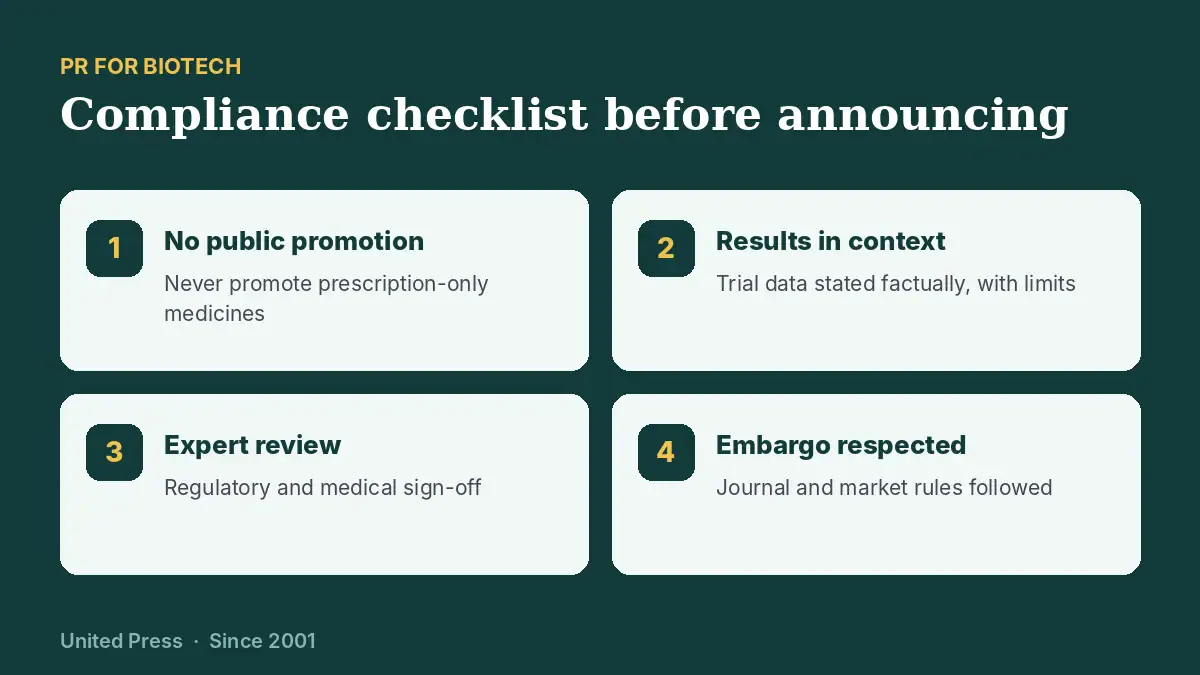
Companies developing medicines face strict rules on what they can say in public. Promoting prescription-only medicines to the public is not allowed in the UK, and the Medicines and Healthcare products Regulatory Agency sets out the rules in its guidance on how to advertise and promote medicines. Press releases and interviews about products in development must stay on the right side of that line.
In PR for biotech, we focus public stories on the science, the company and the people, describe trial results factually and in context, and avoid language that could encourage the public to ask for a specific treatment. Your regulatory and medical teams review every word before it is shared. Careful PR for biotech protects your licence to operate and builds trust with journalists who cover health responsibly. It also means PR for biotech can move quickly when news breaks, because the approval route is already agreed.
A 90-day plan for PR for biotech
Biotech news is driven by milestones: funding rounds, trial readouts, partnerships, new facilities and senior hires. The best PR for biotech maps these in advance, so each moment is ready with approved messages, spokespeople and supporting material.
- Weeks 1 to 2: map upcoming milestones, agree spokespeople and set an approval process with your regulatory and medical teams.
- Weeks 3 to 6: secure a first science or business feature built around your platform, team or a recent result.
- Weeks 7 to 10: add expert commentary on life sciences news and a plain-language explainer of your science.
- Weeks 11 to 12: share coverage with investors, partners and candidates, review results and plan around the next milestone.
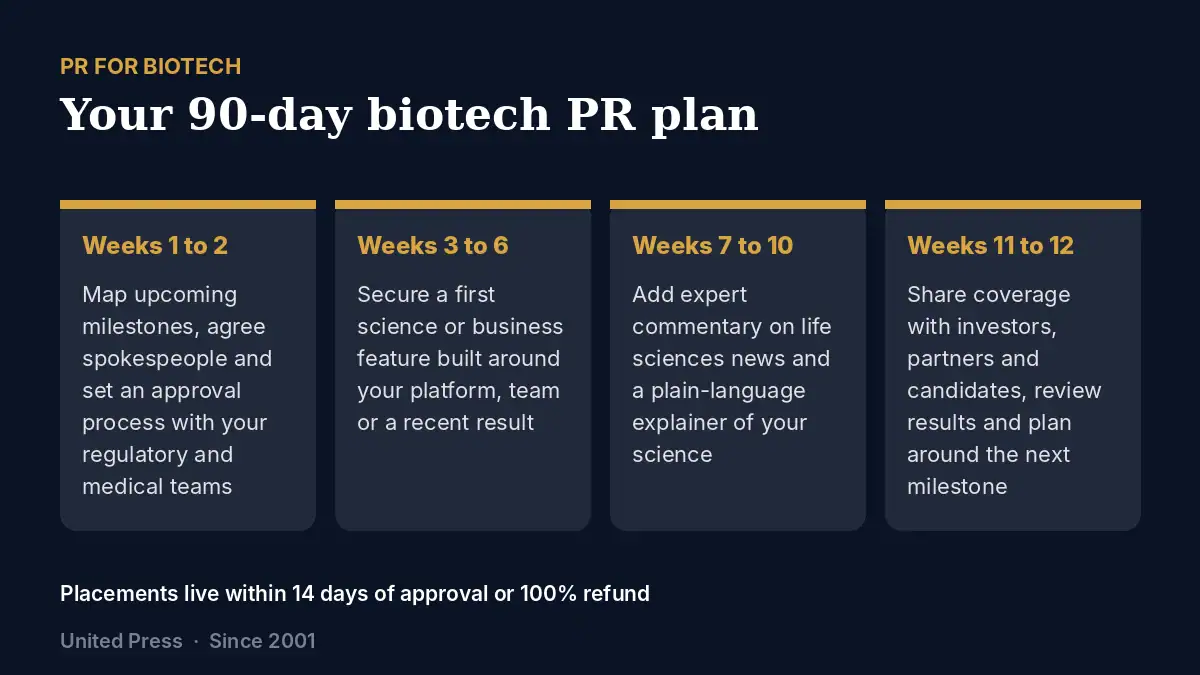
Placements go live within 14 days of approval, or you receive a 100% refund. Related reading: our guides to PR for research institutes and PR for AI research.
Investors, partners and journalists now also ask ChatGPT, Gemini and Google AI which UK biotech companies are working in a given field. Those tools rely on trusted publications, so consistent PR for biotech gives you a much better chance of being named in their answers. No one can guarantee an AI mention, but accurate coverage is one of the strongest signals a biotech company can build. Over time, PR for biotech that combines careful science communication with steady visibility becomes a real asset at every funding round.
Who covers biotech
Life science trade press. Funding, deals and pipeline news for investors and partners.
Science and health journalists. Research findings explained for the public, with independent experts often asked to comment.
Business and regional press. Jobs, investment and the growth of science clusters.
Careers and university media. Useful when you are hiring scientists.
Science titles in our network
Science and trade coverage is earned. Next to that, you can book features in titles from our publication network, such as Science Times, Inverse, Technology.org and Healthcare Business Today. Booked features go live within 14 days of approval or you get a 100% refund. We use them for company and science news, never to promote medicines to the public.
Listed in our network, October 2026. Terms, including link treatment, are confirmed in writing before you book. Google asks that paid links are marked as sponsored or nofollow.
Three example biotech campaigns
A spin-out closing its seed round
“University spin-out raises funds to develop a faster test for sepsis”
- Route: trade, regional business and university press.
- Timing: on announcement day.
- Outcome sought: investors for the next round and hires.
A peer-reviewed paper
“Study shows new approach could make gene therapy cheaper to produce”
- Route: science journalists under the journal embargo.
- Timing: journal publication time.
- Outcome sought: partner interest.
A new lab opening
“New lab to create 80 science jobs in Oxfordshire”
- Route: regional and business press, plus a Science Times feature.
- Timing: opening week.
- Outcome sought: recruitment.
Illustrative plans with example headlines. They are not client results.
What clients say about United Press
★★★★★“The team understood our industry and, more importantly, understood the story we needed to tell. Seeing our company featured across relevant publications gave us a much stronger presence when potential customers researched us.”
Olivia BennettMarketing Director
★★★★★“United Press helped us turn our company story into something journalists could genuinely engage with. The coverage gave our brand a level of credibility that was difficult to achieve through our own marketing channels.”
James WhitmoreFounder & CEO
★★★★★“United Press built our brand from launch to nationwide recognition. Real media coverage gave new customers the trust they needed — our ROI has been over 100:1, which blows my mind.”
Annabelle SparksGlobal Head of Marketing
United Press is a London PR agency at Brook’s Mews, working since 2001 with clients worldwide, and a winner or shortlisted at PRWeek, CIPR Excellence, UK Agency, PRCA DARE, The Drum and UK Social Media Communications Awards.
Biotech PR questions
What does PR for biotech do?
It explains your science, funding and progress to investors, partners, talent and the media, accurately and in plain words.
How do you keep the science accurate?
Your scientists review every claim before release, and we avoid overstating early results.
Can you work around journal embargoes?
Yes. We plan coverage to go live at the embargo time and brief journalists in advance only where the journal allows it.
Do you work with biotech companies outside the UK?
Yes, including US and European companies building a UK presence.
Can you guarantee coverage in a science section?
No. Science coverage is earned. Guaranteed features are available only in titles from our publication network.
How much does biotech PR cost?
There is no fixed price. Every campaign is planned around your goal and the titles you need. Share your goal and budget in the form below for a personalised plan.
Ready to explain your science?
Tell us about your company, your stage and your next milestone. We will send a free plan with the angle, titles and timing that fit.